If you've noticed your child typing away at odd hours, laughing or sighing at a screen with no one else in the room, there's a decent chance they're not texting a friend. They might be talking to one that isn't human at all. AI companion apps — chatbots designed to feel like a friend, mentor, or even a romantic partner — have quietly become part of many kids' daily routines. This isn't a reason to panic. It's a reason to understand what's going on and open a conversation.
What Exactly Is an AI Companion?
Unlike a search engine or a homework helper, AI companion apps — such as Character.AI, Replika, or custom "friend" personas built into some social platforms — are designed to simulate an ongoing relationship. They remember past chats, adopt a personality, respond with warmth and curiosity, and are available 24 hours a day. Some kids use them the way they'd use a diary. Others treat them more like a best friend, confidant, or even a boyfriend or girlfriend.
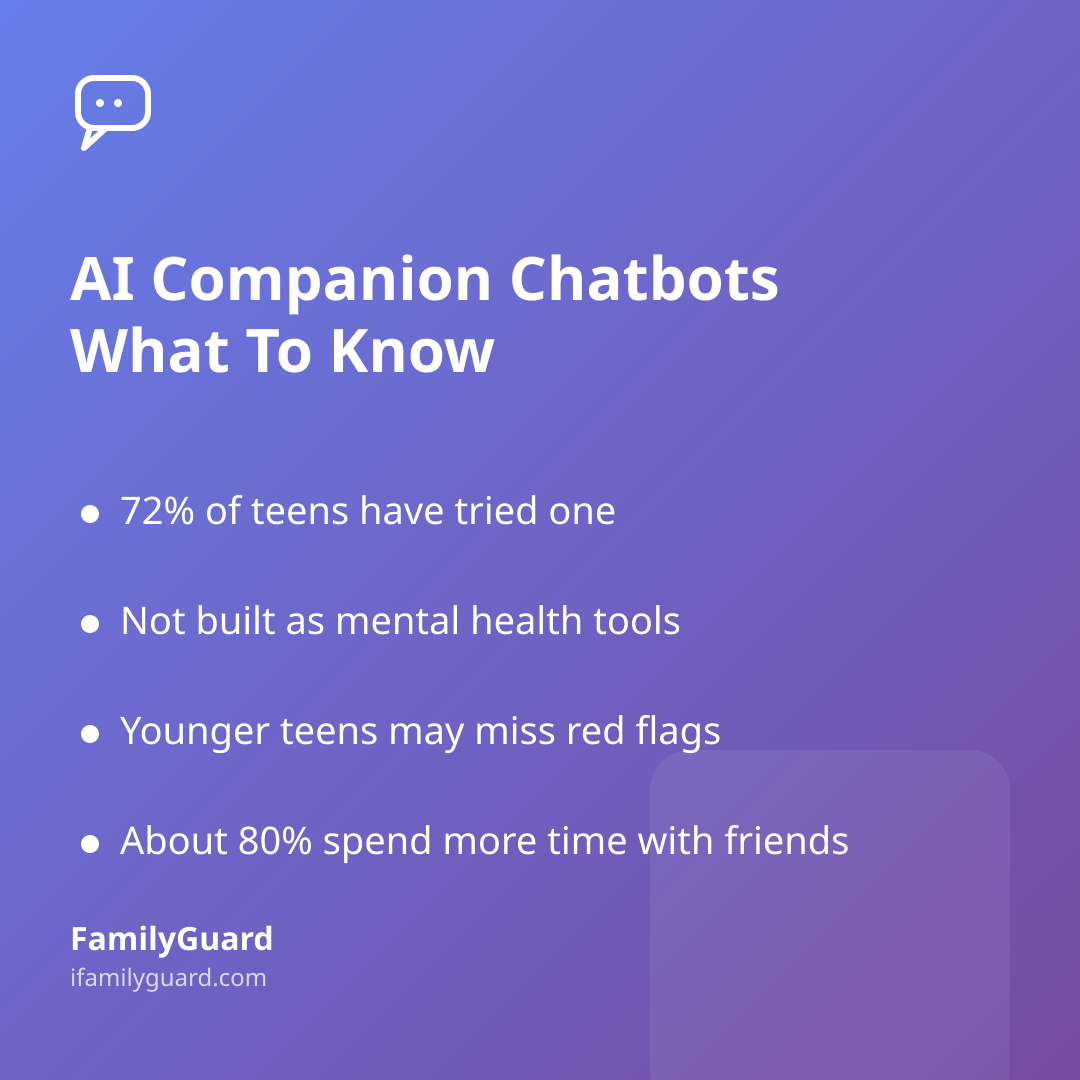
The scale here is bigger than most parents realize. A 2025 national survey by Common Sense Media found that 72% of U.S. teens ages 13–17 have used an AI companion at least once, and 52% use one regularly — several times a month or more.
Why These Apps Appeal to Kids and Teens
It helps to understand the pull before judging it. Adolescence is a stage built around seeking belonging, validation, and figuring out who you are. An AI companion is available instantly, never tired, never distracted, and never judges. It reflects attention back at exactly the moment a teen wants it.
That same Common Sense Media research found that about a third of teens said conversations with an AI companion felt as satisfying, or more satisfying, than conversations with real friends — and a similar share said they'd rather talk through something serious with an AI than with a person. That's not a sign your child is broken or isolated by nature. It's a sign the tool is working exactly as designed: to feel endlessly agreeable and available.
The Risks Worth Taking Seriously
In November 2025, the American Psychological Association issued a formal health advisory on generative AI chatbots and wellness apps, specifically flagging risks for children and teens. A few points are worth knowing:
- These tools were not built or tested as mental health resources, and they've repeatedly failed to recognize or appropriately respond to signs of distress, self-harm, or crisis.
- Younger teens, in particular, are less likely to question what a chatbot tells them or notice when it's simply agreeing to keep them engaged — Common Sense Media's research describes this as a real "AI literacy gap."
- A companion app is optimized to keep a conversation going, not to give sound advice or gently redirect a struggling teen toward a trusted adult.
- Some teens form attachments that start to replace, rather than supplement, time with real friends and family.
None of this means every teen who's tried one of these apps is at risk. The same Common Sense Media survey found that about 80% of teens who use an AI companion still spend more time with real-life friends than with their AI companion. The goal isn't fear — it's awareness, so you can notice if the balance shifts.
Gentle Signs Worth a Check-In
You don't need to read your child's chat logs to stay in touch with what's going on. Watch for shifts rather than one-off moments:
- Pulling back from friends, family dinners, or activities they used to enjoy
- Noticeably different sleep patterns, especially late-night phone use
- Talking about an AI companion as if it were a close friend or partner, with real emotional weight
- Mood shifts tied to how a conversation with the app went
- Reluctance to talk about what they discuss with it
If you notice one or two of these, the right move is a calm, curious conversation — not confiscating the phone. If concerns persist, the APA advisory recommends looping in your pediatrician or a mental health professional, the same way you would for any other change in mood or behavior.
Talking About It, Together
The most useful approach parents have found isn't a ban — bans on popular apps tend to just push the activity out of sight. It's treating this like any other new technology: curious, open, and age-appropriate.
- Ask what they like about it, genuinely. "What does it say that feels helpful?" tells you more than "why are you talking to a robot?"
- Name what it is, plainly: a program trained to keep you talking, not a friend with its own thoughts or a professional who can help in a crisis.
- Agree on what's off-limits for sharing — full name, school, address, photos — the same ground rules you'd set for any chat app.
- Keep real connection easy to reach for. A quick family chat thread that actually gets used, where a tough day can be mentioned without a big conversation, gives kids a human alternative that's just as available as the app. Some families use FamilyGuard's built-in chat for exactly this — a low-pressure space to check in that doesn't require tracking anything, just staying in touch.
- Revisit the conversation occasionally rather than treating it as a one-time talk. These apps and the way kids use them keep changing.
The Bottom Line
AI companions aren't going away, and for most kids, using one occasionally is closer to playing a game or writing in a journal than anything alarming. The job isn't to eliminate the app — it's to make sure your child still has, and uses, real people to turn to when something actually matters. That starts with staying curious, not suspicious, and keeping the door open for the next conversation.