There's a moment many families reach, often around the time a child gets their first phone or starts going places on their own: someone suggests turning on location sharing. How that conversation goes — not just the decision at the end of it — tends to shape whether the whole arrangement feels like teamwork or like being watched.
It's tempting to treat location sharing as a quick settings change: open an app, send an invite, done. But the "first ask" is really a relationship moment. Handled well, it can become one of the more reassuring parts of growing up. Handled as a one-sided announcement, it can plant a seed of resentment that outlasts the setting itself.
Why the Conversation Matters More Than the App
The American Academy of Pediatrics' Center of Excellence on Social Media and Youth Mental Health has found that the large majority of features built into parental safety apps are designed around parental control, while only a small share support kids in building their own self-regulation skills. The Academy's guidance is to pair any monitoring tool with open conversation and a family online-safety plan that kids have a hand in shaping, rather than relying on settings alone. In other words, the technology is only half the story. The other half is whether your child understands why sharing is happening, what it actually shows, and that it's something you're doing with them rather than to them (American Academy of Pediatrics, 2023).
This isn't just a concern for younger kids. Pew Research Center found that a quarter of parents say they track their grown child's location by GPS, rising to 42% among parents of 18- to 24-year-olds — proof that these conversations don't end at a certain age, they just change shape (Pew Research Center, 2024). Starting with openness early tends to make those later, higher-stakes conversations easier.
What to Actually Say
You don't need a script, but it helps to walk in with a clear, honest reason rather than a vague sense of worry. Kids can usually tell the difference between "I want to feel connected and know you're safe getting to practice" and an unspoken "I don't fully trust you yet." The first invites cooperation. The second invites workarounds.
A simple way to frame it:
- Name the reason. "You're starting to walk to school/take the bus/go to friends' houses on your own, and I want us both to feel good about that."
- Say what it is — and isn't. It shows where everyone in the family is, so no one is left wondering. It's not a way to check up on you every five minutes.
- Invite questions. Ask what feels okay to them and what doesn't. You might be surprised that they're relieved rather than resistant — many kids like being able to see that a parent made it home from a late shift, too.
Questions Worth Answering Together
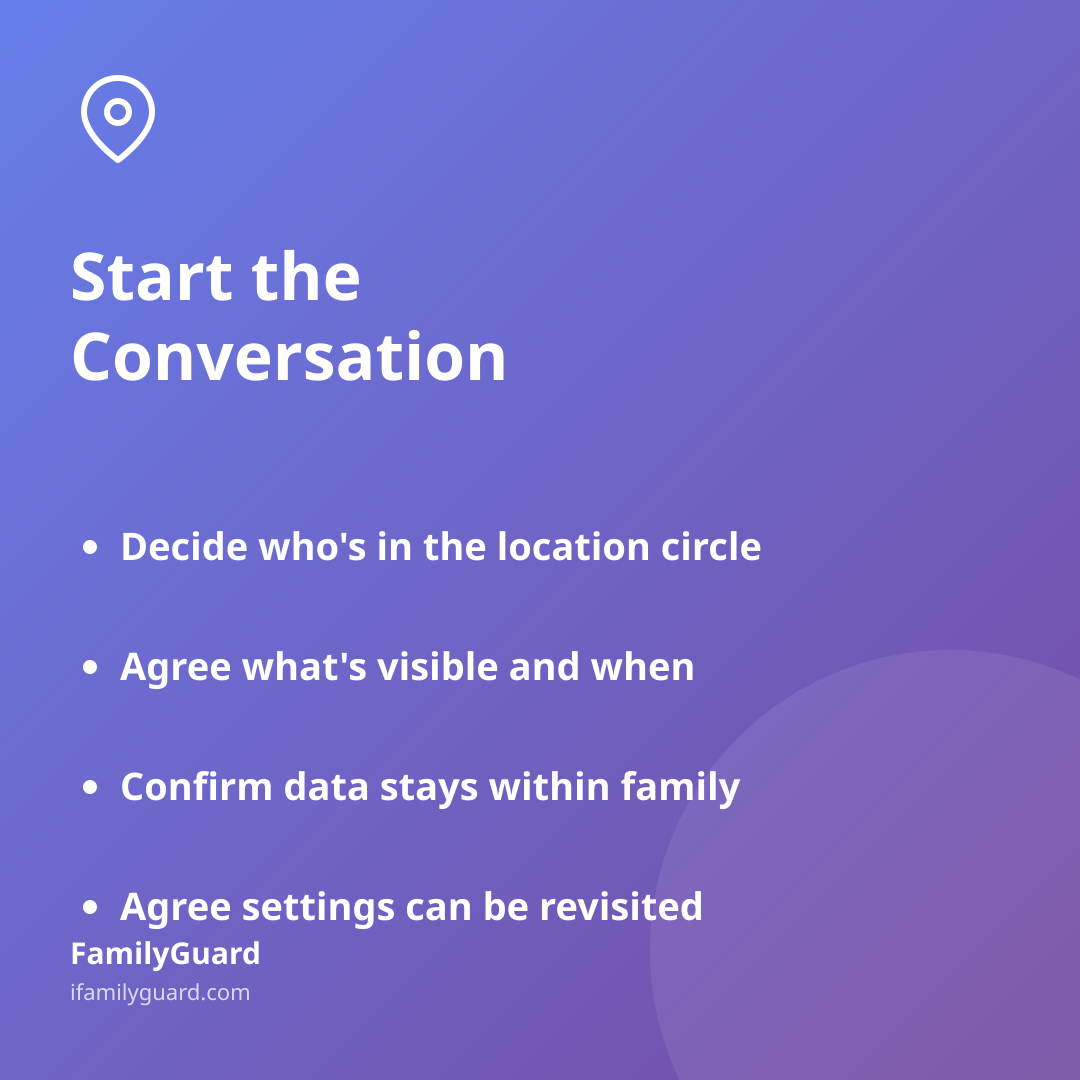
Before anyone taps "accept" on an invite, a short conversation can save a lot of friction later. Consider working through these together rather than deciding them unilaterally:
- Who's in the circle? Just parents and this child, or siblings too?
- What's visible? Real-time location, or just arrival/departure alerts for specific places?
- When does it apply? All day, or mainly during commutes, trips, and sleepovers?
- What happens with the data? Confirm it stays within the family and isn't sold or shared — this is worth saying out loud, not assuming.
- Can it be revisited? Agree upfront that settings aren't locked in forever.
Apps built specifically for consent-based family sharing make this easier to keep concrete. FamilyGuard, for example, pairs family members through a simple QR code that both sides approve, which naturally turns the setup into a joint action rather than something done from one phone while the other person finds out later.
When They Hesitate or Say No
If your child pushes back, resist the urge to make it non-negotiable on the spot. Ask what specifically worries them — is it feeling watched all the time? Not wanting friends to see it on their phone when it's shared? Worrying it'll be used to catch them out over small things? Most objections are solvable with a narrower arrangement: location visible only during a specific outing, or alerts for arrivals rather than a constantly visible dot.
If you do decide sharing is non-negotiable for now — for a younger child, say — the honesty still matters. Telling them plainly, "I know you'd rather not, and I hear that, but I'm not comfortable with you walking alone yet without it," is different from pretending it's purely their choice when it isn't. Kids generally handle an honest "not yet" better than a sense that they were talked into agreeing to something that was already decided.
Revisiting the Conversation as They Grow
The agreement you make with an eight-year-old shouldn't be the same one you're still running when they're sixteen. Build in a loose rhythm for revisiting it — a new school year, a new phone, a first time staying out past dark alone. Each check-in is a chance to loosen settings a little and show that trust, once earned, actually changes something real.
The goal isn't to arrive at a "finished" setup. It's to keep the sharing matched to the trust and independence your child has actually earned, and to keep both of you talking about it as that changes.
A Small Habit With a Long Payoff
None of this requires a long, formal sit-down. Often it's a five-minute chat in the car or over dinner. What matters is that your child hears the reasoning, gets to ask questions, and understands that sharing location is something the family does together — not a rule handed down and switched on behind the scenes. That one conversation, done well at the start, tends to make every future conversation about independence a little easier.