Some family road trips only need one car. Others don't — maybe grandma is following in her own vehicle, maybe the cousins are riding with their dad while you take the minivan, or maybe there's simply too much gear and too many kids for a single back seat. Two cars can make a trip more fun, but they also add a new question: how do you stay together, and in touch, once you're both doing 70 miles an hour in different lanes?
The good news is that a two-car trip doesn't need a complicated system. It needs a short conversation before you pull out of the driveway, and a few simple habits once you're on the road.
Why a Quick Plan Beats Winging It
Most families who drive in convoy have done it before without any plan at all, and most of the time it works out fine. But phones die, gas stations appear at the wrong moment, and construction detours split a route in two without warning. None of that is dangerous on its own — it's just the kind of ordinary mix-up that's a lot less stressful when everyone already knows what to do.
Fatigue is worth planning around too. According to the AAA Foundation for Traffic Safety (2024), an estimated 17.6% of fatal crashes between 2017 and 2021 involved a drowsy driver. Two cars means two drivers who might be getting tired at different times, which is actually a good reason to build real rest stops into the plan rather than just "seeing how far we get."
Before You Leave: Agree on the Basics
Ten minutes at the kitchen table, or even in the driveway with the engines running, is enough to cover what matters. A few things worth settling out loud:
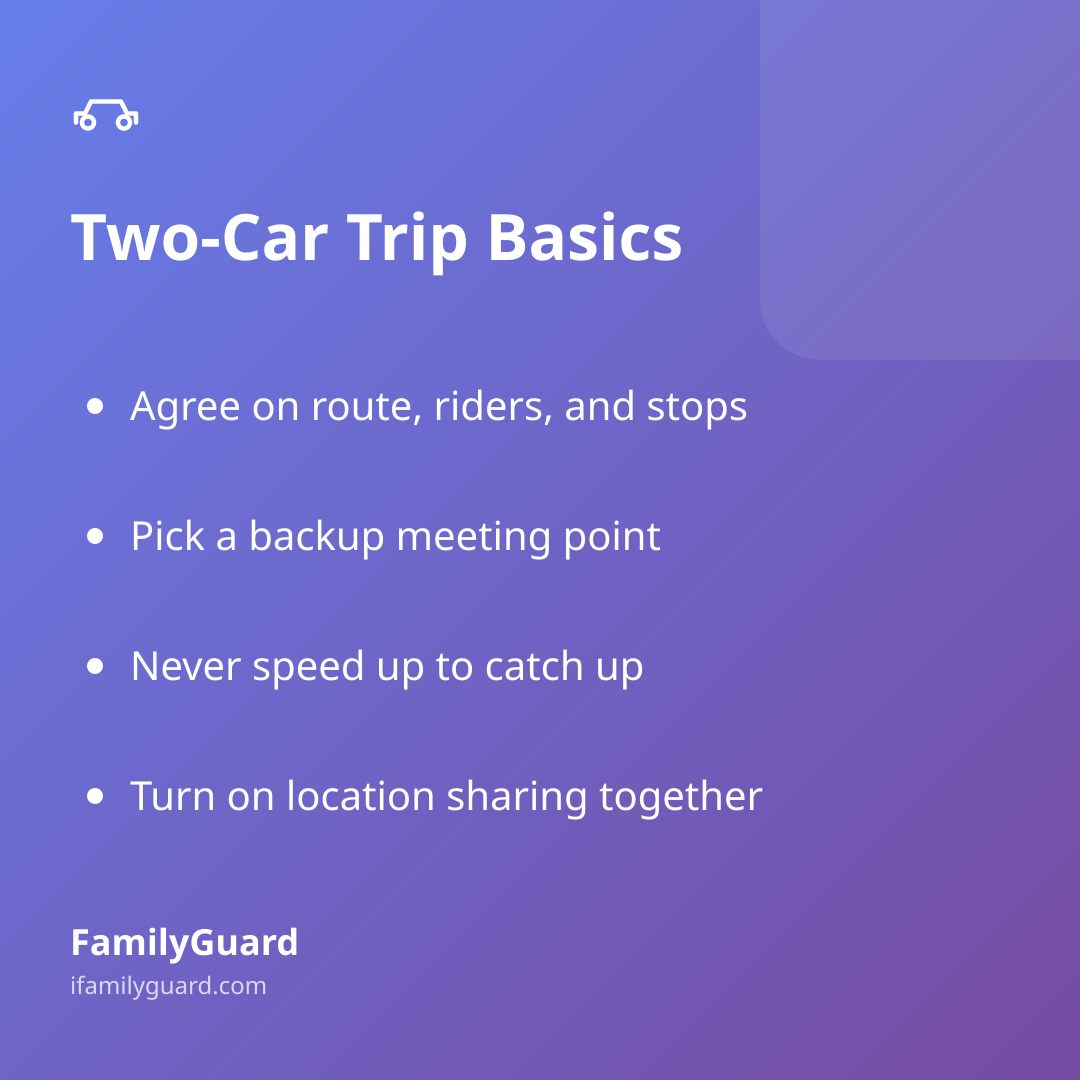
- The route. Both drivers should know the plan, not just the one who's "leading," in case the lead car has to pull off.
- Who's riding where. Especially with kids split between vehicles, it helps to write down who's in which car before anyone buckles up.
- Rest stop rhythm. A break every couple of hours gives both drivers a chance to stretch, refuel, and reset — and it's an easy, natural point for the two cars to regroup.
- What "we lost you" means. Decide in advance that if the cars separate at a light or an exit, nobody chases or speeds up to catch up — everyone just continues to the next agreed stop.
- A backup meeting point. If you get split up near a destination, pick a landmark ahead of time instead of trying to describe one over a bad phone connection.
None of this requires a family meeting or a printed itinerary. A quick voice note or a message in the family group chat the night before is usually enough for everyone to feel oriented.
Staying Connected Without Watching the Phone
The easiest way to keep two cars loosely in sync is to agree, with everyone's knowledge, to share location for the duration of the trip. This isn't about anyone checking up on the other driver — it's simply a way to glance at a map and see where the other car is without a phone call that pulls someone's eyes off the road. Families who already use a location-sharing app like FamilyGuard for everyday use often find it's just as handy on a road trip: both cars show up on the same map, and a zone alert can quietly confirm "we've arrived at the rest stop" without anyone needing to type a message at 70 miles an hour.
A few habits make this smoother:
- Set up sharing before you leave the driveway, not after you've already lost sight of each other on the highway.
- Agree that the passenger, not the driver, is the one who checks the map or sends updates.
- If a stretch of road is known for weak signal, say so out loud before you get there, so nobody panics when the dot disappears for a few minutes.
- Turn sharing off again once the trip is over, the same way it was turned on — by agreement, not by default.
If You Actually Get Separated
Most of the time, a missed exit or a traffic light sorts itself out in two minutes. But it helps everyone stay calm if there's already an answer to "what do we do now?"
The simplest version: the car that's ahead slows down to a normal highway speed and heads for the agreed rest stop or landmark, rather than trying to pull over on the shoulder to wait. The car that's behind does the same. Nobody weaves through traffic to catch up. If a longer gap opens up — say, one car takes a wrong turn in an unfamiliar city — a quick call or text settles it, and having already agreed on a way to flag a real emergency (rather than a normal delay) means nobody has to guess how serious a situation is.
It's worth saying plainly to kids who are old enough to understand: getting separated from the other car isn't an emergency by itself. It's something that happens on road trips sometimes, and the plan exists precisely so nobody has to feel panicked when it does.
Keeping the Trip Running Smoothly
A few small, practical habits go a long way on longer drives:
- Charge phones in the car rather than letting them run low before a stop, especially if location sharing is on.
- Pack a paper map or a saved offline route for stretches where cell coverage is known to drop.
- Let kids know the rest-stop rhythm in advance ("we stop every couple of hours") so waiting isn't a surprise.
- Swap which car leads occasionally — it keeps both drivers more alert and shares the mental load of navigating.
The Trip Is the Point
None of this is about managing risk so much as it is about protecting the fun part — the snacks, the playlists, the arguing over who gets the window seat. A two-car trip with a loose, shared plan tends to feel easier than one where everyone's quietly hoping the other car doesn't get lost. Agree on the basics, stay loosely connected, and let the rest of the trip take care of itself.