There's something about a day at the pool, lake, or beach that feels different from any other outing. The sunscreen, the snacks, the sound of everyone splashing around — it's the kind of afternoon families remember for years. A few simple habits, agreed on before anyone touches the water, let you relax into that afternoon instead of spending it half-watching and half-worrying.
None of this is about fear. It's about the same idea behind any good family safety plan: decide the important things in advance, calmly, so that in the moment everyone already knows what to do.
Why a Few Minutes of Planning Matters
Water safety isn't a niche topic for families who live near a pool. According to the U.S. Centers for Disease Control and Prevention, drowning is the leading cause of death for children ages 1 to 4 in the United States, and most of those drownings happen in swimming pools. For children ages 5 to 14, drowning is the second leading cause of unintentional injury death, after motor vehicle crashes.
The same CDC page points to what actually works: formal swim lessons are linked to a lower drowning risk among children and young adults, and four-sided pool fencing that fully separates the pool from the house and yard reduces a child's drowning risk by about 83% compared with a fence that only runs along the property line.
None of this is meant to make water days feel scary. It's the opposite — knowing what genuinely reduces risk means you can spend less energy on generalized worry and more on the specific habits that help.
The One Rule That Matters Most: An Undistracted Watcher
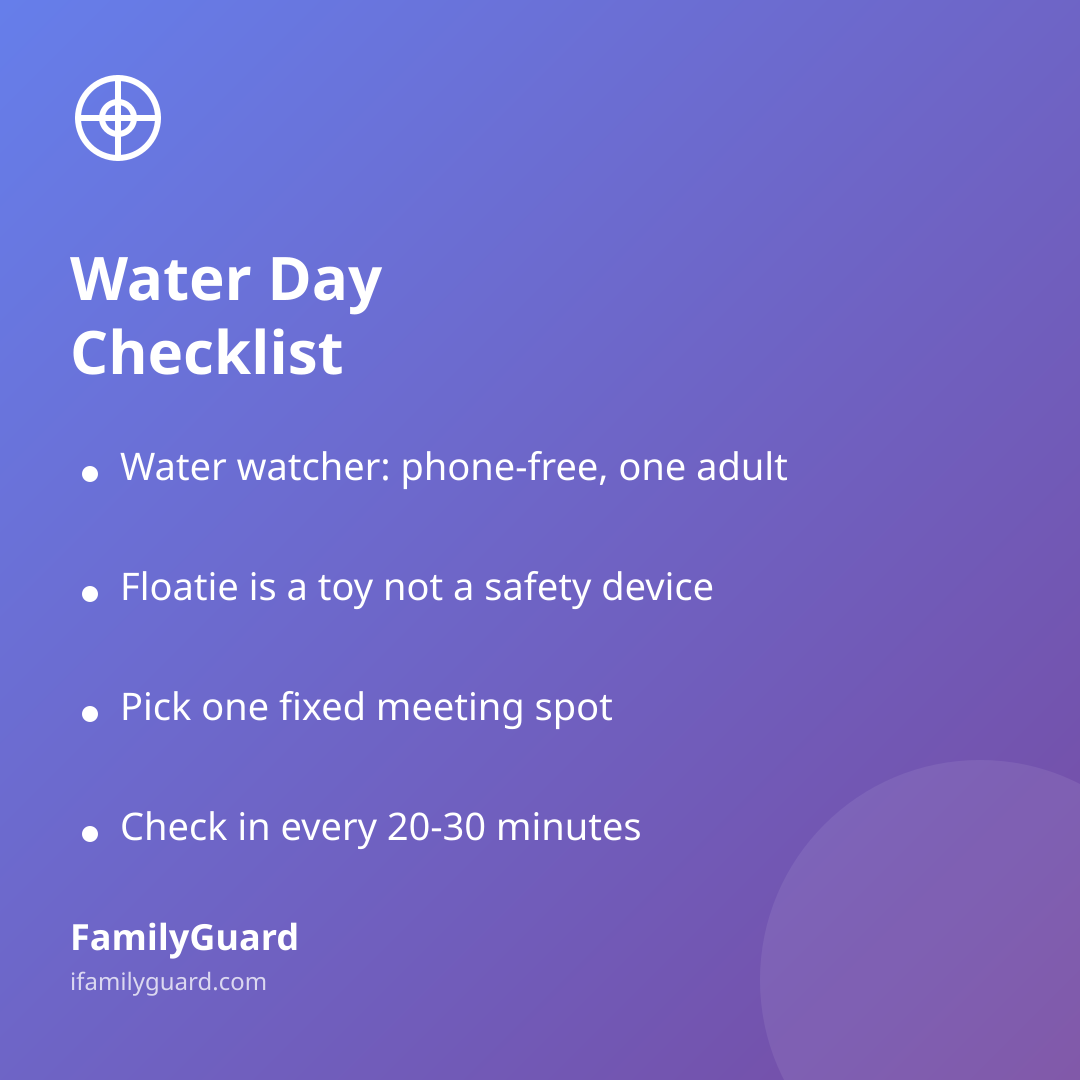
Most families already supervise kids near water. The detail that makes the real difference is undistracted supervision — one designated adult, for a set stretch of time, whose only job is watching the water. Not scrolling, not chatting with other parents, not reading. Just watching.
Many pediatric safety groups call this the "water watcher" role, and it works best with a simple handoff system:
- Use a physical object — a lanyard, a card, a water-watcher badge — that gets handed from one adult to the next.
- Set a time limit, like 15 minutes, so no one watcher gets fatigued or distracted.
- Agree out loud: "I've got the kids until 3:15, then you're on."
- Keep the watcher phone-free during their shift — texts and photos can wait a few minutes.
This matters even when a lifeguard is on duty. Lifeguards are watching dozens of swimmers at once; they're not a substitute for a parent's eyes on their own child, especially a young one.
Teaching Kids to Respect the Water
Confidence in water comes from skill, not just comfort. If your child hasn't had formal swim lessons, it's worth looking into options at a local pool, community center, or the American Red Cross, which offers water safety and swim courses for a range of ages. Lessons also teach something just as important as swimming itself: what to do if you're tired, if you get pulled by a current, or if a friend needs help.
A few habits are worth repeating often enough that kids know them by heart:
- Life jackets for non-swimmers and weak swimmers on boats, at lakes, and in open water — a pool "floatie" is a toy, not a safety device.
- Swim with a buddy, and know where that buddy is at all times.
- Check conditions before going in — lake and ocean water can have currents, drop-offs, and temperatures that a backyard pool never has.
- Feet first, not head first, in any water of unknown depth.
- Get out when tired — tiredness and cold are two of the quiet ways swimmers get into trouble.
It also helps to talk, gently and without drama, about what drowning actually looks like. It's rarely the loud, splashy struggle shown in movies — it can be quiet, with a swimmer's head low in the water and little movement. Knowing this helps the whole family, including older kids, notice sooner if someone needs help.
Staying Connected on Crowded Water Days
Beaches, water parks, and busy public pools bring a different challenge: it's easy for a family to get spread out, and hard to spot each other in a crowd of similar-looking swimsuits. The fix is the same one that works at any crowded event — agree on it before you arrive, not after someone's missing.
- Pick one obvious, fixed meeting spot — a specific lifeguard chair, a particular umbrella color, a snack stand — and point it out to every kid when you arrive.
- Dress younger kids in a bright, easy-to-spot swimsuit color.
- Agree on a simple check-in rhythm, like every 20–30 minutes, rather than constant calling out.
- If older kids and teens are heading off to a different part of the beach or pool with friends, agree on when they'll check back in.
This is where a shared family location app can quietly help, without anyone needing to shout across the sand. Many families use FamilyGuard for exactly this kind of day — a quick glance at everyone's general location on a crowded beach, a smart zone alert when a teen leaves the pool area, or a one-tap SOS if someone genuinely needs help fast. It's all consent-based and visible to everyone in the family, so it supports the plan you've already agreed on rather than replacing the conversation.
A Simple Family Water Safety Checklist
Before the next pool, lake, or beach day, it can help to run through a short list together:
- Who is the water watcher, and for how long?
- Does every weak swimmer or young child have a properly fitted life jacket?
- Where is the meeting spot if someone gets separated?
- Does everyone know the swim-with-a-buddy rule for today?
- Is there a lifeguard, and does everyone know where they're stationed?
- What's the check-in plan for older kids heading off on their own?
Running through questions like these takes less time than packing the cooler, and it means everyone — including kids — walks into the water already knowing the plan.
A Good Day, Not a Guarded One
None of this is about hovering or turning a fun day into a tense one. It's a short list of habits, agreed on calmly in advance, that let the adults actually relax a little instead of half-watching the water while half-watching their phone. That's really the goal of any family safety plan — not to remove the fun, but to make room for it.