
It was a busy week for anyone who touches a screen — which, in most households, is everyone. A new state law took direct aim at AI chatbots that get too close to kids, a critical flaw in widely used web software kept security teams up at night, and another household-name company confirmed a breach affecting millions of accounts. Here's what actually happened between October 26 and November 1, 2026, and what it means for your family — explained without the jargon.
AI & new tools
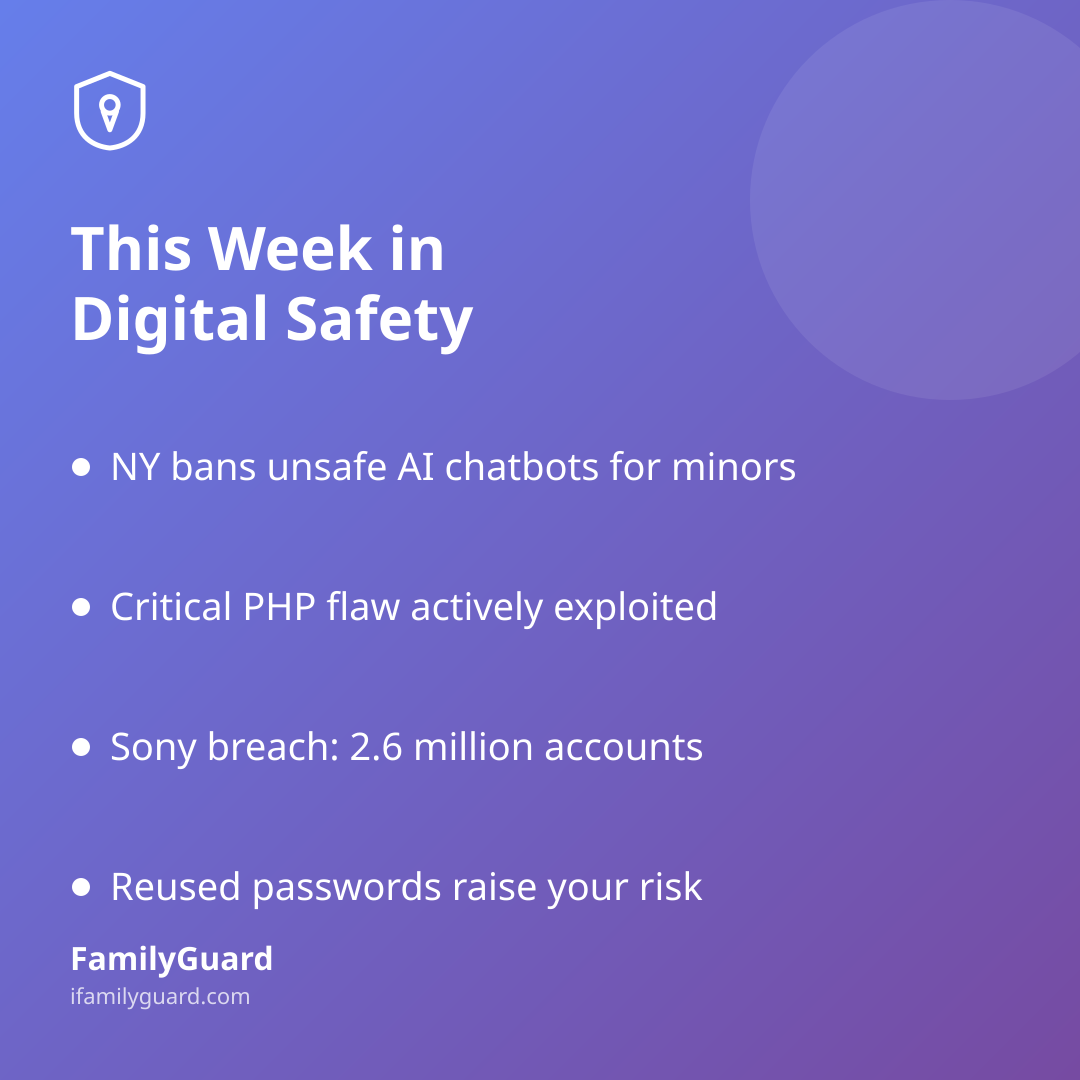
New York signs the country's toughest AI companion chatbot law for minors. On October 28, Governor Kathy Hochul signed legislation banning a dozen categories of "unsafe AI companion features" for users under 18, including chatbots that pose as human, foster emotional dependency, or engage in self-harm or sexual talk with minors. The law takes effect January 1, 2027, carries penalties of up to $25,000 per violation, and is written broadly enough to cover general-purpose AI assistants, not just dedicated "companion" apps. Tech Times — Hochul Signs Chatbot Safety Law That Reaches ChatGPT and Claude (2026). Why it matters for families: this is a signal, not just a headline — regulators are starting to treat AI chatbots the way they treat other products kids use, with real safety rules attached. It's a good prompt to ask your own kids which chatbots or "AI friends" they're actually talking to.
Google unveils Gemini 4 Carbon, built for cybersecurity work. On October 28, Google introduced Gemini 4 Carbon, a new AI model focused on finding and patching software vulnerabilities, initially rolling out to a limited group of security defenders rather than the general public. U.S. News — Google Launches Gemini 4 Carbon AI Model With Cybersecurity Focus (2026). Why it matters for families: AI is increasingly being pointed at defense, not just offense, in the ongoing arms race between hackers and the companies that protect your data — a quietly reassuring trend, even if it's not something you'll interact with directly.
Cybersecurity & threats
A critical flaw in PHP, the software behind huge swaths of the web, is being actively exploited. Two vulnerabilities (CVE-2026-109618 and CVE-2026-109619), both rated 9.2 out of 10 in severity, were added to the U.S. Cybersecurity and Infrastructure Security Agency's list of known exploited vulnerabilities on October 26, after researchers tracked exploitation attempts in the wild. Tenable — PHP2Shell: Frequently Asked Questions About Critical PHP Remote Code Execution Flaws (2026). Why it matters for families: you don't need to patch anything yourself, but this is exactly the kind of behind-the-scenes flaw that can lead to the data breaches you read about below — a good reminder that reusing the same password across sites turns one company's bad week into your problem too.
Sony confirms a breach affecting roughly 2.6 million customer accounts. Sony Network Communications disclosed on October 27 that an October 19 intrusion exposed names, emails, phone numbers, and birth dates for about 2.58 million customers of its So-net and plala internet services in Japan. Passwords were exposed for roughly 54,000 secondary email accounts tied to those services (not customers' main membership logins), and data from 16 bank accounts was also affected; payment card numbers were not among the exposed data. CyberInsider — Sony Discloses Data Breach Exposing 2.6 Million Customer Records (2026). Why it matters for families: if anyone in your household has ever used an internet or gaming-adjacent account from a major provider, it's worth checking whether you're affected and changing any reused passwords — especially if a teen's gaming or streaming login shares a password with something more sensitive.
Scammers are impersonating federal officials over the phone. The Federal Trade Commission warned in October that callers posing as FTC staff are telling people their phone number is linked to scams abroad, then transferring them to a fake "police officer" who threatens arrest unless they send money. FTC — The FTC Is Not Calling to Deactivate Your Phone Number (2026). Why it matters for families: these calls are designed to create panic fast, which is exactly what makes them effective on anyone — teens included. The real rule of thumb: no legitimate government agency will ever threaten to shut off your phone or demand payment to avoid arrest. Hang up and call the agency back using a number you look up yourself.
Online safety & privacy
West Virginia sues TikTok and ByteDance over child safety design. The state's attorney general filed suit on October 29, alleging TikTok's endless scrolling, autoplay, and recommendation features are designed to keep kids compulsively engaged while exposing them to inappropriate content, and citing a West Virginia University study linking frequent use to higher rates of depressive symptoms among young users. WVVA — West Virginia Sues TikTok, Alleges App Harms Children (2026). Why it matters for families: it's another reminder that app design — not just content — shapes how hard it is for kids (and adults) to put the phone down. Built-in screen time tools and family-wide app limits can help more than relying on willpower alone.
Roblox's safety overhaul continues to roll out. Updates reported this month include facial age-estimation to help keep adults out of kids-only spaces, direct messaging blocked by default for under-13 accounts, and parent accounts linked directly to a child's account for easier oversight. Bitdefender — TikTok and Roblox Just Added New Safety Features (2026). Why it matters for families: if your kids play Roblox, it's a good moment to revisit the parental settings — new protections only help if they're actually turned on.
This week's takeaway for families
- Check for reused passwords. With Sony's breach affecting millions of accounts, this is a good week to update any password your family has reused across sites — a free password manager makes this painless.
- Talk about AI chatbots, calmly. New York's new law is a sign that lawmakers are catching up to how kids actually use AI companions. Ask what chatbots your kids use and why — curiosity works better than a ban.
- Treat "urgent" calls as a red flag, not a reason to rush. Whether it's a fake FTC agent or a fake police officer, the pressure to act immediately is the scam. A quick pause and a callback to a verified number defuses almost all of them. Families who use a consent-based app like FamilyGuard to stay in touch can also lean on a quick check-in message instead of panicking alone when an odd call comes in.
Sources
- Tech Times — Hochul Signs Chatbot Safety Law That Reaches ChatGPT and Claude (2026)
- U.S. News — Google Launches Gemini 4 Carbon AI Model With Cybersecurity Focus (2026)
- Tenable — PHP2Shell: Frequently Asked Questions About Critical PHP Remote Code Execution Flaws (2026)
- CyberInsider — Sony Discloses Data Breach Exposing 2.6 Million Customer Records (2026)
- FTC — The FTC Is Not Calling to Deactivate Your Phone Number (2026)
- WVVA — West Virginia Sues TikTok, Alleges App Harms Children (2026)
- Bitdefender — TikTok and Roblox Just Added New Safety Features (2026)