Shuttling between two homes is just part of normal life for millions of kids. Backpacks go back and forth, schedules get swapped in group chats, and somewhere in the mix, two households have to agree on the basics: who's picking up, what time, and what happens if something goes sideways. None of that has to be stressful. With a few shared routines, both homes can stay on the same page without constant back-and-forth texting or second-guessing.
This isn't about tracking an ex-partner or keeping score. It's about building a safety net that follows the child, not the address — something both parents and the child can see and trust.
Kids Do Well When the Logistics Are Handled Calmly
Parents often worry that moving between two homes is inherently hard on kids. Research doesn't back that up when the arrangement is handled well. A study of Swedish children by researchers at Stockholm University and the Karolinska Institutet found that kids in shared-residence arrangements had outcomes comparable to children living with both parents in one household — similar friendships, health, and school experiences, with no evidence that splitting time between two homes caused extra stress or isolation (Fransson et al., Child Indicators Research, 2017).
The same research found that kids living with only one actively involved parent fared worse across several measures than kids in either shared custody or two-parent households. In other words, what tends to matter most isn't the number of homes — it's whether both of them feel organized, informed, and connected.
What Both Households Actually Need to Know
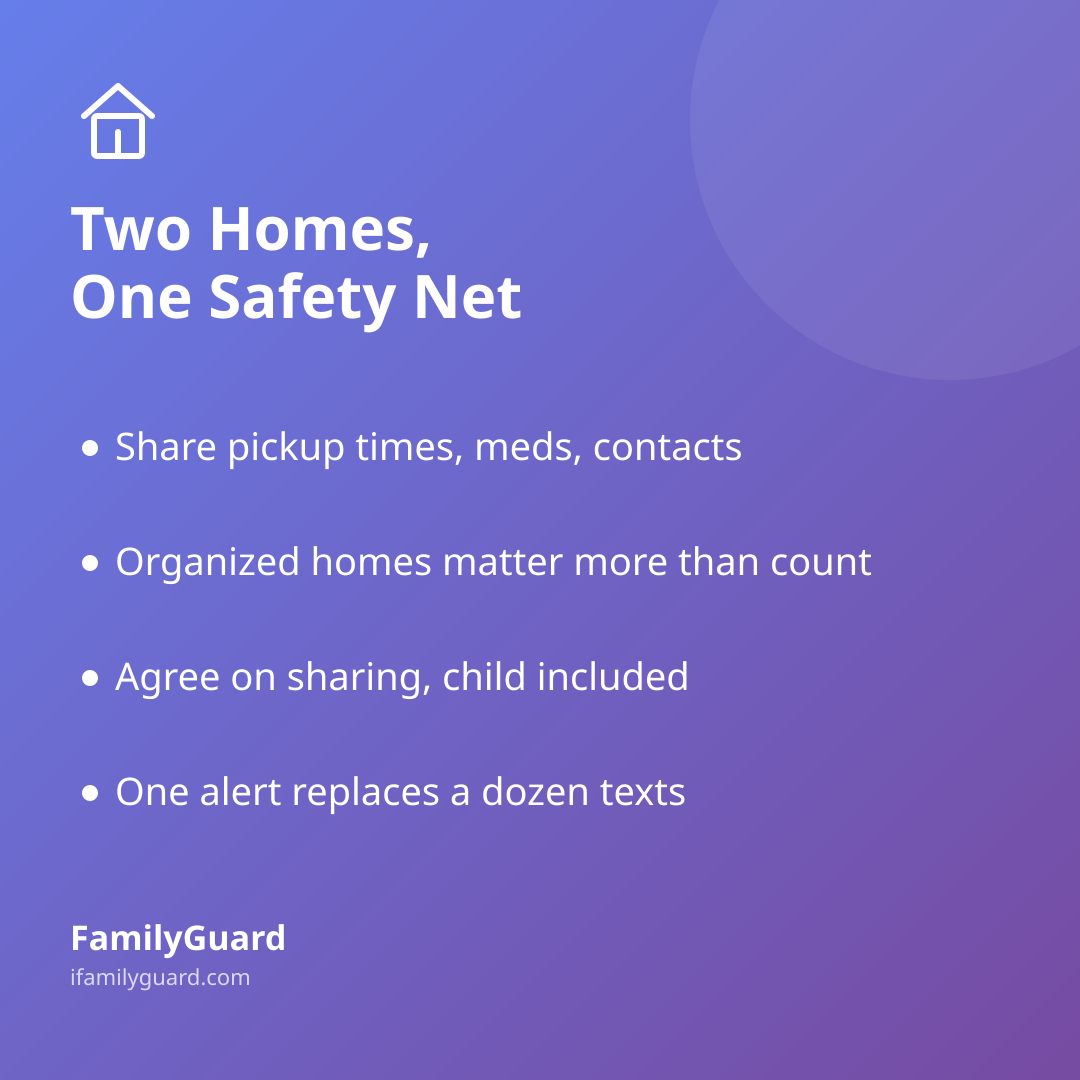
A lot of co-parenting stress comes from information gaps, not conflict. One parent doesn't know about a schedule change, an allergy update, or who's driving to practice. A short, shared reference — even a simple shared note or document — can solve most of it. Consider covering:
- Pickup and drop-off times, including who's actually doing the driving that week
- Allergies, medications, and any current health notes
- School, activity, and carpool schedules for the week ahead
- Emergency contacts for both homes, including a backup adult at each
- What the child should do if a pickup is running late or plans change
The goal is that any adult involved — either parent, a grandparent on either side, a babysitter — can look at the same information instead of relying on memory or a half-remembered text from two weeks ago.
Location Sharing That Works for Both Homes
Real-time location sharing can genuinely lower the friction of custody exchanges, but it only works when it's set up with everyone's knowledge and agreement — the child included, especially once they're old enough to understand it. The point isn't for either parent to monitor the other household. It's for whoever has the child that day to know they've arrived safely at school, at the other parent's home, or at practice, without a round of "did they get there okay?" texts.
Apps built specifically for this, like FamilyGuard, are designed around that distinction: sharing happens only among family members who've agreed to it, nothing is visible to anyone outside that circle, and a smart zone alert — "arrived at Mom's," "left school" — can replace a dozen check-in texts a week. It's a transparency tool for the child's day, not a surveillance tool aimed at an ex-partner.
A Few Ground Rules Worth Agreeing On Early
- Location sharing is about the child's safety and logistics — not about monitoring the other household's comings and goings
- Both parents and the child (when age-appropriate) agree to what's shared and for how long
- Either parent can raise a concern about how it's being used, and the setup can be adjusted
- The child always knows the sharing is happening — nothing hidden, nothing secret
Keeping Communication Calm and Child-Focused
The American Academy of Pediatrics notes that children do better after separation or divorce when parents collaborate, communicate regularly, and keep rules and routines consistent across both homes — and when each parent actively supports, rather than undermines, the other's parenting role (HealthyChildren.org, American Academy of Pediatrics, 2020). That same spirit works well for day-to-day logistics, too. A quick, factual message — "Running 15 minutes late for pickup" — lands a lot better than a longer explanation, and it keeps the focus on the handoff instead of the history.
It also helps to agree on what "late" actually means before it happens. Fifteen minutes because of traffic is different from an hour with no word. Having a shared understanding — and a simple way to check in, like a location ping or a quick message — means nobody has to guess whether it's time to worry.
A Simple Routine for Exchange Days
Most of the stress around custody exchanges comes down to uncertainty, and uncertainty is fixable with a routine. A few things that tend to help:
- Confirm the pickup time and driver the night before, not the morning of
- Have the child send (or the app show) a quick "arrived safely" update after each transition
- Keep a go-bag or checklist at each home so forgotten items don't become a recurring issue
- Agree on one shared channel for logistics — a group chat or shared calendar — so nothing gets lost between separate conversations
Over time, these small habits stop feeling like "co-parenting logistics" and just become how the family runs. That's really the goal: two households, working from the same playbook, so the child experiences consistency instead of coordination gaps.
The Bigger Picture
Two homes can absolutely feel like one steady, connected family life for a child — the research bears that out, and so does the everyday experience of countless co-parenting families. The pieces that make it work aren't complicated: shared information, honest communication, and a safety routine that both parents and the child trust. When location sharing and check-ins are set up with consent and clarity, they stop being a source of tension and start being exactly what they're meant to be — a quiet, reliable way of knowing everyone made it where they needed to go.