Most of us grew up with one safety rule: don't talk to strangers. It's simple, but it has a problem. If your child ever actually gets separated from you in a store, a park, or a crowded event, the person who can help them is almost always a stranger. What kids need isn't a blanket warning — it's a clear, practiced plan for finding the right stranger, fast.
The good news is that this is a teachable skill, not a source of fear. A few calm conversations and a little practice can turn "I don't know what I'd do" into "I know exactly who to look for."
Why "Don't Talk to Strangers" Falls Short
Child safety experts have moved away from blanket stranger warnings for a good reason: they don't tell a child what to do when they're actually scared or lost. According to Nemours KidsHealth (reviewed 2023), a more useful approach teaches kids to judge people by their behavior, not their appearance, and to actively seek out specific kinds of helpers rather than avoiding everyone they don't know.
The National Center for Missing & Exploited Children's KidSmartz program (accessed 2026) echoes this: kids are taught to "Tell a Trusted Adult" whenever something feels wrong, and to look for specific, identifiable helpers rather than freezing or wandering further.
What a "Safe Helper" Actually Looks Like
Give your child a short, concrete list rather than a vague category. Both KidSmartz and KidsHealth point to the same practical hierarchy:
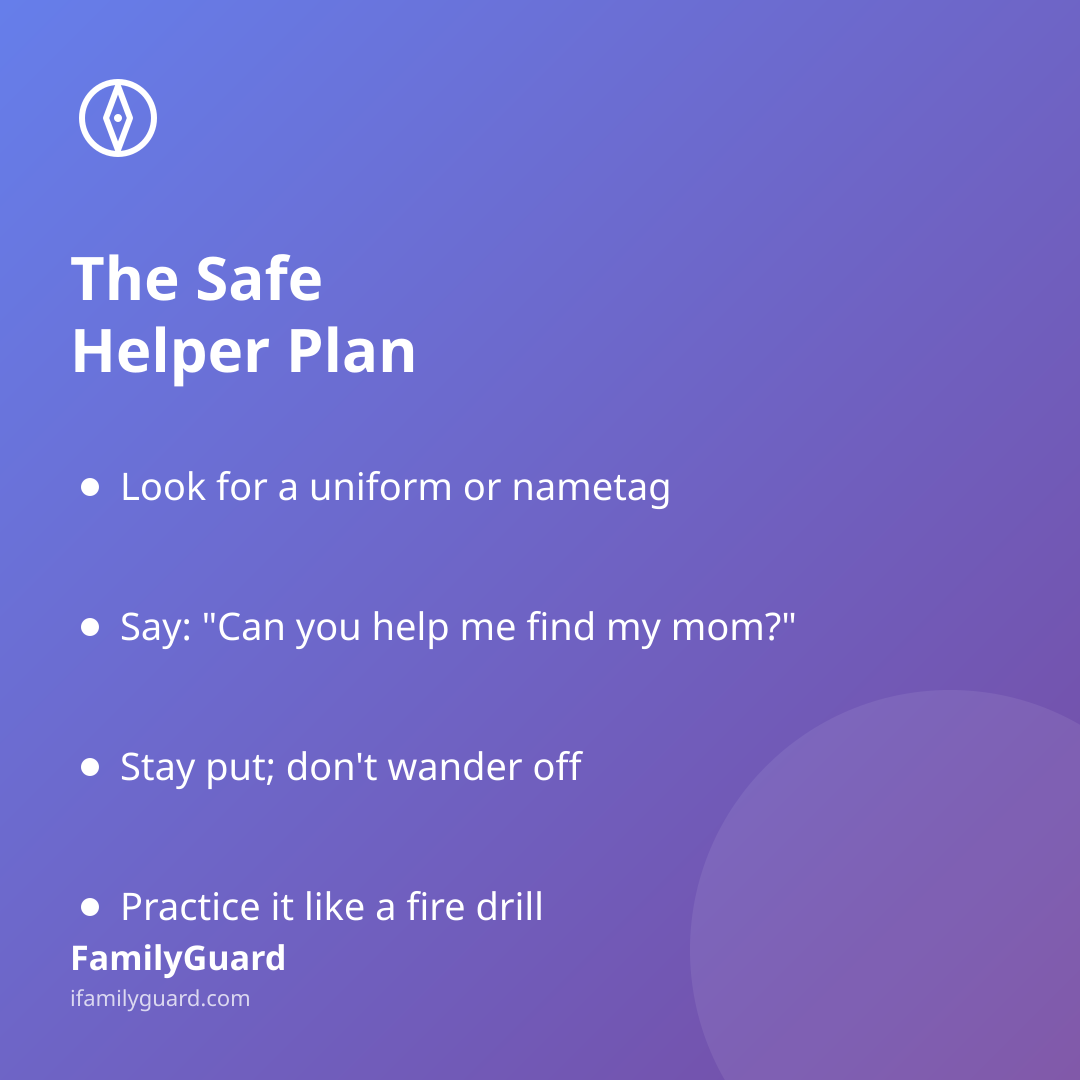
- Someone in uniform — a police officer, security guard, firefighter, or paramedic
- Someone with a nametag who works there — a cashier, a store employee at an information desk, a ride operator
- A parent with kids of their own nearby — a good fallback if no uniformed or badged helper is in sight
Walk through this list with your child before you need it: "If you ever got separated from me at the mall, who would you look for first?" Let them answer out loud. Hearing themselves say it builds the habit far more than hearing it from you.
The Script That Actually Works
A plan is only useful if your child can say it under stress, so keep the phrase short and the same every time:
"I'm lost. Can you help me find my mom/dad/grandma?"
That's it. No long explanation, no need to remember an address in the moment (though it's worth them knowing it too). Practice saying it together, even playfully, until it comes out easily. You can rehearse it the way you'd rehearse a fire drill — not to scare anyone, but so the right words are already there when they're needed.
It also helps to tell your child explicitly: staying put and asking for help is almost always better than wandering around trying to find you on their own. Movement makes it harder for you to find each other, while a stationary, identifiable helper gives both of you a fixed point.
Practicing the Plan, Not Just Talking About It
A one-time conversation fades fast. A quick habit sticks. A few ways to build it in without making it feel heavy:
- Scout the helper together. Whenever you arrive somewhere new — a theme park, a mall, an airport — spend ten seconds pointing out who they'd ask for help: "See that woman with the badge by the entrance? That's who you'd look for."
- Set a meeting point too. A safe-helper plan and a family meeting point work as a team — one is the immediate first move, the other is where you reconnect.
- Role-play at home. Take turns being the "lost kid" and the "store employee." It sounds silly, but rehearsal under low stakes is exactly what makes the real version less scary.
- Revisit it occasionally. A quick refresh before a crowded outing takes thirty seconds and keeps the habit current as your child grows.
What Comes After "I'm Lost"
Finding a safe helper is the first move, but staying connected afterward matters too. If your child carries a phone or smartwatch, it helps to agree in advance on what happens next — who they call, and how you'd find each other quickly. Many families use a tool like FamilyGuard for exactly this moment: a one-tap SOS to alert you the instant something feels off, paired with real-time location sharing that both of you have already agreed to, so a parent or guardian can get to them without delay. It's not a substitute for the safe-helper skill — it's the layer that works alongside it, entirely within the family and with your child's full knowledge.
A Calm Skill, Not a Scary One
The goal here isn't to make your child wary of the world. It's the opposite: a child who knows exactly what to do when they're lost is usually calmer in the moment, not more anxious beforehand. Keep the conversation light, make the practice a little bit fun, and revisit it now and then as your child's world gets bigger — new schools, new outings, new independence. A clear plan, rehearsed a few times, tends to be the thing that actually gets used.