At some point, almost every family faces the same small milestone: your child, home alone, for the first time. Maybe it's twenty minutes while you run to pick up a sibling. Maybe it's an afternoon after school before anyone gets home. Whatever the occasion, the question underneath it is always the same — is my child really ready for this?
The honest answer is that readiness isn't really about a birthday. It's about a specific mix of maturity, practice, and preparation that looks different for every child. Here's how to think it through calmly, without second-guessing every decision afterward.
Age Is a Starting Point, Not an Answer
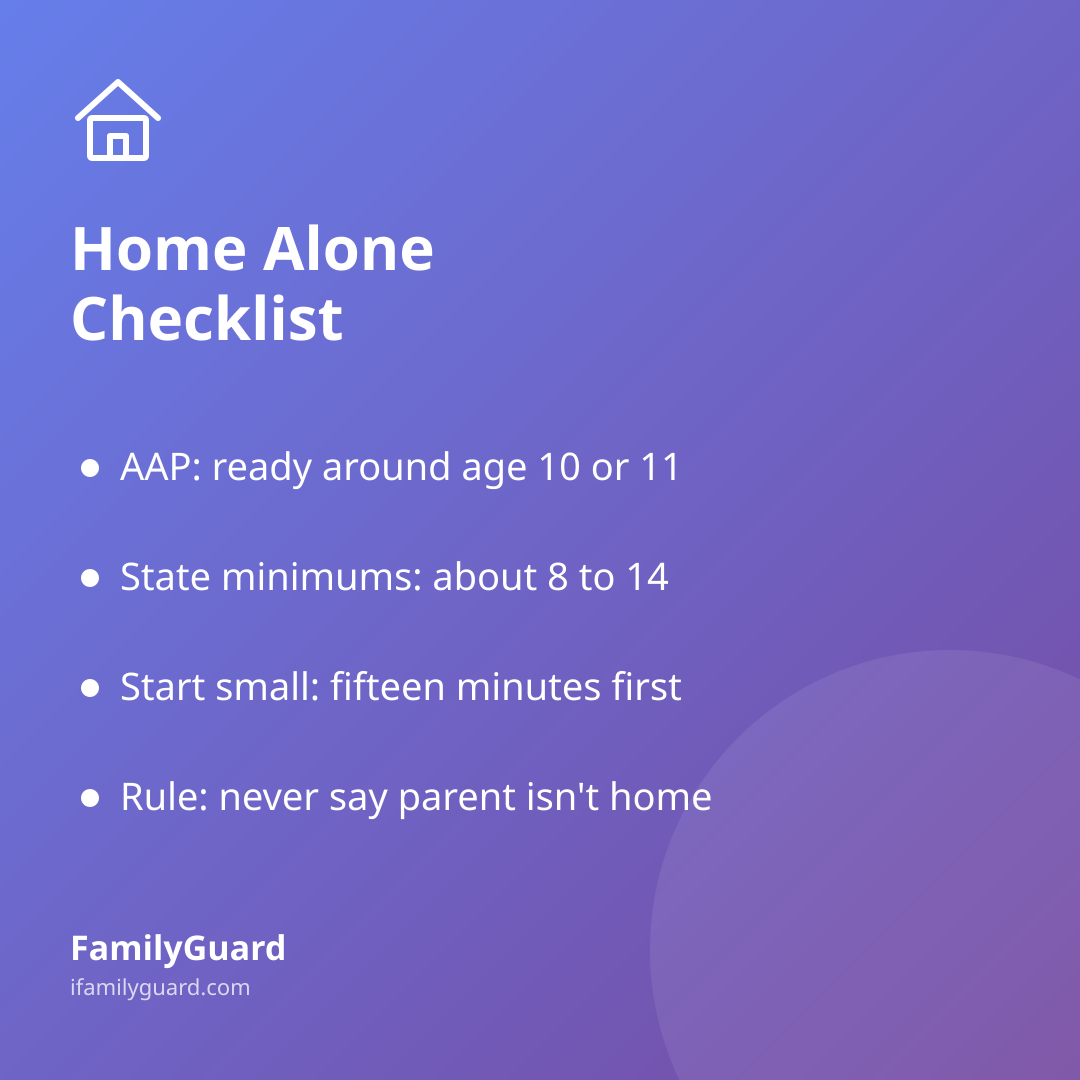
Pediatric safety experts generally point to the preteen years as the earliest reasonable window for unsupervised time at home. The American Academy of Pediatrics (2023) notes that most children aren't mature enough to be home alone on a regular basis until around 10 or 11 years old, with 11 or 12 being a more typical age for a few hours alone. Nationwide Children's Hospital puts the bar a bit higher, suggesting most kids aren't ready until at least age 12, and recommends against leaving any child home alone at night, even once they clear that bar.
Worth knowing: the American Academy of Pediatrics also notes that several states have actual minimum-age laws for leaving a child unsupervised, with minimums ranging from about 8 to 14 depending on the state. It's worth a quick search for your own state's guidance before you plan around age alone — the law sets the floor, but your own read on your child still matters more than the number.
What Readiness Actually Looks Like
Instead of asking "is she old enough," it helps to ask a handful of more specific questions. None of these require a special test — just some honest observation of how your child already handles things.
- Do they follow rules even when no one is watching? A child who bends the rules when you're in the next room will likely bend them when you're not home at all.
- Can they stay calm when something unexpected happens? A dropped glass, a knock at the door, a flickering light — small surprises are a decent preview of how they'd handle a bigger one.
- Do they actually want to do this? Some kids are eager for the independence; others feel genuinely anxious about being alone. Ask directly, and take the answer seriously either way.
- Do they know the basics by heart? Full name, home address, a parent's phone number, and how to reach a neighbor or relative if something's wrong.
- Can they keep themselves occupied without constant screen time? This isn't a strict rule, but a child who can read, draw, or putter around the house is usually showing the kind of self-management that matters here.
Start Small and Build Up
The first time home alone doesn't need to be a full afternoon. A short, low-stakes test run — fifteen minutes while you're at the mailbox or the neighbor's — tells you far more than a long conversation about hypotheticals. From there, both of you can build confidence gradually: a half hour, then an hour, then longer stretches, only once each step has gone smoothly.
It helps to talk through a few scenarios together before the actual day, almost like a dry run in conversation:
- "What would you do if the phone rings and you don't recognize the number?"
- "What if someone knocks on the door?"
- "What if you smell something burning, or the power goes out?"
- "What if you just feel scared, even though nothing is actually wrong?"
There's no need to make these sound like a quiz. Framed as "let's figure this out together," they usually come across as reassuring rather than frightening — a sign that you're preparing them, not just hoping for the best.
A Few Ground Rules Worth Setting Together
Clear, agreed-upon rules take a lot of the guesswork out of the experience for both of you. A short written list — stuck on the fridge, not hidden in a drawer — tends to work better than rules that only exist in memory. Nationwide Children's Hospital recommends covering a few essentials in particular: never telling a caller or visitor that a parent isn't home, generally not opening the door to anyone, and reviewing at least two exit routes from the house in case of fire.
Beyond that, most families find it useful to agree on:
- What's okay to use unsupervised (microwave, stove, certain appliances) and what's off-limits for now
- Whether friends are allowed over, and under what conditions
- A simple check-in — a text or a call at a set time, so neither of you is left wondering
- Where the emergency numbers are posted, even if your child has them memorized
Some families find it reassuring to build the check-in into a tool they already use together, rather than relying on a single phone call that might get missed. In our family, we've used FamilyGuard for this — a simple "arrived home safe" notification that lets us know the front door opened as expected, so nobody has to remember to send a text. It's a small thing, but it takes one piece of the worry off the table on both sides.
When It Doesn't Go Perfectly
It's worth preparing for the fact that the first few attempts might not be flawless. Your child might forget to lock the door, ignore a text, or simply say afterward that they didn't like it as much as they thought they would. None of that means the experiment failed — it means you've learned something real, instead of guessing. Treat early hiccups as information, adjust the plan, and try again on a smaller scale if needed. Readiness tends to arrive in increments, not all at once.
Staying home alone for the first time is a genuine milestone — for your child's confidence and for your own trust in them. Taken slowly, with a plan both of you helped build, it usually turns out to be far less dramatic than it felt in the planning stage.