Most families have a plan for sleepovers, school pickups, and lost-in-the-crowd moments. But ask where everyone would meet if the smoke alarm went off at 2 a.m., and the answer is often a shrug. That's not a failure of planning — it's just a conversation that hasn't happened yet. The good news is that a real home fire escape plan takes far less time to build than most people expect, and once it exists, it quietly sits in the background doing its job: giving everyone, especially kids, a clear and calm next step when seconds matter.
Why a few minutes of planning matters so much
According to the U.S. Fire Administration, residents could have less than two minutes to escape a home fire once the smoke alarm sounds. That's not a lot of time to think, and thinking clearly under stress is hard for adults, let alone children who may be half-asleep or frightened. A plan that's already been talked through and practiced removes the need to improvise. Everyone already knows the two things that matter most: how to get out, and where to go once they're outside.
This isn't about dwelling on worst-case scenarios. It's the same logic behind a fire drill at school — calm, routine, and over in minutes — just brought home.
Start with the map, not the worry
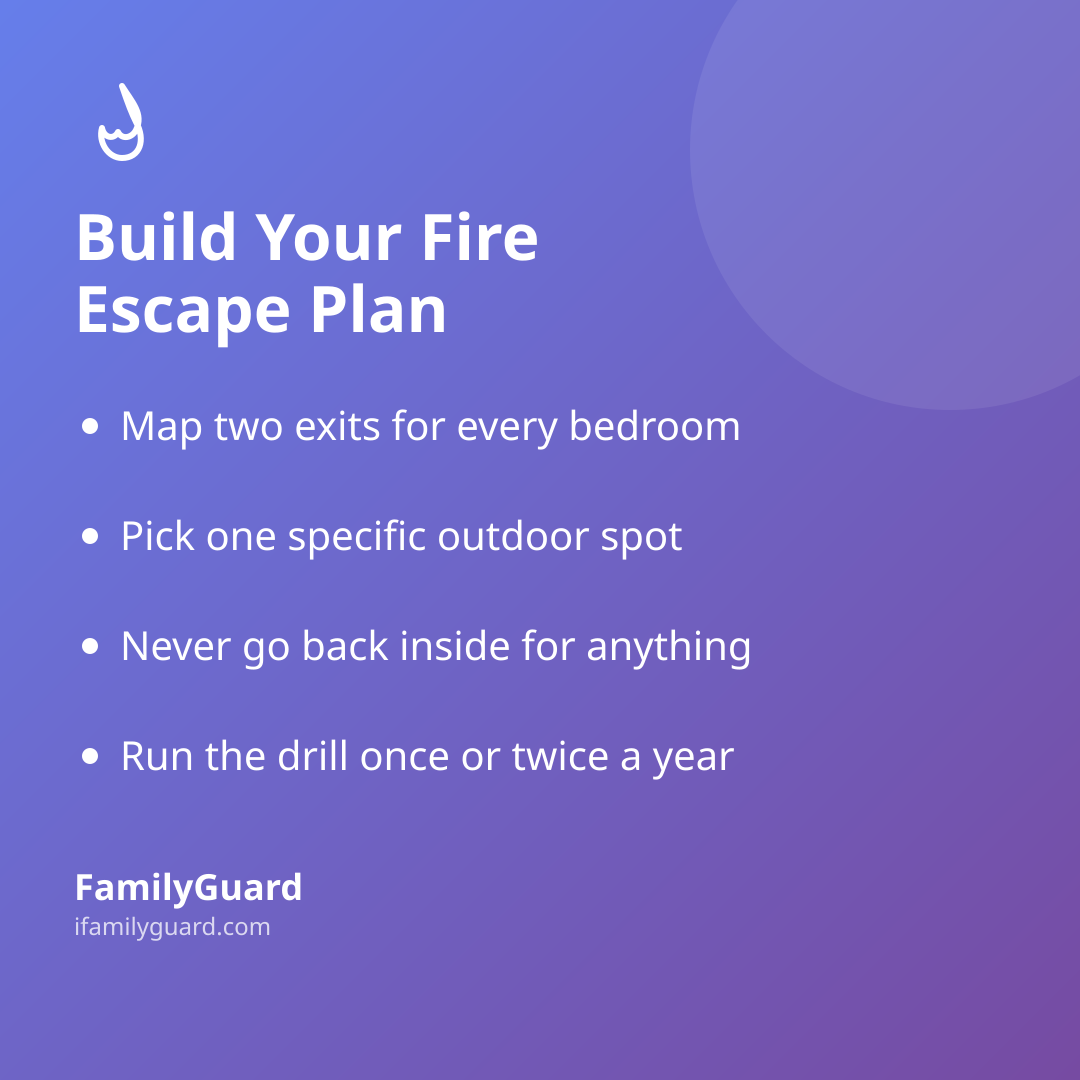
A good first step is sitting down together with a simple sketch of your home. It doesn't need to be to scale. Just mark each room, every door, and every window that's big enough to climb through. For each bedroom, try to identify two ways out: the usual door, and a backup, such as a window. If a bedroom is on an upper floor, this is also the moment to check whether you need an escape ladder and to show kids, in a non-alarming way, that it exists and where it's kept.
Framing matters here. You're not asking "what if there's a fire," you're saying "let's figure out how we'd all get outside quickly, just like we know where the exits are at the movie theater." Kids tend to take their emotional cue from the adult's tone, so a relaxed, practical voice does a lot of the work.
Pick one meeting spot — and make it specific
Every family escape plan needs an outdoor meeting point, somewhere a safe distance from the house that every family member, including the smallest ones, can find without help. A specific tree, a neighbor's mailbox, or a particular point on the sidewalk works better than something vague like "outside." The goal is that if everyone who can gets there safely, you'll know quickly who's accounted for — which is also exactly what firefighters need to hear when they arrive.
A few things worth deciding together:
- Where exactly the outdoor meeting spot is, and whether it changes in winter or bad weather
- Who is responsible for helping younger kids, pets, or family members who need extra assistance
- That the rule is always "get out, then call for help" — never go back inside for anything, including a phone or a pet
- That if someone is missing, you tell firefighters immediately rather than going back in to look
This is also a natural moment to talk about how your family stays in touch once everyone is safe outside, especially if a parent is away from home when something happens. Apps like FamilyGuard can help here in a small but useful way — a quick SOS alert and a shared location can let the rest of the family know everyone made it to the meeting point, without anyone needing to remember a phone number in a stressful moment.
Practice it like you'd practice anything else
A plan that only exists on paper is easy to forget. The U.S. Fire Administration recommends actually running the drill: sound the smoke alarm, have everyone walk their escape route, and regroup at the meeting spot. Doing this once or twice a year, maybe alongside the clock change or a birthday, is enough to keep it fresh without making it feel like a big event.
For younger children, keep the first practice gentle — walk the route in daylight, with no urgency, and talk through it step by step. Save the louder, faster version for when they're a bit older and the basic layout is already familiar. The aim is confidence, not fear.
Check the equipment while you're at it
A plan is only as good as the alarms that trigger it. While you're walking through escape routes, it's a good moment to test smoke alarms, check that they're in every bedroom and on every level of the home, and swap batteries if needed. If anyone in the home is deaf or hard of hearing, look into alarms with strobe lights or bed shakers, which are widely available and far more reliable than hoping someone wakes up in time.
Residents could have less than two minutes to escape a home fire once the smoke alarm sounds. (U.S. Fire Administration)
It's worth noting that a working alarm only helps if it's heard — and it's only acted on quickly if everyone already knows where to go next. The map, the meeting spot, and the alarm all work together.
A plan that fades into the background
The point of a fire escape plan isn't to make your home feel less safe — it's the opposite. Once it exists, it's one less thing anyone needs to figure out under pressure. Kids especially benefit from knowing, in a concrete and unspooky way, exactly what to do and where to go. That kind of clarity tends to lower anxiety rather than raise it, the same way knowing the fire drill route at school makes the alarm less scary, not more.
Block out ten minutes this week, sketch the rooms, pick the spot by the tree or the mailbox, and walk it once together. It's a small task that quietly makes the whole family safer.