The drop-off is over. The dorm room is decorated, the last box is unpacked, and you're driving home to a much quieter house. For years, your family safety habits were built around a kid who lived under your roof. Now they're an adult, living on their own for the first time, and the old rules — bedtime, curfews, "text me when you land" — don't quite fit anymore. What replaces them isn't a bigger set of rules. It's a lighter, more mutual kind of safety net, built together.
Why This Transition Feels Different
Homesickness is far more common than most families expect, on both sides. A longitudinal study published in the journal Emotion found that 94% of first-year college students experienced at least some homesickness during their first ten weeks away from home, and that staying connected with family was one of the things that helped students adjust over time (English et al., Emotion, 2016). In other words, the urge to check in more often in those first weeks is normal — for you and for them.
The goal isn't to recreate high school supervision on a college campus. It's to agree, together, on a rhythm of contact that respects their new independence while giving your family an easy way to stay close.
Start With a Conversation, Not a Rulebook
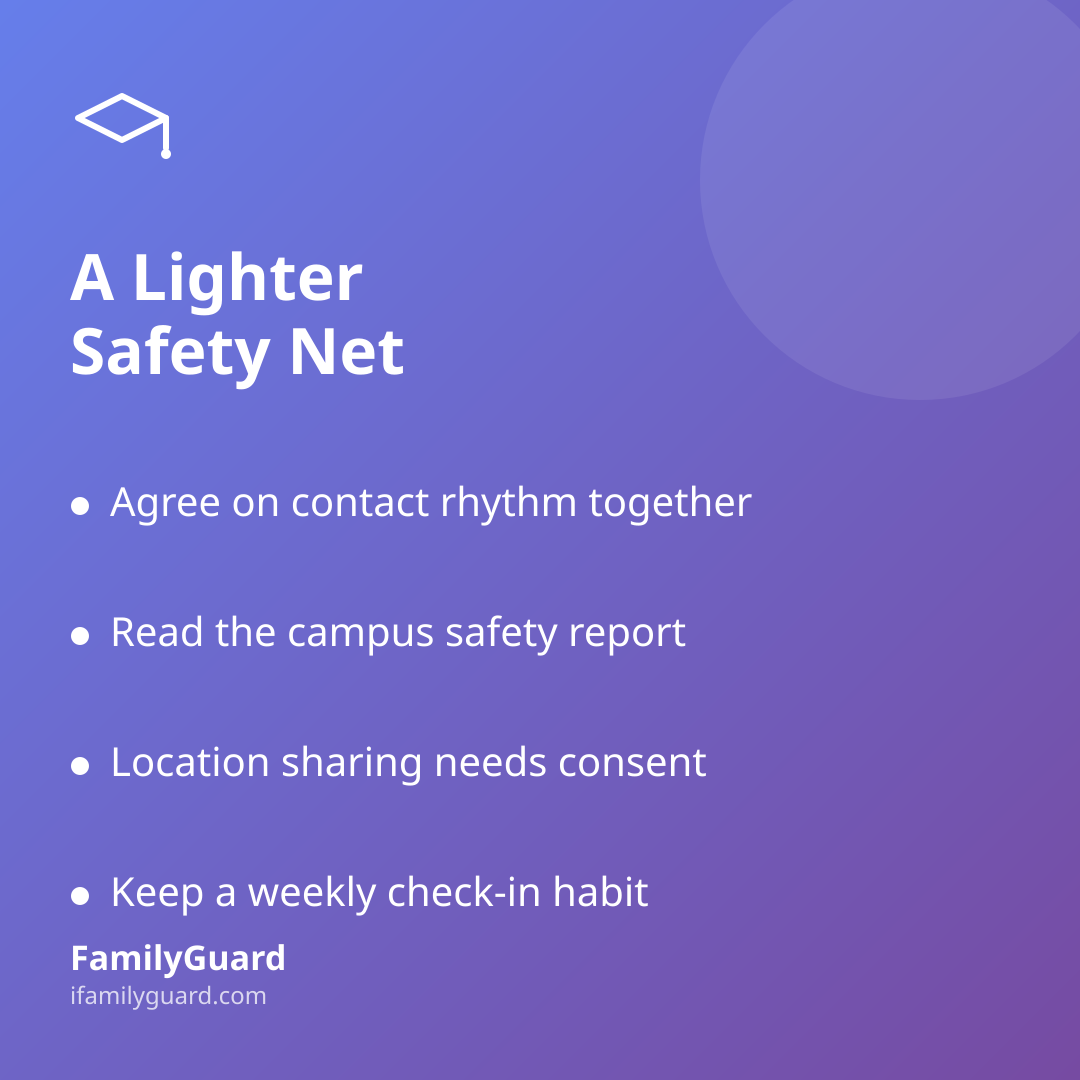
Before move-in day, or soon after, have an open conversation about expectations rather than announcing them. Ask what feels supportive to your teen versus what feels like hovering. Most young adults are happy to stay connected — they just want it to feel like partnership, not monitoring.
Useful questions to cover together:
- How often do we actually want to talk or text — daily, a few times a week, or a weekly call that's protected on the calendar?
- Is there a simple way to signal "I'm okay, just busy" without a full conversation, like a quick emoji or a shared family chat?
- Would sharing location occasionally — for peace of mind during a late-night study session, a solo road trip home, or a first big party weekend — feel like support or surveillance? Let your teen set the terms.
- Who else should be part of the safety circle — a roommate, an RA, a campus friend who knows to call you if something feels off?
Whatever you land on, treat it as a living agreement. What works in the first homesick month may loosen naturally by spring semester, and that's a good sign, not a red flag.
Know the Campus Safety Basics
Most families never read the fine print on how colleges handle safety, but it's worth a quick look together. Under the federal Clery Act, every college and university that receives federal funding must publish an annual security report by October 1 each year, listing crime statistics from the past three years and issuing timely warnings when there's an ongoing safety threat on or near campus (Clery Center, 2024). That report is public, so it's a genuinely useful document to read together before your teen leaves — not to alarm them, but to understand what resources exist: campus police, safety escorts, blue-light emergency phones, and victim support services.
Encourage your teen to save a few numbers in their phone before the semester starts: campus security, the campus health center, and a trusted contact on campus like an RA or advisor. Small, boring preparation like this rarely gets used — but when it is needed, everyone is glad it's already there.
Rethinking Location Sharing for a Young Adult
Location sharing doesn't have to disappear once a teen turns 18 — but its purpose usually shifts. It stops being about knowing where they are at all times and becomes more like a mutual safety tool, used with consent, on their terms. Some families keep sharing on all the time, especially early in the semester when the campus is unfamiliar. Others switch to sharing only during specific moments: a solo drive home for break, a late walk back from the library, or a trip abroad for study.
What matters most is that it stays a two-way, transparent arrangement rather than something switched on quietly. Apps like FamilyGuard are built around that idea — location sharing only happens with everyone's knowledge and consent, and it can be turned on or off together as circumstances change, rather than being a fixed setting imposed from home.
Building a Lightweight Check-In Routine
Instead of "text me every day," many families find it easier to agree on a low-pressure rhythm that fits college life. Consider:
- A short weekly call or video chat at a set time, so it becomes a habit rather than an obligation.
- A shared family group chat for quick updates, funny photos, or logistics — a place that feels lighter than a one-on-one check-in.
- An agreed signal for travel days, like a quick message when they land after flying home or arrive safely after a long drive.
- Permission to reach out anytime, without guilt, if either side just needs to hear from the other.
These small, predictable touchpoints tend to reduce anxiety far more than constant location checks — because they're rooted in connection, not surveillance.
When to Step In
Most first semesters go smoothly, but it helps to agree in advance on what would prompt a bigger conversation: a missed check-in with no explanation, signs of persistent homesickness or low mood, or a safety concern your teen mentions. Organizations like The Jed Foundation, which focuses on mental health for teens and young adults, offer practical guidance for families navigating this transition, including when ordinary homesickness might need extra support. Keeping that resource in your back pocket — without hovering — is a quiet way to stay prepared.
A New Kind of Togetherness
Letting go doesn't mean losing touch. It means trading daily oversight for a safety net built on trust, clear agreements, and a few reliable habits. The dorm room may be new, and the distance may be real, but the same principle that's guided your family all along still applies: safety works best when everyone understands it, agrees to it, and feels like a partner in it — not a subject of it.