
The bus is ten minutes late. Practice ran long. A friend's mom offered a ride home and nobody mentioned it. Most of the time, lateness has a boring explanation — and yet it's one of the most reliable ways a calm evening turns into a stomach-drop moment. The problem usually isn't the lateness itself. It's not knowing whether this particular delay is "normal" or the kind that needs action.
A good family plan doesn't try to eliminate lateness — that's impossible. Instead, it gives everyone a shared, calm way to move through the waiting, so a few minutes of silence doesn't automatically spiral into worst-case thinking, and so you also never talk yourself out of acting when something really is wrong.
Why most lateness really is nothing
It helps to say this out loud as a family: the vast majority of "they're not here yet" moments resolve themselves within minutes. Phones die. Lines at the pickup loop back up. A text gets missed because headphones were in. Treating every delay as an emergency trains everyone — especially kids — to associate being a few minutes behind with panic, which makes them less likely to speak up honestly next time they're genuinely running late for a mundane reason.
The goal isn't to ignore your instincts. It's to have a structure in place so your instincts have something to compare against, instead of just the raw feeling of "I don't know what's happening."
Build a lateness ladder, not a single tripwire
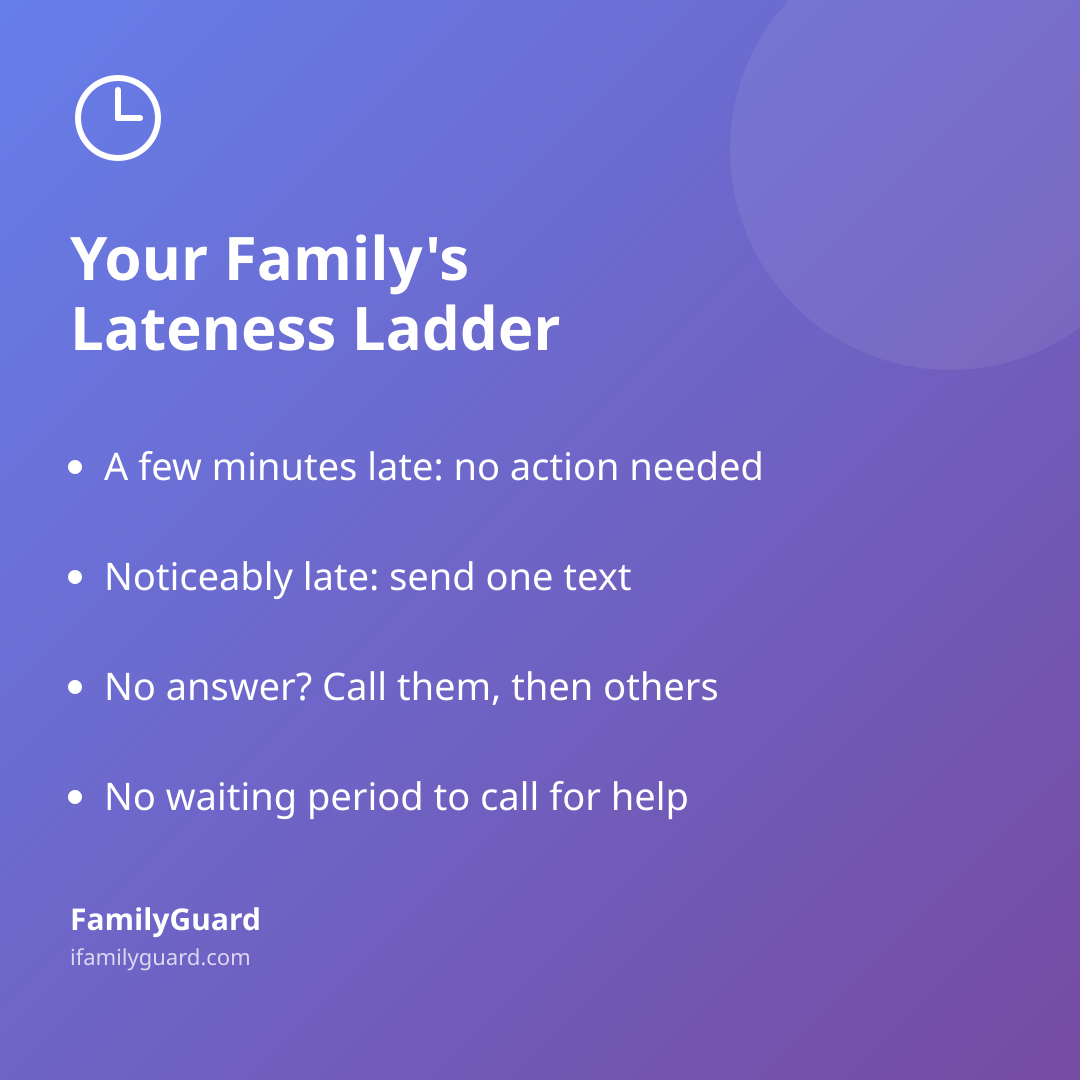
Rather than one fixed rule like "call the police after an hour," most families do better with a few graduated steps, each with its own simple trigger. You can adjust the exact minutes to fit your family and the situation — a teen driving home from a friend's house is different from a nine-year-old walking from the bus stop.
- Step 1 — A few minutes late: No action needed. This is the normal buffer for traffic, lines, or a slow goodbye.
- Step 2 — Noticeably late: Send one low-pressure text: "Running behind? Let me know when you can." This isn't an interrogation — it's a check-in that's easy to answer with one word.
- Step 3 — No response after a reasonable window: Call directly. If there's no answer, call a sibling, friend, or whoever else was with them, and check the last known location if you share one.
- Step 4 — Still nothing, and the situation doesn't add up: Trust that feeling. Retrace the plan — where they were supposed to be, who they were with — and don't hesitate to involve another trusted adult or, if genuinely worried, local authorities.
Having these steps agreed on in advance means nobody has to improvise a decision tree in the middle of a worried moment. It also means a late teenager knows exactly what's going to happen if they don't check in, which is often enough motivation on its own.
The myth that keeps people waiting too long
One piece of this that's worth stating clearly, because it's widely misunderstood: there is no mandatory waiting period before you can report a missing child or ask for help. The idea that you have to wait 24 hours is a persistent and dangerous myth. The National Center for Missing & Exploited Children advises that the moment you're unable to locate your child and determine they're missing, the right move is to call your local law enforcement agency immediately — not after waiting any set number of hours.
The U.S. Department of Justice's Office of Juvenile Justice and Delinquency Prevention makes the point even more explicitly in its long-standing family guide: parents should immediately report a missing child to local law enforcement, and "there is no waiting period" for entering a child's information into the national missing-persons database (NCIC) for children under 18. In other words, the ladder above is for your own peace of mind — it's never a reason to delay getting real help if something feels genuinely wrong.
Take the guesswork out where you can
A lot of the anxiety in "where are they" moments comes from not having any information to work with — just silence. This is where a bit of shared visibility, used with everyone's knowledge and consent, earns its keep. Seeing that a phone's battery died an hour ago rather than just now, or that someone is sitting still at a friend's house rather than nowhere near their usual route, changes a moment of dread into a reasonable "oh, that makes sense."
This is exactly the kind of situation FamilyGuard is built for: within-the-family, consent-based location sharing and smart zones that quietly note when someone has arrived somewhere or left, plus a device and battery status that explains a lot of "why aren't they answering" moments before they become scary ones. It's not about watching every move — it's about having one less unknown in a moment that already has enough of them.
After it's resolved, talk about it without blame
Once everyone's accounted for and the relief has set in, resist the urge to turn the moment into a lecture. A short, calm conversation works better than a scolding: "I was starting to worry — next time, can you shoot me a quick text if you know you'll be running behind?" This keeps the door open for the next time they're late, instead of teaching them to avoid telling you because they're worried about the reaction.
If the delay happened because of something that felt uncomfortable or unsafe, that's worth a longer conversation — but separate it from the logistics conversation about communication, so neither gets lost in the other.
A calmer way to wait
Lateness is one of those small, recurring moments where a little bit of preparation goes a long way. A shared sense of "here's what normal delay looks like, here's what we do if it goes past that, and here's that we never wait to get help if we're truly worried" turns a stressful guessing game into a simple, familiar routine. Most of the time, you'll use the first step and nothing more. But knowing the rest of the ladder is there — and that help is never gated behind a waiting period — is what lets you stay calm in between.