There's a particular kind of pride on a kid's face the first time they walk to school without a parent trailing a few steps behind. It's a small milestone that says: I know this route, I can handle it, and you trust me to. Getting there takes a little more than just pointing them toward the sidewalk, though. A short family planning session — walking the route together, agreeing on a few rules, and deciding how you'll both feel at ease along the way — turns that first solo walk into something calm instead of nerve-wracking.
The good news is that walking and biking to school is genuinely good for kids, and the safety side of it is very manageable with a little preparation. Here's how to build a plan that works for your family.
Why This Is Worth Planning, Not Just Allowing
Child pedestrian deaths are rarer than many parents assume, but they're not nothing: 172 child pedestrians were killed in traffic crashes in 2024 — about 17% of all children killed in crashes that year — according to the National Highway Traffic Safety Administration's 2024 data on child traffic deaths. That's not a reason to keep kids off the sidewalk; most of that risk clusters around predictable moments: busy intersections, low visibility, and kids crossing mid-block without checking traffic. A short walk-through of the actual route your child will take removes most of that uncertainty before it ever becomes a problem.
Timing matters too. Across all ages, NHTSA's 2024 pedestrian crash data shows that 24% of pedestrian deaths happen between 6 and 9 p.m. — the single most dangerous three-hour window of the day — and nearly three-quarters occur after 6 p.m., once daylight fades. The practical takeaway for a family walking plan is simple: a route that's perfectly safe in September can start overlapping with those low-visibility hours as afternoons get darker earlier in the year. It's worth rechecking both the route and what your child wears as daylight shifts.
Walk the Route Together First
Before your child walks or bikes the route solo, walk it with them — more than once, at the actual time of day they'll be doing it. You're not just checking it's safe in general; you're teaching them to read it.
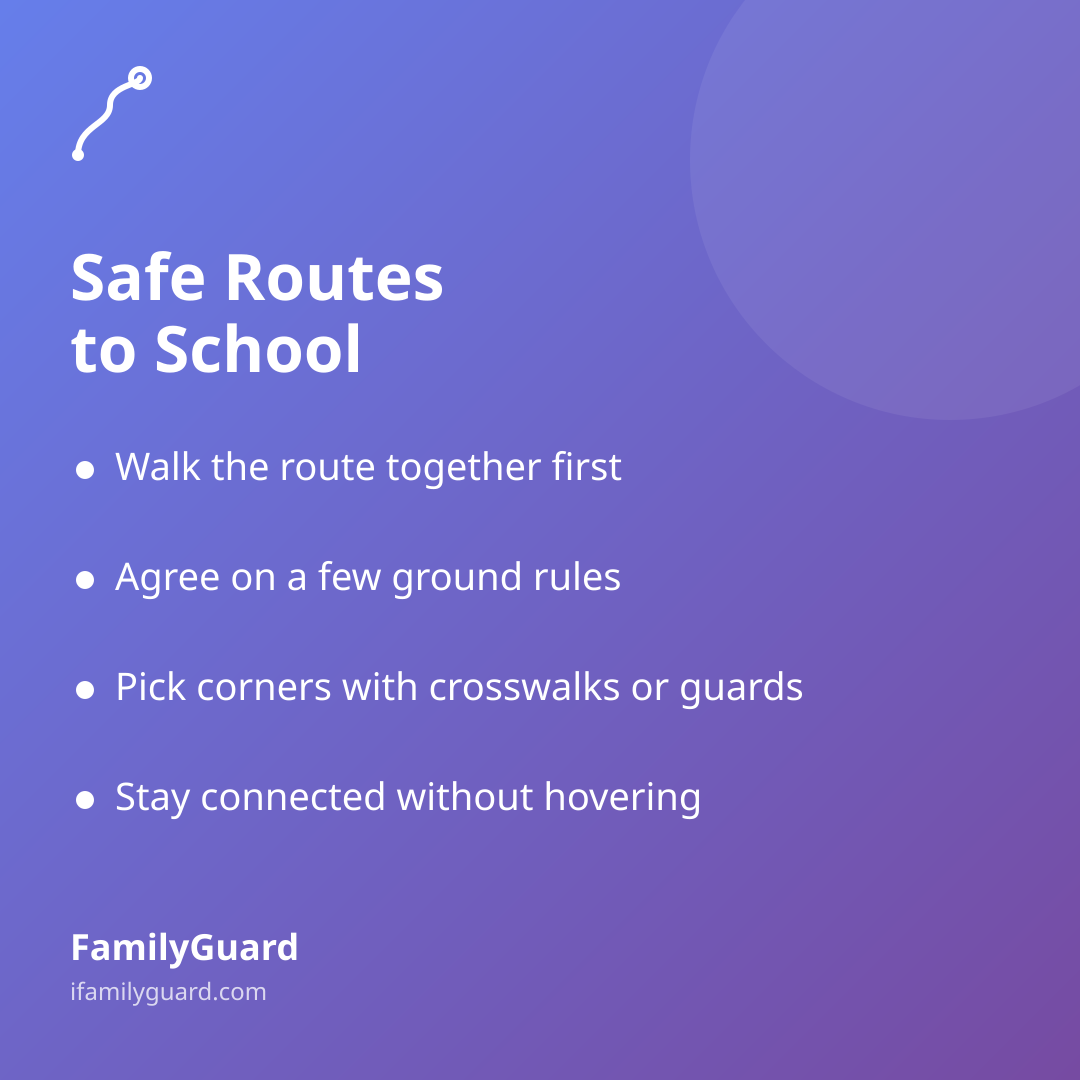
- Pick the crossing points together. Choose the corners with crosswalks, signals, or crossing guards, even if it adds a few minutes. Teach the habit of looking left, right, then left again, and making eye contact with drivers before stepping off the curb.
- Notice where sidewalks run out. If part of the route has no sidewalk, practice walking facing oncoming traffic rather than with their back to it.
- Identify a few "safe spots." A friendly neighbor's house, a store, a school crossing guard — places your child could go if they ever felt uneasy or needed help.
- Talk about distractions. Earbuds in one ear only (or none at all) and phones away while crossing streets — not because something is likely to go wrong, but because full attention is what prevents it.
- Agree on what to wear. Bright colors or a light-colored backpack make a real difference for visibility, especially as mornings and afternoons get darker later in the year.
Most pediatric safety guidance, including from the American Academy of Pediatrics, suggests waiting until kids are around 10 years old before they cross streets entirely unsupervised — younger children are still developing the depth perception and impulse control needed to judge a car's speed and distance reliably. That's a general guideline, not a hard rule; you know your own child's judgment best.
Set a Few Ground Rules, Not a Long List
A short, memorable plan beats a long one nobody follows. Three or four rules are usually enough:
- The route is the route — no shortcuts through alleys, parking lots, or unfamiliar streets, even on a whim.
- If plans change (a friend invites them somewhere, practice runs late), they check in before changing course, not after.
- A buddy is better than walking alone, especially for younger kids or less-traveled stretches.
- If something ever feels wrong, their job is to get to a safe spot and get help — not to handle it alone.
Revisit the plan occasionally, especially after a change in season, a new crossing guard schedule, or a shift in daylight hours. A route that felt safe in September can feel different once it's dark at 5 p.m.
Staying in the Loop Without Hovering
Part of what makes a first solo walk feel safe for parents is simply knowing it went as planned — not watching every step of it. A quick text or call when they arrive is the simplest version of this. Some families set up a shared smart zone so everyone gets a quiet, automatic heads-up when their child arrives at school or gets home, without needing a check-in text every single day. Apps like FamilyGuard build this on consent — your child knows the zone is there, and it's set up together, not switched on behind their back. The goal isn't to track every footstep; it's to replace "are you there yet?" texts with a quiet confirmation that lets both of you get on with your day.
That transparency matters. Kids are far more likely to stick with a safety plan — and come to you if something goes wrong — when they understand what's being shared and why, rather than feeling watched. Frame it as "we both get peace of mind," not "I'm checking up on you."
When the Route Includes Biking
If part of the commute is on a bike or scooter rather than on foot, the same walk-through principle applies: ride the route together first, identify the trickiest intersections, and confirm a helmet is non-negotiable. A 2013 study in the journal Pediatrics by researchers at Columbia University's Mailman School of Public Health examined a decade of New York City crash data and found that neighborhoods with Safe Routes to School improvements — new traffic signals, marked crossings, speed bumps — saw a 33% drop in the annual pedestrian injury rate for school-age children, while the rate stayed flat in neighborhoods without the program. If your school doesn't have a formal program, you can borrow the same idea informally: agree on one consistent route, know its trouble spots, and treat it like something worth revisiting as conditions change.
A Milestone Worth Celebrating
The first unaccompanied walk to school is a genuine step toward independence, and it's worth treating it that way — with a plan, a bit of practice, and a quiet way to stay connected, rather than anxiety on one side and no structure on the other. Most mornings will be completely uneventful. That's the point: a good plan makes the ordinary walk stay ordinary, and gives both of you room to relax into the new routine.