If you ask most kids "is anyone bothering you online?" the answer will almost always be "no." Not because nothing's happening, but because that question is too big, too direct, and a little bit scary to answer honestly. Cyberbullying tends to live in the quiet corners — a group chat someone got removed from, a comment that stings more than it should, a username that keeps popping up where it shouldn't. The good news is that you don't need to read every message to notice when something's wrong. You just need to know what to watch for, and how to talk about it in a way your child can actually meet you halfway on.
Why It's Easy to Miss
Cyberbullying is more common than most parents realize, and more hidden than most parents expect. According to a Pew Research Center study (2022), 46% of U.S. teens ages 13 to 17 say they've experienced at least one of six forms of online harassment, most commonly offensive name-calling or having false rumors spread about them. Older teen girls reported the highest rates, at 54% for ages 15–17, compared with 44% of boys the same age. Yet the same report found many teens don't tell a parent right away — often because they worry it will mean losing their phone or their friendships, rather than getting help.
That gap between what's happening and what gets said out loud is exactly why open communication matters more than surveillance. A child who feels safe telling you the messy, embarrassing, or upsetting parts of their online life is protected in a way that no amount of password-checking can replicate.
The Quiet Signs Worth Noticing
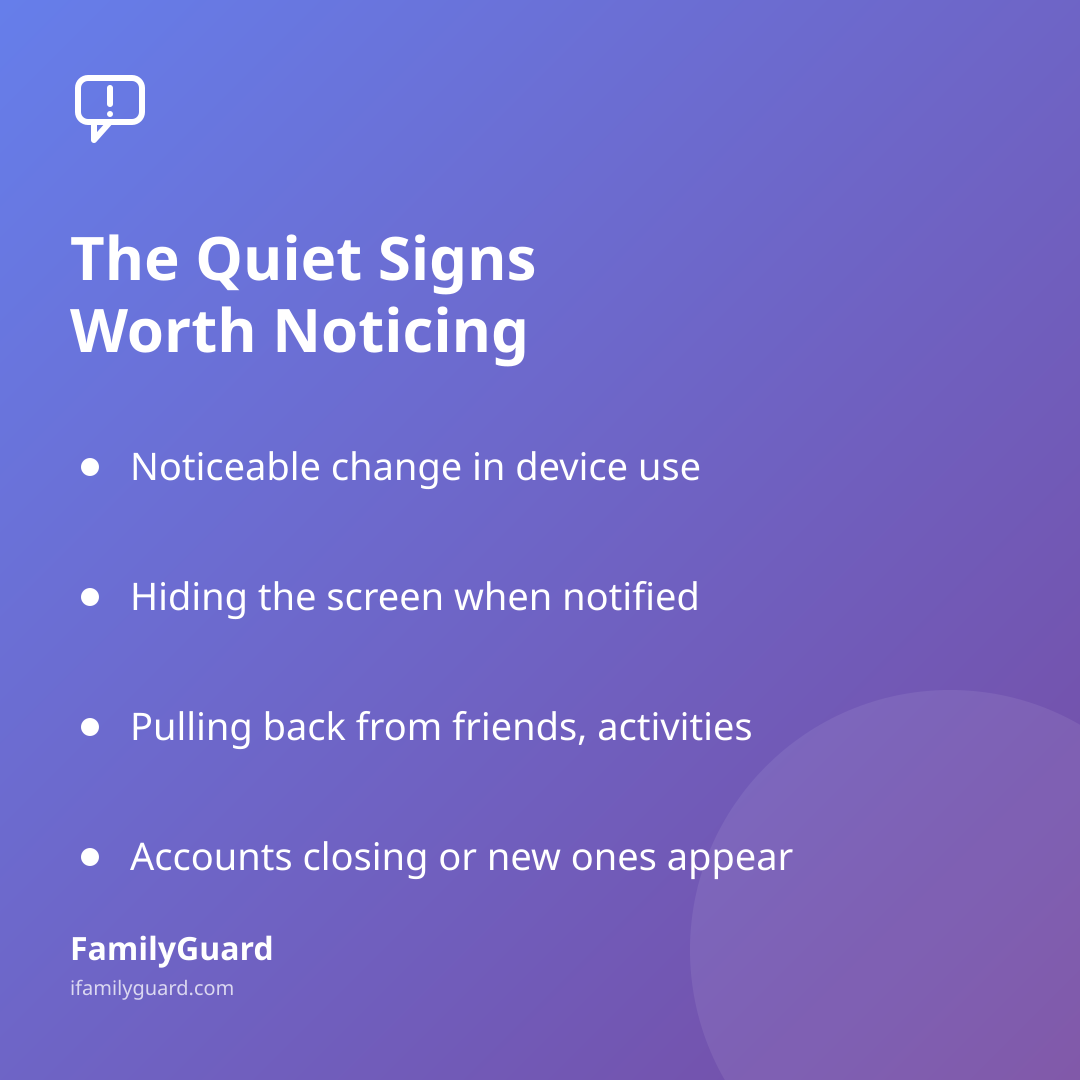
You don't need to monitor every notification to catch early signs something's off. According to StopBullying.gov, the federal government's bullying-prevention resource, the warning signs tend to cluster around sudden shifts in behavior rather than any single red flag:
- A noticeable increase or decrease in phone or device use
- Strong emotional reactions — laughing, anger, or visible upset — right after checking a device
- Hiding the screen or leaving the room when a notification comes in
- Social media accounts closing suddenly, or new ones appearing without explanation
- Pulling back from activities, friend groups, or school events they used to enjoy
- Becoming withdrawn, low, or uninterested in people and activities they used to care about
None of these signs confirm cyberbullying on their own — plenty of them just mean "being a teenager." But a cluster of them, especially a change that seems tied to device use, is worth a gentle check-in rather than a dismissal.
Starting the Conversation, Not the Interrogation
The way you open the conversation matters almost as much as the fact that you're having it. A few things tend to help:
- Ask about others before asking about them. "Has anyone in your class had something mean said about them online?" is an easier entry point than "is someone bullying you?" It gives your child room to talk about the topic without immediately feeling exposed.
- Pick a low-stakes moment. Car rides, walks, or side-by-side chores tend to produce more honest conversation than a sit-down "we need to talk."
- Lead with curiosity, not alarm. A calm "that sounds like it stung — want to tell me more?" keeps the door open. A big emotional reaction from you, even out of love, can make a child feel like they need to protect you from the news.
- Separate the problem from the punishment. Many kids stay quiet because they fear losing their phone will be the consequence of speaking up. Make it clear, out loud, that telling you about a problem will never be the reason the phone disappears.
If You Learn Something's Wrong
When a child does open up, the instinct to immediately fix it — message the other parent, call the school, delete the app — is understandable, but worth pausing on. Start by listening fully before acting. Ask what they've already tried and what outcome they actually want; sometimes it's your help, sometimes it's just to be heard. From there, most situations benefit from a few practical steps: saving screenshots as a record, blocking or muting the person involved together, and looping in the school or platform if the behavior is ongoing or severe. StopBullying.gov also outlines how to report harmful content directly to most major platforms, which can resolve things faster than waiting it out.
Building a Home Where Kids Want to Talk
The strongest protection against cyberbullying isn't a setting you switch on — it's the ongoing sense that home is a safe place to land when something online goes wrong. That's built slowly, through everyday moments rather than one big talk.
Some families find it helps to have a low-pressure way to stay in touch throughout the day, separate from constant check-in texts that can feel like pressure rather than connection. A shared family chat — the kind built into an app like FamilyGuard — can work well for this, since it's a space the whole family already uses for ordinary things, which makes it a more natural place for a kid to drop in something that's bothering them, on their own terms.
Ultimately, kids who are bullied online recover best when they already know, without question, that bringing it to you won't make things worse. That certainty is worth more than any filter or setting.