
There's a particular kind of quiet that fills a house the first time your teen drives off alone. No instructor in the passenger seat, no parent in the back giving directions — just your kid, the keys, and a car full of trust you've been building for months. It's a proud moment. It's also, for most parents, a little terrifying.
That mix of pride and nerves is completely normal, and it doesn't mean you've done anything wrong in how you've prepared them. It usually just means you're paying attention to something that genuinely carries risk. The good news is that a little planning — done together, out loud, before the keys ever leave your hand — can turn that first solo drive from a source of anxiety into a shared milestone.
Why the first few months matter so much
It helps to understand, in plain terms, why parents of new drivers feel the way they do. According to the U.S. Centers for Disease Control and Prevention (CDC), the risk of a motor vehicle crash is higher among teens ages 16–19 than any other age group, and per mile driven, teen drivers in that age range have a fatal crash rate nearly three times that of drivers 20 and older.
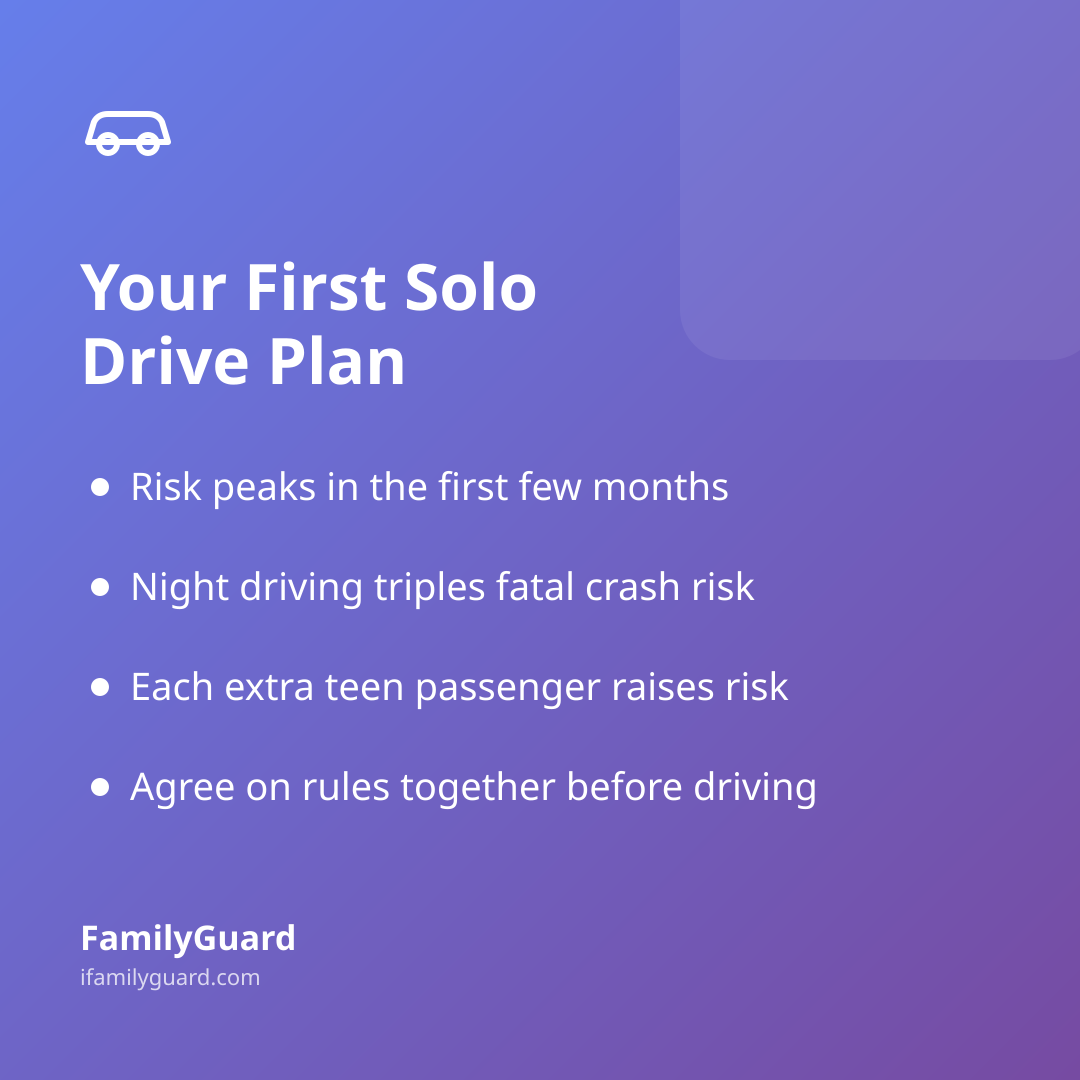
The CDC also notes that this risk is not evenly spread across a teen's driving life — it tends to be highest in the first months after getting a license, while skills like hazard recognition and split-second judgment are still developing. Two specific situations stand out in the CDC's research on teen driver risk factors:
- Nighttime driving: the fatal crash rate at night for teen drivers is about three times as high as it is for adult drivers ages 30–59, per mile driven.
- Driving with teen passengers: the presence of teen or young adult passengers increases crash risk for an unsupervised teen driver, and that risk rises with each additional young passenger in the car.
None of this is meant to scare you — it's simply why so many states build nighttime and passenger limits into graduated licensing programs, and why it's worth having a clear family plan rather than leaving things to chance. Knowing where the risk concentrates lets you focus your rules where they'll actually help, instead of over-restricting everything.
Have the conversation before the first drive, not after
The best time to agree on ground rules is while you're both calm — not in the driveway with the engine already running. A short, honest conversation works better than a list of rules handed down from above. Try framing it as teamwork: you want them to have real independence, and you want to feel at ease while they build it.
Some questions worth working through together:
- What times of day are okay for solo driving at first, and when will that expand?
- How many passengers, if any, are allowed in the first few months?
- What's the plan if the car breaks down, a warning light comes on, or the weather turns bad?
- How and when will they check in — a text on arrival, a call if plans change?
- What happens if they're running late?
Letting your teen help set these answers, rather than just receiving them, tends to make the rules stick better — and it respects that they're a young adult learning to manage real responsibility, not a child being supervised.
Check-ins that build trust instead of friction
"Text me when you get there" is a reasonable starting point, but it puts the whole burden of reassurance on your teen remembering to send a message — easy to forget in the middle of parking, saying goodbye to friends, or just being a teenager. A shared, consent-based way to see that the car has arrived safely can take the pressure off both sides.
This is where a family safety app like FamilyGuard can genuinely help, not as a way to watch your teen's every move, but as a quiet backup to the conversation you've already had. With location sharing agreed on by everyone in the family, a quick glance at the family map can confirm they made it to practice without a text exchange, and smart zone alerts can let you know the moment the car pulls into the school lot or back into the driveway — no secrecy involved, just a shared view everyone in the family has agreed to.
The key word there is agreed. If your teen feels like sharing their location is being done to them, it breeds resentment. If it's something you set up together, as part of earning more independence, it becomes a tool that benefits everyone — including your teen, who can also check that you got home safely from work.
A few habits that make a real difference
Beyond check-ins, a handful of simple habits tend to have an outsized effect on safety in those early months:
- Phone away while driving. Agree in advance that the phone goes in a bag or glovebox, not the console, and that check-in texts happen before the car starts moving or after it's safely parked.
- A passenger limit. Many graduated licensing laws already restrict non-family passengers for new drivers — it's worth following your state's rule even if friends push back.
- A short list of "call home, no questions asked" situations. Car trouble, feeling unsafe, bad weather, a passenger who's been drinking — anything on this list gets an immediate pickup and zero lecture in the moment.
- Practice the boring stuff. Checking tire pressure, knowing where the spare tire and jack are, pumping gas, using a map app without staring at the phone — these small competencies reduce panic when something unexpected happens.
- Review, don't relitigate. After the first few solo drives, have a short, low-pressure check-in: what felt fine, what felt stressful, does anything need to change.
Letting the rules loosen as trust grows
The goal of all of this isn't to keep your teen on a short leash forever — it's to get them safely through the riskiest stretch so independence can keep expanding. As the weeks and months go by without incident, most families naturally extend curfews, allow more passengers, and check in less often. That's the plan working, not the plan being abandoned.
It helps to say that out loud too: "These rules are tighter right now because the first few months are the highest-risk ones — they'll ease up as you get more experience." Framing it as temporary and tied to skill, rather than permanent and tied to distrust, makes the whole arrangement easier for a teen to accept.
The bottom line
Handing your teen the keys for the first solo drive is a milestone worth celebrating, even while it keeps you a little on edge. A calm conversation beforehand, a shared understanding of where the real risks are, and a simple, consent-based way to check in can turn that nervous first drive into the start of a confident, trusted new chapter — for both of you.