
This week brought a mix of big promises and familiar warnings. Governments and AI companies put their names to a new safety pledge, Meta widened its net for teens who hide their real age online, and two very different companies — a rideshare giant and a video game publisher — both had to send breach notices because of trouble at outside vendors. None of it is cause for panic, but each story carries a practical takeaway for families. Here's what mattered between November 9 and 15, 2026.
AI & New Tools
A global AI safety pledge, with no teeth yet. On November 9, sixteen governments, ten AI companies (including Anthropic, OpenAI, Microsoft, and Mistral AI), and several civil-society groups signed the Paris Call for AI Safety and Security. Signatories committed to publishing safety evaluations of powerful AI models, building in "shutdown" mechanisms, and sharing warnings quickly if something goes wrong. Why it matters for families: this is a political promise, not a law — there are no deadlines or penalties attached. It's a good sign the industry is talking seriously about guardrails, but it doesn't replace the settings and conversations you control at home.
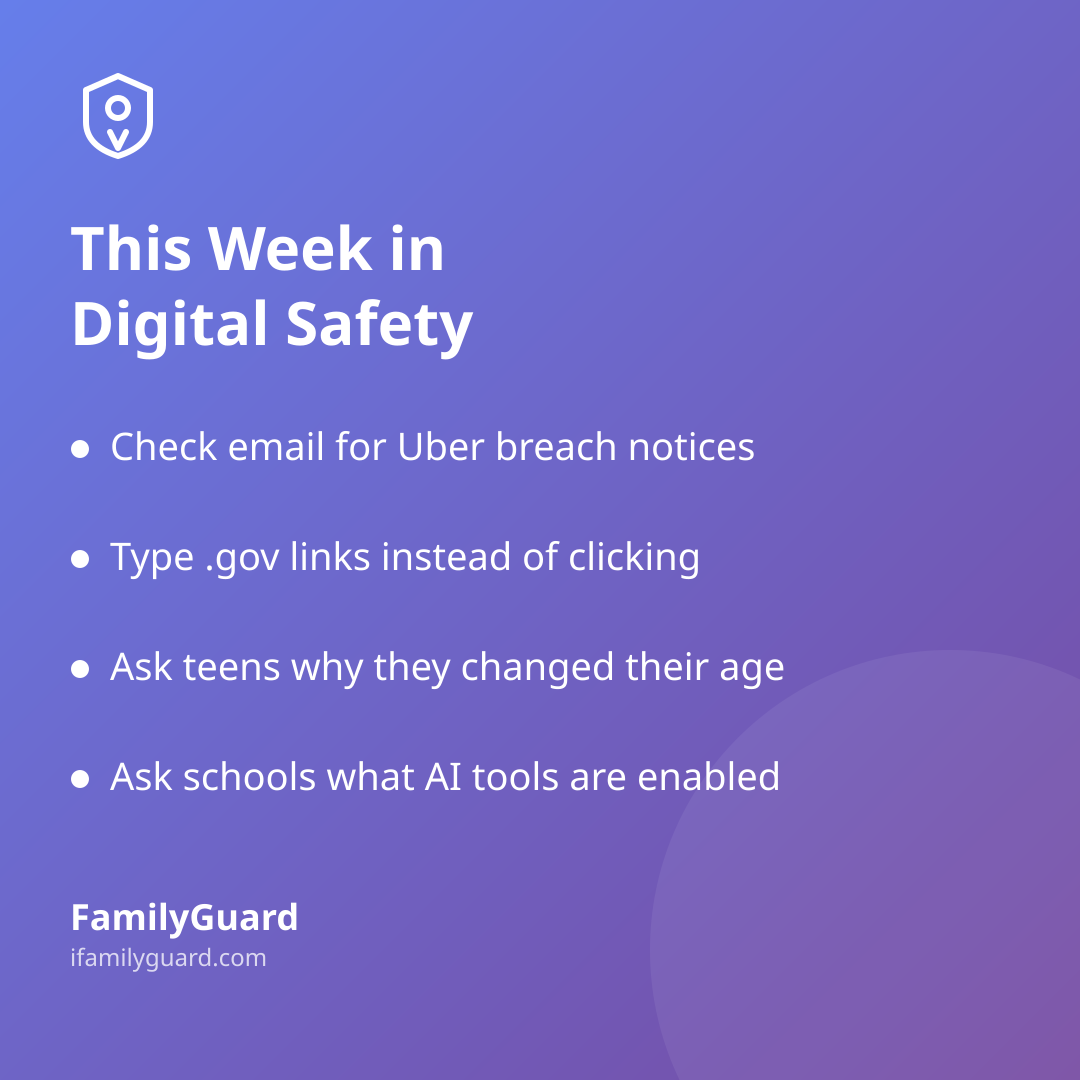
Meta widens its AI age-detection net. Meta announced it is rolling out its AI age-estimation technology worldwide on Instagram, using contextual clues — not just the birthday a user typed in — to find accounts likely run by teens, even when an adult age was listed. Flagged accounts are automatically moved into Teen Account protections, which include private-by-default profiles, restricted messaging, and content filters, with parents able to approve or deny requests to loosen those settings. Why it matters: it's a useful backstop, but it works best alongside an honest conversation — ask your teen why they listed a different age, rather than letting a setting do the talking for you.
Cybersecurity & Threats
Uber confirms a breach tied to an AI vendor. Uber confirmed this week that a breach at third-party technology provider Fireworks AI exposed driver's license information for thousands of U.S. drivers, with notification letters going out to affected states beginning November 10. Uber says it has cut data connections with the vendor and has not found evidence the stolen data has been misused, according to Cyber Security News. Why it matters: most breaches today start with a trusted outside vendor, not the company itself. If anyone in your family drives for or uses a rideshare app, watch your email for an official notice and treat any unexpected "verify your account" message with caution.
SEGA's newsletter vendor exposes millions of email addresses. SEGA confirmed on November 9 that an attack on its email-marketing vendor, Arara, exposed about 2.19 million customer email addresses. Names, passwords, and payment details were not included, according to Cyber Security News. Why it matters: expect a bump in phishing emails pretending to be from SEGA or its games in the coming weeks. If your kids have a gaming account on file, remind them that a legitimate company will never ask them to click a link to "verify" their password.
The FTC warns about fake FTC websites. On November 12, the FTC issued a consumer alert about scammers building lookalike agency websites and posing as FTC staff. The agency says Americans lost about $3.5 billion to imposter scams of all kinds in 2025, with scams impersonating government agencies specifically accounting for roughly $920 million of that total, according to the FTC's consumer alert. Why it matters: these same tricks target parents and grandparents through phone calls and texts claiming money needs to be "recovered" or a benefit is about to be cut off. Type government web addresses in directly instead of clicking a search ad or link — real FTC pages always end in .gov — and remember real agencies never demand instant payment or secrecy.
Online Safety & Privacy
A lawsuit raises hard questions about AI chatbots on school devices. This week, coverage grew around a lawsuit filed by a North Carolina family against Google, alleging that their 13-year-old's months of conversations with the Gemini chatbot on a school-issued Chromebook touched on self-harm before any safeguard intervened. Google has said it is reviewing the claims. Details via Dataconomy. Why it matters: school-issued devices often come with their own AI tools and monitoring rules that differ from whatever parents set up at home. It's worth asking your child's school what AI features are enabled on their devices and what, if anything, is monitored. If your own child ever mentions thoughts of self-harm, treat it as urgent and reach out to a trusted doctor, school counselor, or a crisis line right away — no app or filter is a substitute for that conversation.
Apple tightens the rules on AI "companion" apps. Apple's updated App Store policy, announced November 3 and beginning to phase in from November 16, requires AI companion and dating apps that offer romantic or sexual content to carry an 18+ rating and clearer content labels; full compliance is required by January 12, 2027, according to TechCrunch. Why it matters: AI companion apps can look like harmless chat apps at a glance. The new labeling makes it easier to spot one on your child's phone — a good prompt to sit down this week and check age ratings on anything with a chat "friend" feature installed.
This week's takeaway for families
- Check your inbox for any official breach notice from services your family uses — rideshare, gaming accounts, retail newsletters — and reset passwords or turn on two-factor authentication wherever you haven't already.
- Before trusting a call, text, or website claiming to be from a government agency or company, go directly to the official site or number instead of clicking a link, and talk to older relatives about doing the same.
- Take a few minutes to see what AI chat features exist on your kids' devices, including school-issued ones, and ask what oversight is in place. Whatever tools your family relies on for safety — whether that's a school's monitoring software or something like FamilyGuard for everyday location check-ins — work best when your kids know they're being used, and why.
Sources
- French Ministry for Europe and Foreign Affairs — Paris Call for AI Safety and Security (2026)
- Meta — Expanding Teen Account Protections to Teens Around the World (2026)
- Cyber Security News — Uber Confirms Data Breach (2026)
- Cyber Security News — SEGA Confirms Data Breach After Third-Party Email Provider Exposes 2.19 Million Customer Email Addresses (2026)
- Federal Trade Commission — How to Spot Fake FTC Websites and FTC Impersonators (2026)
- Dataconomy — Lawsuit Says Gemini Missed Teen's Suicide Crisis For Months (2026)
- TechCrunch — Apple Restricts Dating Apps and AI Companions to Users 18 and Up (2026)