
Between October 12 and 18, 2026, the biggest families-and-technology story wasn't one dramatic headline — it was a pattern. AI tools got better at catching scams this week, even as the FBI warned that scammers are using those same kinds of AI tools to fool people. Meanwhile, courts and researchers kept wrestling with how to make social media safer for kids, and a few new family gadgets were announced. Here's what actually happened, and what it means for your household.
AI & New Tools
This week's AI news cut both ways — new defenses arrived just as new scam tactics made headlines.
- Android gets AI-powered scam defenses. On October 14, Google announced a wave of Gemini-driven scam protections for Android: an opt-in "Enhanced protection" mode in Google Messages that flags slow-building scam conversations, real-time AI checks on unfamiliar links, and screen-share privacy that hides passwords and banking details during video calls. A feature that blocks apps from quietly redirecting your calls is set to follow in December on Pixel and other select devices. Source: Google. Why it matters for families: most of these protections work automatically once enabled — worth checking, over the next few weeks, that they're switched on for both your phone and your teen's.
- Google's newest AI model, Gemini 4 Argon, goes global. Google DeepMind made its latest model broadly available to developers and subscribers on October 13. Source: Google DeepMind. Why it matters for families: this is the kind of model likely to power the homework helpers, chatbots, and search tools your kids already use — it's worth keeping an eye on how (and whether) the apps in your house label AI-generated answers.
Cybersecurity & Threats
Several stories this week are reminders that scams and data exposure increasingly ride on AI realism and everyday accounts — here's how to respond defensively, not how any of it works.
- FBI and CISA warn of AI-cloned voices and images in election-season scams. On October 16, the FBI and the Cybersecurity and Infrastructure Security Agency issued a joint warning that scammers are using AI-generated voices, images, and messages to impersonate political campaigns and government officials, tricking people into handing over money or personal data. Source: Help Net Security. Why it matters for families: the same cloning techniques show up in "grandchild in trouble" or "urgent money" calls. A simple family rule — never send money or verify identity based on a phone call alone, always call back on a known number — protects everyone, including grandparents.
- A grocery loyalty program breach touched family data. Pattison Food Group confirmed on October 16 that customer data — including names, addresses, phone numbers, emails, and birth dates — was accessed in a breach of its More Rewards loyalty database, used by Save-On-Foods and several other Canadian grocery chains. Source: CTV News. Why it matters for families: loyalty programs often hold more personal detail than people realize. If your family shops at an affected store, watch for phishing emails or texts that reference your real name or order history — they'll look more convincing than usual.
- A wearable heart monitor maker disclosed a breach affecting up to 8.2 million people. iRhythm Technologies, which makes cardiac monitoring devices often used by older relatives, began notifying patients in early October about a breach exposing names, birth dates, insurance numbers, and device details. Source: BankInfoSecurity. Why it matters for families: many households manage health accounts on behalf of aging parents — it's a good week to check if anyone in your family received a notice and to set up a credit freeze or fraud alert if so.
Online Safety & Privacy
The debate over how to protect kids online without overreaching kept moving this week, with developments pulling in different directions.
- Florida can now enforce its under-14 social media ban. On October 14, a federal appeals court lifted an injunction, clearing the way for Florida to enforce a law barring social media accounts for children under 14 and requiring parental consent for 14- and 15-year-olds. Source: CBS News Miami. Why it matters for families: if you're in Florida, expect more platforms to ask for age or parental verification soon. Elsewhere, it's a sign more states may follow with similar age rules.
- Research shows many teens find ways around age bans anyway. A report covered by MIT Technology Review on October 16 found that roughly four in five teens under 16 still manage to access age-restricted platforms, often using workarounds like a sibling's face or a parent's ID to pass identity checks. Source: MIT Technology Review. Why it matters for families: laws and age gates are one layer, not the whole plan. Ongoing conversation about what your child sees and does online still matters more than any single rule.
Notable in Tech
Two new devices announced this week were built with families specifically in mind.
- Apple unveiled its first smart home display, HomeView. Announced October 13 and set to go on sale November 13 for $299, the device uses facial recognition to personalize its screen for up to six household members, showing each person their own calendar and reminders; Apple says sensitive content only appears when the recognized person's own paired phone is nearby and unlocked. Source: CNBC. Why it matters for families: shared home devices that recognize individual family members are becoming more common — it's worth reviewing, ahead of launch, what each person's profile can see and who else is in the room when sensitive information pops up.
- Amazon's new Kids Tablets with Google Play access started shipping. First unveiled October 8 and shipping to US customers from October 14, the Kids Tablet 8 and Kids Tablet 11 run standard Android instead of Amazon's older Fire software, pairing a much larger app library with a parent dashboard for approving app downloads, setting bedtimes, and managing screen time. Source: About Amazon. Why it matters for families: opening up Google Play means kids now have access to far more apps than before — the approval step in the parent dashboard becomes more important, not less.
This week's takeaway for families
Three small habits cover most of what this week's news points to:
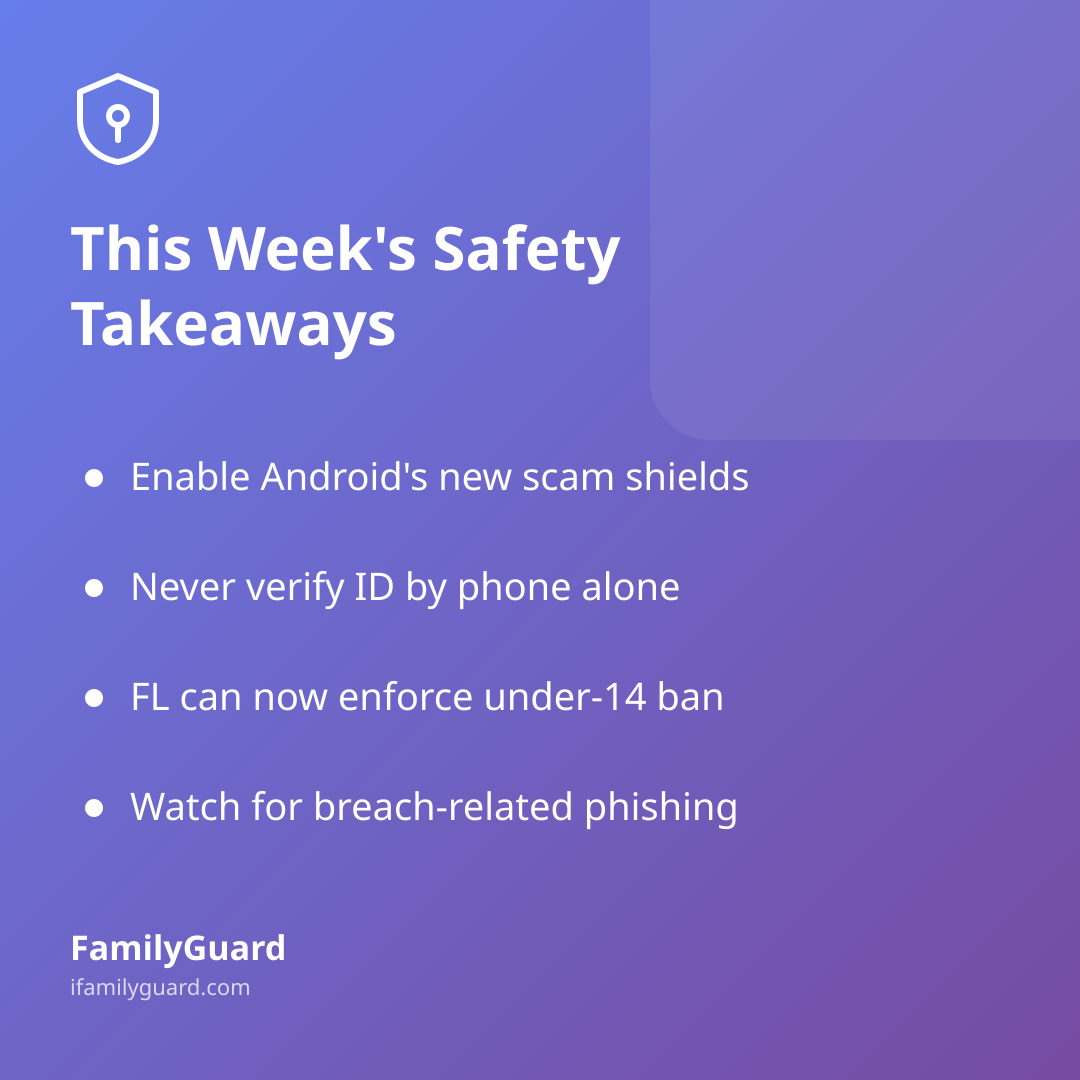
- Agree on a verification habit, not just a password. With AI voice and video cloning in the news again, a simple rule — always call back on a known number before acting on an urgent request for money — is more useful than memorizing scam patterns. Some families also keep a shared check-in habit or a family safe word for exactly this kind of moment, which is part of why apps like FamilyGuard focus on consent-based, within-the-family communication rather than one-way monitoring.
- Check for breach notices before assuming "it won't be us." If your family shops at an affected grocery chain or uses an affected medical device, look for an official notification email and follow its instructions rather than searching for one yourself.
- Treat new age rules as a starting point, not a finish line. Whether or not your state has an age-verification law yet, the real safeguard is still an ongoing, judgment-free conversation with your kids about what they're seeing and doing online.

Sources
- Google — New Android protections to help keep you safe from mobile scams (2026)
- Google DeepMind — Gemini 4 Argon Model Card (2026)
- Help Net Security — Scammers clone candidates' voices to steal cash and voter data ahead of 2026 midterms, FBI warns (2026)
- CTV News — More Rewards customers' data accessed in a cybersecurity breach (2026)
- BankInfoSecurity — Cardiac Monitoring Firm iRhythm's Hack Affects 8.2 Million (2026)
- CBS News Miami — Appeals court lets Florida enforce social media ban for kids under 14, overturning injunction (2026)
- MIT Technology Review — Kids are outsmarting social media bans. That's not a problem we need to solve. (2026)
- CNBC — Apple releases HomeView smart home hub with screen as showcase for Siri AI (2026)
- About Amazon — New Amazon Kids Tablets take the guesswork out of screen time for parents (2026)