If you have more than one child, you've probably heard it: "Why does she get to walk to the store alone and I couldn't at her age?" or "How come he doesn't have to share his location and I do?" Siblings compare notes constantly, and when the rules don't match, it can sound like proof of favoritism — even when it isn't.
The good news is that different rules for different ages aren't unfair. They're actually the whole point of parenting well. The challenge isn't deciding whether to treat your kids differently — you already do, because they're different people at different stages. The challenge is explaining that difference in a way that lands as care rather than comparison.
Different Rules Aren't Favoritism — They're Development
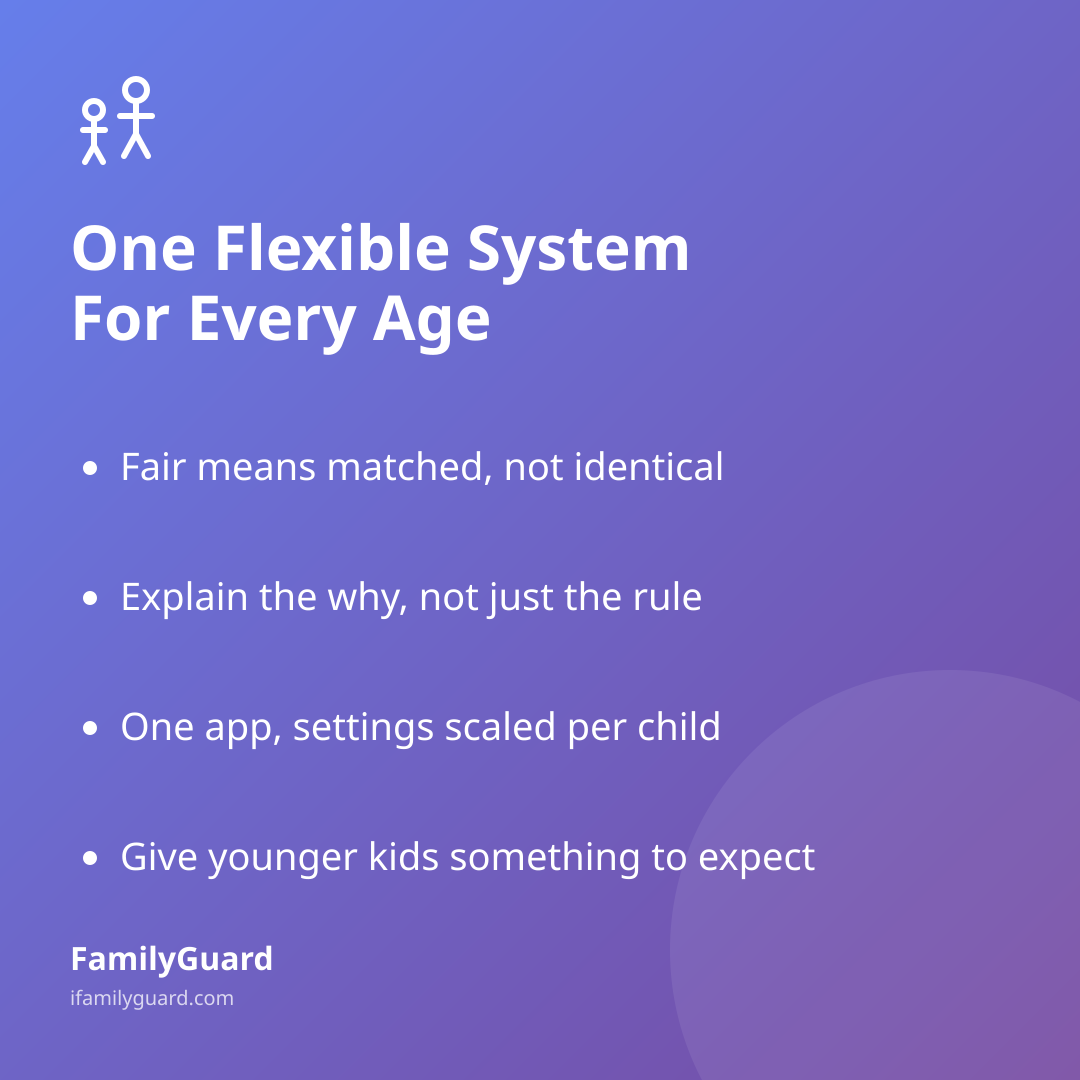
It helps to say this out loud in your house: fair doesn't mean identical. It means each child gets the level of freedom and support that matches who they are right now.
This isn't just a parenting hunch — it's backed by how families actually adjust monitoring as kids grow. A March 2024 Pew Research Center survey found that 62% of parents of 13- to 14-year-olds say they limit how much time their teen can spend on their phone, compared with 37% of parents of 15- to 17-year-olds. A similar pattern shows up in monitoring habits: 64% of parents of younger teens say they look through their teen's phone, versus 41% of parents of older teens. In other words, scaling back oversight with age isn't a quirk of your family; it's the norm across American households.
The American Academy of Pediatrics makes a similar point about independence more broadly: even preschoolers benefit from small, age-matched freedoms — a routine they manage themselves, a choice they get to make — because independence grows in stages, not all at once. Your 9-year-old and your 15-year-old aren't at the same stage, so it makes sense that their rules aren't either.
What Actually Changes Between a Younger Child and a Teen
It helps to get specific about what's shifting, since "you'll understand when you're older" rarely satisfies anyone. A few things typically change as a child moves from elementary school into the teen years:
- How much location detail is shared. A younger child's day is mostly predictable — home, school, a friend's house you know well. A teen's day involves more unsupervised stretches, so ongoing sharing matters more, not less, even as their privacy needs grow.
- Who initiates check-ins. Younger kids usually need reminders to check in. Teens can be trusted to text or tap a button on their own, with parents stepping back from constant prompting.
- How much explanation is expected. A 9-year-old accepts "because it keeps us connected." A 15-year-old deserves an actual conversation about why a rule exists and some say in how it's applied.
- How much room there is for judgment calls. A younger child follows a fixed routine. An older teen might get to decide, within limits, when it makes sense to check in versus when it doesn't.
None of these differences are about trusting one child more as a person. They're about matching the rule to the situation each child is actually in.
Making the "Why" Visible
Siblings rarely resent different rules once they understand the reasoning — what stings is feeling like the rule was handed down with no explanation. A short, honest conversation goes a long way:
- Name the difference directly: "You and your brother don't have the same rules, and that's on purpose."
- Connect it to something concrete: "He's allowed to walk home alone because he's older and knows the route. You'll get that same freedom when you're ready for it, too."
- Give the younger child something to look forward to, not just something to wait for: "At his age, you'll probably have this same rule."
It also helps to occasionally revisit rules with the older child present, so younger siblings see that privileges were earned through age and demonstrated responsibility — not granted arbitrarily.
Building One Family System That Flexes by Age
In practice, most families don't want to run two completely separate safety setups — one system that everyone understands is usually easier to maintain. The trick is choosing tools flexible enough to scale the level of detail up or down per child, without singling anyone out in front of the whole family.
This is where a shared family safety app can genuinely help rather than complicate things. In FamilyGuard, for instance, each family member has their own profile, so a younger child might have more continuous location sharing and simple smart-zone alerts like "arrived at school," while an older teen shares within agreed windows and uses the one-tap SOS and family chat mainly for their own peace of mind and yours. Everyone is on the same app, everyone knows what's shared and why, and nothing is hidden from anyone — the settings simply reflect where each child is developmentally.
The point isn't the specific tool — it's having one consistent, transparent system that the whole family understands, even if the settings inside it look different for each child.
When the Younger One Catches Up
Perhaps the most reassuring thing to tell a child who feels left out of a privilege is that the rule is tied to them, not taken away from them permanently. Set a rough marker — an age, a grade, a demonstrated skill like remembering to check in reliably for a month — so the path forward feels real rather than vague.
And when that day comes, mark it. Loosening a rule is worth acknowledging out loud: "You've earned this because of how you've handled things." That moment does more to build responsibility than the rule itself ever did.
The Bigger Picture
Siblings will always compare notes, and that's normal — it's part of how kids make sense of fairness. Your job isn't to eliminate the differences between their rules; it's to make sure those differences are visible, explained, and tied to growth rather than favoritism. When kids understand that safety rules move with them as they mature, "that's not fair" tends to fade into "I get it" — and eventually, into "I remember when I couldn't do that either."