There's a particular kind of pride a kid gets the first time they pedal off down the street without you jogging alongside. These days, that ride might not be a plain old bicycle — it could be a scooter, an electric scooter, or even an e-bike that can hit speeds a regular bike never could. The independence is wonderful. It just asks a little more preparation than it used to.
None of this is about clipping anyone's wings. It's about setting kids up so the freedom feels good for everyone — them included.
Why This Generation's Ride Looks a Little Different
Bikes and scooters aren't new, but e-bikes and e-scooters have changed the math. They're faster, heavier, and quieter than what most parents grew up riding, which means stopping distances are longer and reaction time matters more. The U.S. Consumer Product Safety Commission has tracked this shift closely: in a 2023 report, the agency found that children 14 and younger accounted for about 36% of all e-scooter, e-bike, and hoverboard injuries between 2017 and 2022 — roughly double their 18% share of the U.S. population.
That's not a reason to panic. It's a reason to treat these rides with the same seriousness as a first drive, not just a fun errand to the park.
Helmets Are the One Non-Negotiable
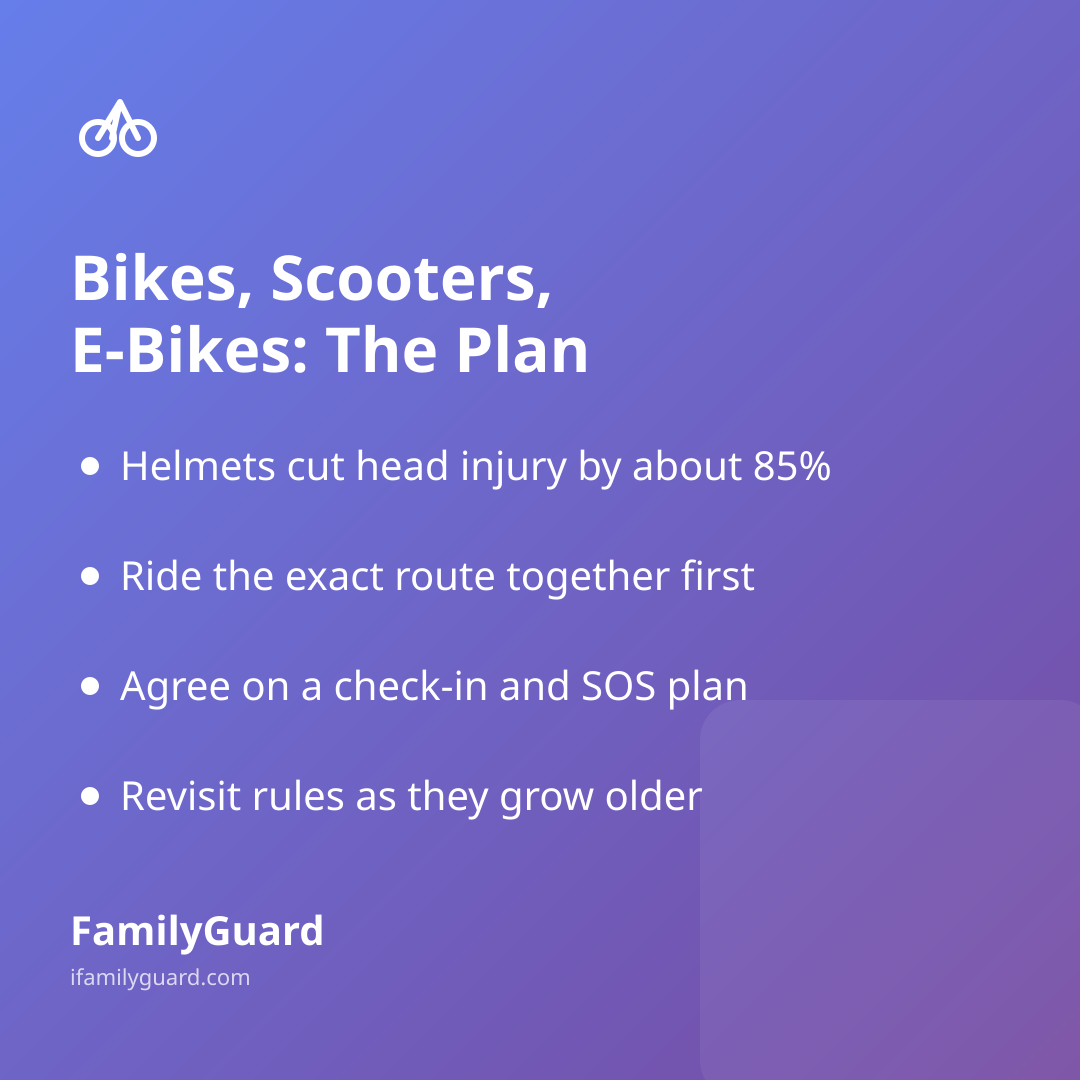
If there's a single rule worth never bending on, it's this one. In a 2022 technical report, the American Academy of Pediatrics found that helmets reduce the risk of head injury by about 85% and facial injury by about 65% for bicyclists, and the same logic applies to scooters and e-bikes, where falls can happen fast and without much warning.
A few ways to make the helmet habit stick rather than feeling like a chore:
- Let your child pick out their own helmet and personalize it with stickers — ownership makes it easier to enforce.
- Check the fit every season; a helmet that's outgrown or loose doesn't protect the way it should.
- Replace any helmet that's been in a crash, even if it looks fine on the outside.
- Wear one yourself. Kids notice when the rule applies to everyone in the house, not just them.
Setting the Rules of the Road Together
Before the first solo ride, sit down and talk through the actual route and the actual limits — not in the abstract, but on a map or a walk together. Questions worth answering out loud:
- Which streets are okay, and which are off-limits (busy intersections, roads without sidewalks or bike lanes)?
- What time do they need to be home, and does that change once it starts getting dark?
- Are they riding alone or with a friend? A buddy system is a simple, low-friction layer of safety.
- Does the device have a speed limit or a "class" restriction — many towns cap e-bike speeds and set minimum ages for public roads?
It helps to treat this like any other skill: start with a supervised ride on the exact route, then let them do it solo once you've both seen it go well. Confidence built this way tends to last longer than confidence that was just assumed.
Staying Connected Without Hovering
Once a kid is out of your sightline, the question isn't really "where are they" so much as "how do I know they're okay without making ten check-in calls." A short conversation about what you both expect — a text when they arrive, a check-in if plans change — goes a long way. Some families find it useful to set up a smart zone for the park, a friend's house, or school, so everyone gets a gentle notification when the ride starts or ends, instead of relying on memory. This is the kind of thing an app like FamilyGuard can help with quietly in the background, since it's built around mutual, visible sharing between family members rather than one-sided tracking — your child knows it's on, and can see your location too.
And because falls happen even to careful riders, it's worth having a plan for "something went wrong." A one-tap way to call for help, agreed on in advance, matters more than any lecture about caution ever will.
Letting the Freedom Grow With Them
The rules that make sense for an 8-year-old on a scooter in the cul-de-sac won't be the rules a 15-year-old needs on an e-bike crossing town. Revisit the agreement every so often — after a growth spurt, a new device, or a move to a busier neighborhood. Ask what's working and what feels too restrictive now. Loosening the rules on purpose, in a conversation, feels very different to a teenager than having them loosened by default because nobody checked in.
The goal isn't to eliminate every risk — it's to make sure your child has the judgment and the tools to handle the ones that come up.
A Calm Takeaway
Bikes, scooters, and e-bikes are one of the best early tastes of independence a kid gets. A helmet that fits, a route you've walked together, a clear check-in plan, and room to grow into more freedom as they earn it — that's really the whole plan. It's not about watching every pedal stroke. It's about making sure the first ride, and every one after it, ends the same way: safely, and with a little more trust than before.