Somewhere between a viral post, a group chat forward, and a confident-sounding answer from an AI chatbot, most kids run into misleading information every single day. It rarely looks like a scam. It looks like a headline, a screenshot, or a reasonable-sounding sentence typed out by a tool that never says "I'm not sure." Helping kids spot this kind of content isn't about making them suspicious of everything they see. It's about giving them a calm, repeatable habit for checking before they believe or share.
Why This Deserves a Family Conversation
Misinformation isn't a rare encounter for teens anymore, it's part of the daily scroll. A 2024 survey from the News Literacy Project found that eight in ten American teens say they see conspiracy theories on social media at least once a week, and among those who were exposed, 81% said they believed at least one of them. The same study found a real appetite for help: 94% of teens said schools should teach media literacy, but only 39% had actually received that instruction in the past year. (News Literacy Project, 2024)
AI chatbots add a new layer to this. Common Sense Media's 2026 census found that 86% of kids ages 9 to 17 have now used AI tools, often for schoolwork as well as entertainment, and many turn to them for quick answers without fully grasping that these tools can sound certain while still being wrong. (Common Sense Media, 2026)
None of this means kids are careless or gullible. It means the information landscape they're growing up in is genuinely harder to navigate than the one most parents learned to read.
Where Misinformation Likes to Hide
It helps to name the usual places, so the conversation feels concrete rather than abstract:
- Social media feeds: posts are ranked by what gets attention, not what's accurate, so the most emotional or surprising claim often rises to the top.
- Screenshots and forwards: a quote or statistic with no link back to where it came from is easy to fabricate and hard to trace.
- AI chatbot answers: these tools are built to sound fluent and confident, even when they've gotten a fact wrong or made something up entirely.
- "My friend said" chains: a claim that's been retold a few times through group chats, picking up extra certainty each time it's repeated.
- Doctored or out-of-context images: a real photo or video, but from a different event, place, or year than the caption claims.
Pointing these out isn't about making a child distrust every source. It's about teaching them to notice the specific shape misinformation tends to take.
Teaching the "Pause, Check, Verify" Habit
A simple three-step habit travels well across ages and holds up even when you're not standing over their shoulder:
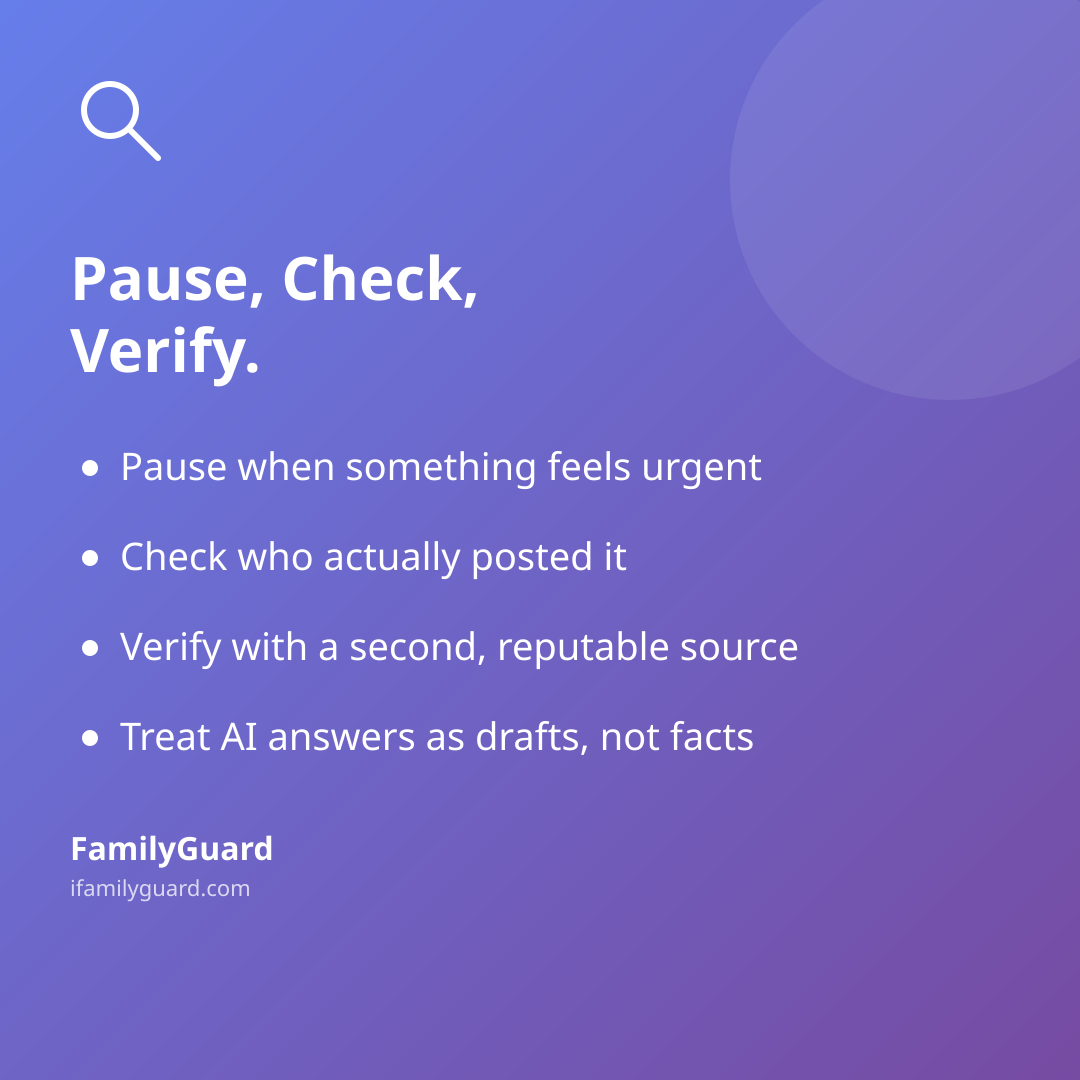
- Pause: before sharing or reacting, notice if the content is designed to make you feel shocked, angry, or urgent. That emotional pull is often the whole point.
- Check the source: who actually posted this? Is it a known news outlet, an anonymous account, or an AI-generated summary with no citation at all?
- Verify elsewhere: is a second, independent, reputable source saying the same thing? If a claim is true and important, it won't be sitting on exactly one account.
With younger kids, this can be as light as asking, "Who said that, and how do they know?" With teens, it can grow into comparing sources themselves. Either way, the goal is a habit of mind, not a one-time lecture.
Talking Specifically About AI Chatbots
Many kids now treat AI chatbots as a quick stand-in for a search engine or even a knowledgeable friend. It's worth having a direct, judgment-free conversation about what these tools actually are: a predictor of likely-sounding words, not a fact-checked encyclopedia. They can get dates wrong, invent sources, and state incorrect information with the same tone they use for correct information.
A useful family rule of thumb: an AI answer is a draft, not a final answer. For homework, health questions, or anything that matters, the next step is checking it against a real source, whether that's a textbook, a teacher, or a trusted website. This framing helps kids use these tools without quietly outsourcing their judgment to them.
Making Fact-Checking a Normal Family Habit
The habit sticks best when it's shared rather than assigned. A few ways to build that in:
- Model it yourself out loud: "That number seems high, let me see where it actually came from" teaches more than any rule.
- Make it safe to be wrong: if a child shares something that turns out to be false, respond with curiosity rather than correction that feels like a scolding.
- Give the family a low-pressure place to drop a "wait, is this real?" link or screenshot. Many families already use a shared chat for everyday logistics, and the same group thread in an app like FamilyGuard works just as well for a quick "can someone check this" moment, turning fact-checking into something the whole family does together rather than a solo task.
- Celebrate good catches: when a kid spots a fake post or questions a shaky claim, let them know that instinct is exactly the skill you're hoping they'll build.
The Takeaway
Kids don't need to be taught to distrust the internet. They need a few reliable habits for slowing down, checking the source, and asking a second opinion, the same instincts that serve adults well too. Treated as a shared family skill rather than a warning, fact-checking becomes less about fear and more about curiosity, which is exactly the mindset that holds up long after any single viral post has been forgotten.