There's a particular kind of joy in a family trip abroad — new food, new sights, a shared adventure everyone will talk about for years. There's also, quietly, a new set of variables: an unfamiliar city layout, a language you don't speak fluently, a time zone that puts you and your teenager's plans out of sync, and a phone plan that might behave differently than it does at home. None of this needs to cast a shadow over the trip. A little preparation, done together as a family before you leave, turns "what if we get separated in Lisbon" from a source of worry into a plan everyone already knows.
Start the Conversation Before You Pack
The best time to talk about safety abroad is at the kitchen table, not at the airport gate. A short family conversation before the trip lets everyone — including older kids and teens — understand the plan and feel like part of it, rather than a rule handed down at the last minute.
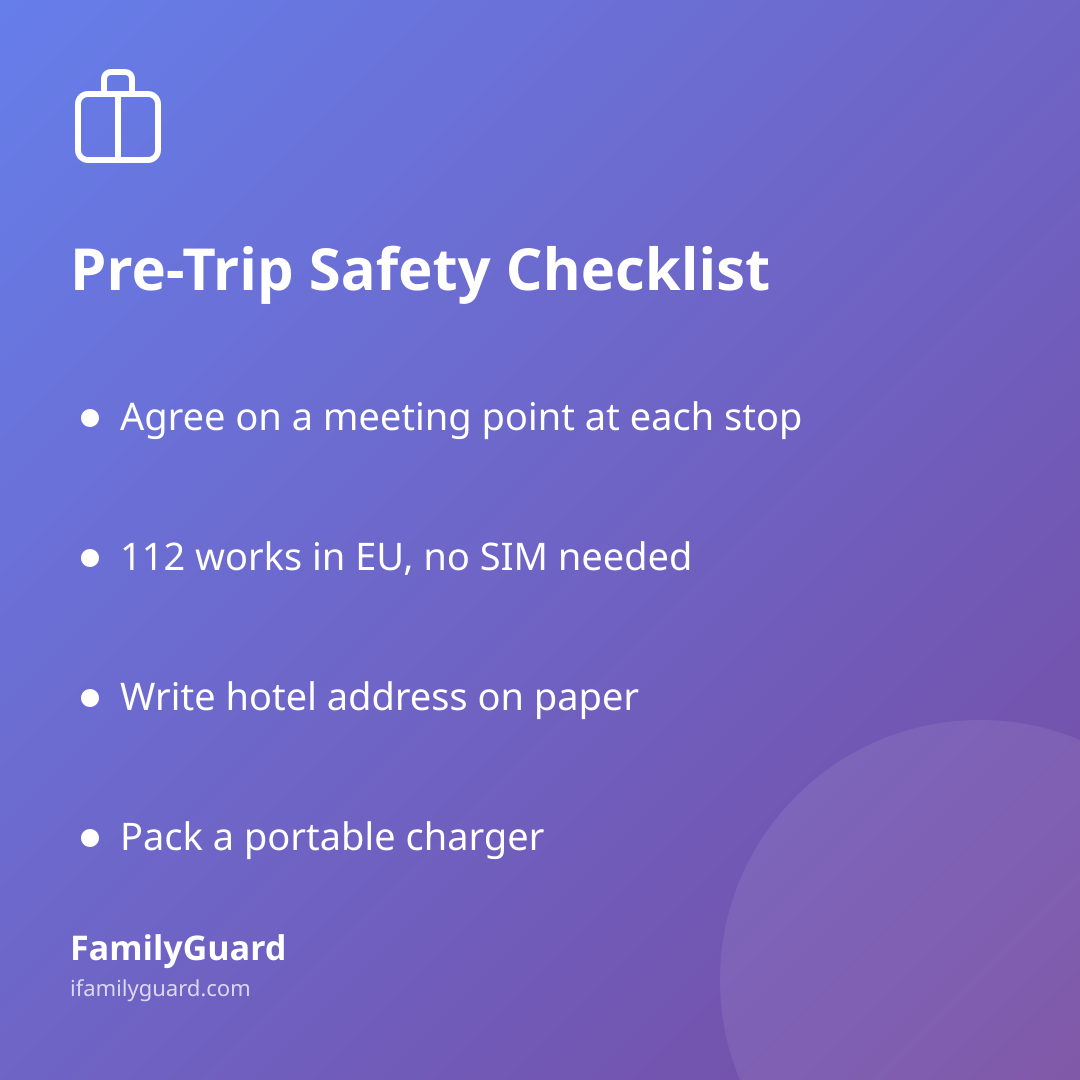
- Agree on a meeting point at each new destination (hotel lobby, a specific landmark, the ship's information desk) in case anyone gets separated.
- Write down — on paper, not just a phone — the hotel address and a local emergency contact, in case a device is lost or a battery dies.
- Decide together how location sharing will work for the trip. A teenager who's used to some independence at home may want the same courtesy in a new city, and agreeing on it in advance avoids friction later.
- Pack a portable charger. Dead batteries are one of the most common — and most avoidable — reasons a family loses touch while traveling.
If your family already uses an app like FamilyGuard to share location at home, the same consent-based setup travels well: everyone can see each other's general whereabouts in a new city, with the same transparency and mutual agreement that makes it feel like teamwork rather than tracking.
Know the Local Emergency Number Before You Need It
Emergency numbers aren't universal, and this is easy to overlook until it matters. In the United States it's 911, but across the European Union, 112 works free of charge from any fixed or mobile phone in all 27 member states, connecting you to police, ambulance, or fire services — it even works on a mobile with no SIM or credit. Other regions have their own numbers entirely. Before you land, look up the right number for your destination and share it with older kids the same way you'd share a house key — something everyone should know where to find.
It's also worth registering your trip with your home country's foreign affairs department if one is available. U.S. citizens can use the Smart Traveler Enrollment Program (STEP), a free State Department service that sends safety alerts for your destination and helps the nearest embassy reach you or your family in an emergency. The State Department estimates enrollment takes about 20 minutes — a reasonable trade for one less thing to think about once you're there.
Staying Connected Across Time Zones
A family used to a quick "on my way" text at home may find that international data plans, spotty hotel Wi-Fi, or a several-hour time difference change the rhythm of communication. Rather than expecting the same instant replies you get at home, it helps to agree on a simpler routine before you go:
- Pick one or two check-in times a day — say, at breakfast and before bed — rather than expecting constant updates.
- Confirm everyone's phone will actually work abroad, whether through an international plan, a local SIM, or an eSIM, and test it before the trip if possible.
- Download offline maps of your destination in advance, so getting turned around doesn't depend on having signal.
- If teens are allowed some independent exploring during the trip, treat it the way you would at home: agree on a return time and a way to reach each other, rather than open-ended freedom in an unfamiliar place.
Smart zone alerts can be genuinely useful here — a quiet notification when a family member arrives back at the hotel, for example, replaces the need to send a check-in text every time.
If You Get Separated
Crowded markets, busy train platforms, and unfamiliar layouts make it easier to get separated abroad than it is in your own neighborhood. The plan doesn't need to be complicated — the goal is simply that everyone, including younger kids, knows what to do without panicking.
- Teach kids to stay exactly where they are rather than wandering to search for you — it's almost always easier for a parent to retrace steps than for a lost child to be found while moving.
- Point out a uniformed staff member, shopkeeper, or family with children as a safe person to approach for help if needed.
- Make sure kids have the hotel's name and address written down or memorized, since a phone screen can be hard to navigate under stress — or may simply be out of battery.
- Agree on your family meeting point at the start of each outing, not just once for the whole trip, since it will change from the museum to the beach to the night market.
Bringing It Home
None of this is about assuming the worst — most family trips abroad go smoothly, and a little planning is what lets everyone relax and actually enjoy the trip once you're there. Knowing the local emergency number, agreeing on a simple check-in rhythm, and having a plan for the unlikely moment you get separated are the same habits that make everyday life feel steady at home, just adapted for a new time zone and a new set of streets. The reassurance isn't in preparing for disaster — it's in knowing that if something small goes sideways, everyone already knows what to do next.