
There's something wonderful about trading sidewalks for trails as a family. No crosswalks to watch, no traffic to track — just trees, dirt, and a shared sense of adventure. But that same openness is exactly why outdoor trips call for a different kind of safety plan. There are no street names to give a 911 dispatcher, no familiar landmarks, and often no cell signal at all. None of that needs to feel scary. It just means planning a little differently than you would for a walk around the block.
Plan Like You're Telling a Story in Advance
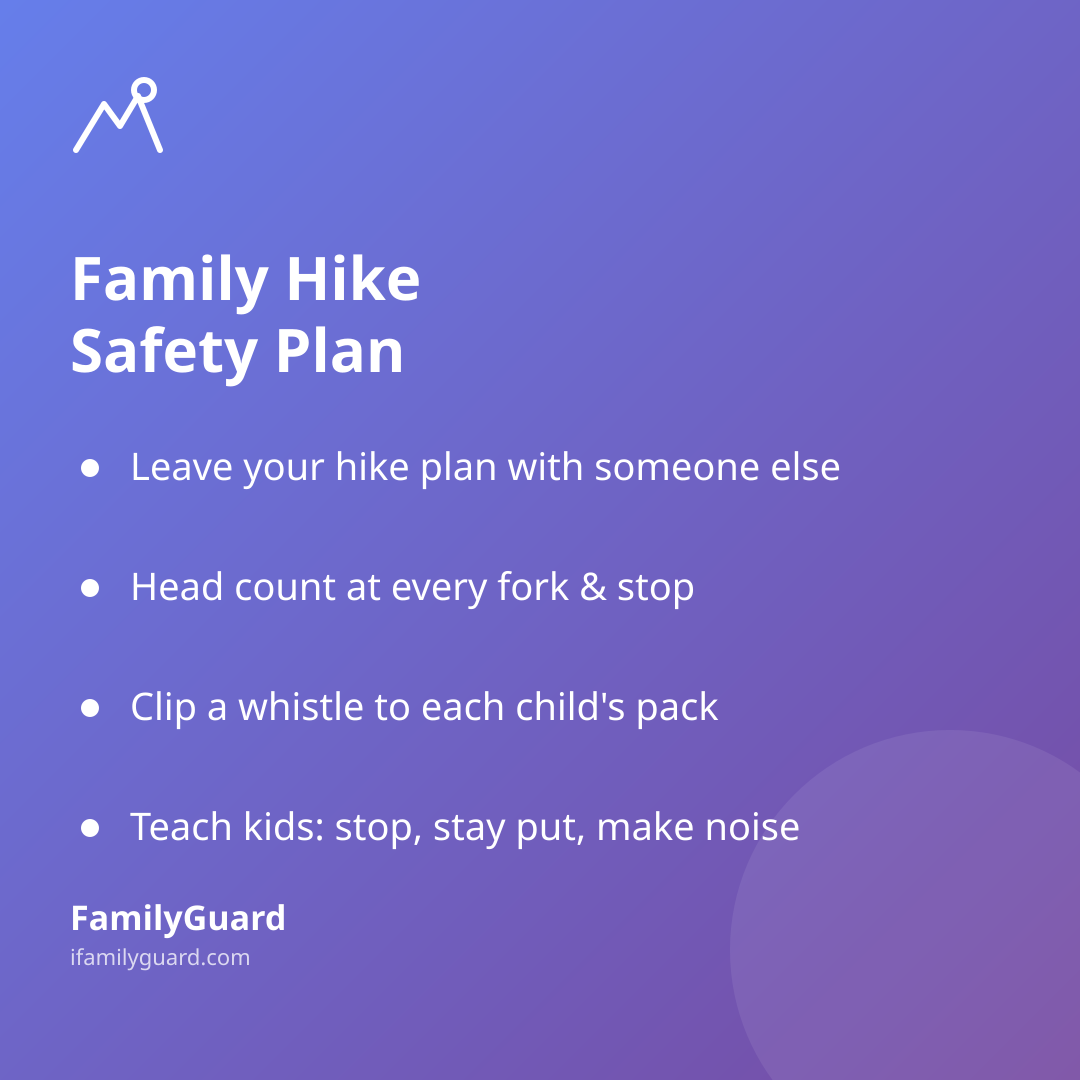
Before you ever reach the trailhead, decide on the route, the expected start and end time, and where you'll park. Then tell someone outside the hiking group — a grandparent, a neighbor, a friend — exactly that plan. This single habit is one that search-and-rescue teams consistently point to as the difference between a quick resolution and a long, worrying search.
The U.S. National Park Service's "Hike Smart" guide (last updated 2024) recommends leaving your hiking plan — where you're going, who's with you, and your expected return time — with a trusted person who isn't on the trip. If plans change mid-trip, a quick text (sent before you lose signal) keeps that person's information accurate.
It also helps to pack with purpose. The NPS's "Ten Essentials" guide (last updated 2026) groups the core gear into categories: navigation, sun protection, extra clothing, illumination, first aid, fire-starting supplies, a repair kit, extra food, water, and emergency shelter — a good checklist even for a short day hike. The Hike Smart guide adds a simple rule for families: let the slowest hiker set the group's pace, and build the return trip into your time estimate so you're not still on the trail after dark.
On the Trail: Simple Habits That Keep Everyone Together
Most families don't lose each other over long distances — it happens in small moments, like someone pausing to look at a bug while the rest of the group keeps walking. A few habits make a real difference:
- Set a "stay within sight" rule for younger kids, and a specific rejoin point (a bridge, a bench, a trail junction) for older kids and teens who range a bit ahead.
- Do a head count at every fork in the trail, every rest stop, and every photo break — out loud, so it becomes a routine rather than a correction.
- Dress kids in bright colors so they're easy to spot against trees and brush.
- Give each child a whistle clipped to their backpack. Three short blasts, repeated, is a widely recognized distress signal, and it carries much farther — and lasts much longer — than a shouting voice.
These habits cost nothing and take seconds, but they turn "staying together" into something the whole family does on autopilot, not something only the adults are managing.
When There's No Signal: A Backup Plan for Checking In
Cell coverage thins out fast once you're past a parking lot, and that's worth planning around rather than being caught off guard by. Before you set out, download offline maps of the area if your phone supports it, and let everyone know that check-ins will resume once you're back near the trailhead or in range of a tower.
This is one place where a family safety app genuinely earns its keep — not by promising signal where there isn't any, but by handling the gap gracefully. FamilyGuard, for instance, shows each family member's last known location before the signal dropped, so if someone in the group checks the app partway through the hike, they can see roughly where everyone was last connected rather than just a blank screen. Once a phone reconnects — even briefly, at a ridge or clearing — sharing picks back up automatically, with no need to remember to turn anything back on.
For longer backcountry trips well beyond cell range, dedicated satellite communicators are worth considering alongside your phone, since they can send an SOS or a short message from almost anywhere. For a typical day hike, though, the combination of a shared plan, an offline or paper map, and a whistle covers the vast majority of situations.
Teaching Kids What to Do If They Get Separated
It's a hard thing to rehearse, but a short, calm conversation before the hike can make a real difference if it ever happens. Keep the message simple and non-scary:
- Stop and stay put. Moving around to search makes it harder for adults to find them.
- Make noise. Blow the whistle, call out, or bang two sticks together — anything louder and more sustained than a single shout.
- Look for other hikers. Most trails have other families and groups passing through who can help flag down park staff or call for assistance.
- Hug a landmark. Staying near a visible tree, boulder, or trail marker — rather than wandering to look for the "right" path — makes it much easier to be found.
Framing this as "here's what to do, just in case" rather than "here's what might go wrong" keeps the conversation reassuring instead of frightening. Kids generally handle a clear plan far better than vague worry.
A Trip Worth Remembering, for the Right Reasons
None of this is about treating a family hike like a high-risk expedition. It's the same instinct behind packing a snack or checking the weather — a little preparation that lets everyone relax and actually enjoy the trail. Share the plan, stick together, carry a whistle, and have a simple answer ready for "what if we lose signal." With that in place, the only thing left to focus on is the view.