It usually starts casually. Your child mentions a friend from a game or an app — someone funny, someone who "gets" them — and then, almost as an afterthought, says: "They live kind of close. Can we meet up sometime?" For a lot of parents, that question triggers a small jolt of panic. But online friendships are part of ordinary childhood now, and most of them are exactly what they look like: kids bonding over shared interests. The goal isn't to shut the door on these friendships. It's to make sure that if a meetup happens, it happens safely, with you in the loop.
Why This Conversation Comes Up More Than You'd Think
Making friends online isn't a fringe behavior anymore — it's mainstream. In a widely cited Pew Research Center report (2015), 57% of teens said they'd made at least one new friend online, and 20% of all teens had gone on to meet one of those friends in person. Those friendships often grow out of gaming, shared fandoms, or group chats — the same places your child already spends time. That's worth remembering before the conversation turns into an interrogation: a friend met through a game is not inherently more suspicious than a friend met at summer camp. The context is different, but the underlying question — "do I actually know and trust this person?" — is the same one families have always had to work through.
Start With Curiosity, Not a Shutdown
If your first reaction is "absolutely not," your child may simply stop telling you about this friend — and that's the outcome you most want to avoid. Kids who feel safe bringing these requests to their parents are far easier to protect than kids who learn to go around them. Try leading with questions instead of rules:
- How did you two first start talking? What do you usually chat about?
- How long have you known them, and how old do they say they are?
- Have you two video-called, or has it only ever been text and photos?
- What makes you want to meet them in person now?
These questions aren't a test your child needs to pass before you'll "allow" anything. They're how you build a real picture of the friendship — and they signal that you're a partner in this, not an obstacle.
If a Meetup Is Going to Happen, Set the Ground Rules Together
The FBI's safety guidance for kids and teens is blunt on this point: don't meet an online friend in person without a caregiver knowing or coming along, since not everyone online is who they say they are. That doesn't mean standing over your child the whole time — it means putting a few sensible guardrails in place:
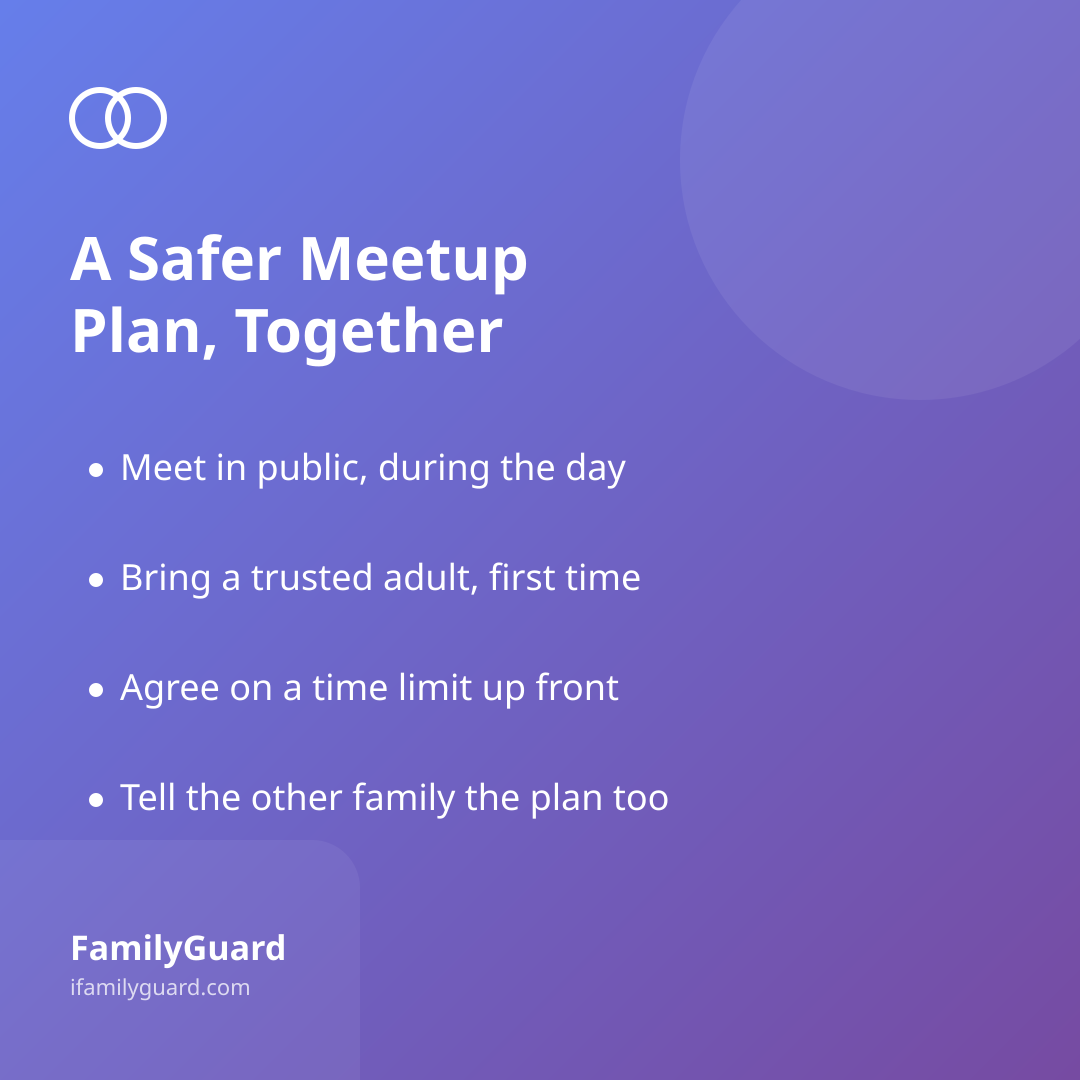
- Meet in public, during the day. A coffee shop, a mall food court, or a library — somewhere busy, bright, and easy to leave.
- A parent or trusted adult comes along, at least the first time. You don't have to sit at the same table, but you should be nearby.
- Tell the other family the plan too. If the other child also has a parent involved, loop them in. A legitimate friend's family will have no problem with this.
- Agree on a time limit up front. "We'll stay for an hour" takes the pressure off and gives everyone a natural exit.
- Keep phones charged and reachable. If your teen is meeting up solo for a later, more independent hangout, make sure you know where they'll be and can check in easily — this is a moment where real-time location sharing within the family, like what FamilyGuard offers, can quietly give everyone peace of mind without anyone feeling watched.
Watching for Red Flags, Without Hovering
Most online friendships are harmless, but it's reasonable to stay alert to a few patterns that deserve a closer look — not panic, just attention. The FBI's guidance for young people online points to several of the same signs:
- The person is vague or inconsistent about their age, school, or location.
- They push to keep the friendship secret from you or discourage a video call.
- They want to move the meeting away from public places, or want to meet alone right away.
- They send gifts, money, or ask your child to keep certain conversations private.
If you notice any of these, slow things down. You don't need to accuse anyone — you can simply say, "I'd like to video chat with them before we plan anything," and see how that lands. A genuine friend (and their family) won't mind.
Keeping the Door Open Afterward
However the meetup goes, debrief afterward in a low-key way: "How was it? Were they like you expected?" This keeps the conversation going rather than treating it as a one-time hurdle. As your child gets older and starts coordinating more hangouts independently — with online friends and in-person ones alike — a shared family chat can be a simple, low-friction way to say "heading out, back by six" without it feeling like a checkpoint. The point isn't to track every move; it's to make staying connected easy enough that it becomes a habit rather than a chore.
The Bottom Line
Online friendships aren't a red flag by themselves — they're just part of how kids connect today. What matters is that your child knows meeting up is something you plan together, not something that happens behind your back. A little structure, a lot of curiosity, and an open door for the next conversation go a lot further than a flat "no" ever will.