
Picture a sleepover: three kids in pajamas, someone's phone comes out, a goofy photo gets taken, and thirty seconds later it's posted to a story. Nobody asked the kid mid-yawn in the background if that was okay. It's a small moment, and most of the time it's harmless. But it's also a chance to teach one of the most useful digital habits a child can carry into adulthood: asking first.
Digital consent isn't just a grown-up policy concept. It's a manners lesson with real stakes, and kids can start learning it early — right alongside "say please" and "knock before you enter."
Why This Is More Than a Manners Lesson
Once something is posted, forwarded, or screenshotted, a child loses control over where it goes next. A funny photo can be re-shared out of context. A screenshot of a private group chat can end up in someone else's group chat by lunchtime. Kids are still developing the judgment to fully weigh those consequences, which is exactly why the habit of pausing to ask matters more than the rule itself.
Pew Research Center has found that teens are aware their information isn't fully in their own hands: six in ten teens say they feel they have little or no control over the personal information collected about them online. Helping kids practice asking before they share is one of the few areas where they genuinely can exercise control — over what they put into the world about other people.
What "Asking First" Looks Like at Different Ages
The skill grows with the child. It doesn't need to be a formal talk — it works best as a habit built through small, repeated moments.
- Young kids (5–9): Before taking a photo of a friend or sibling to show grandma, ask "Is it okay if I take your picture?" This builds the reflex early, long before social media is in the picture.
- Tweens (10–12): Before posting in a family or friend group chat, or tagging someone in a photo, check with them first. This is also a good age to explain that "private" group chats can still be screenshotted and shared beyond the group.
- Teens (13+): Before posting a story, reel, or photo that includes friends, get a quick thumbs-up. Before forwarding a screenshot of someone's message, ask whether the sender would be okay with it going further.
The goal isn't perfection — it's making the pause a reflex, so that "should I check with them first?" becomes an automatic thought rather than an afterthought.
The Group Chat and Screenshot Trap
A lot of friction between kids doesn't come from big public posts — it comes from private conversations that get forwarded without permission. A venting message meant for one friend gets screenshotted into a bigger group. A joke told in confidence ends up as a caption. None of this requires malice; it usually happens because kids haven't yet connected that "private" doesn't mean "permanent" or "contained."
A simple family rule helps here: if you wouldn't want it forwarded, don't forward someone else's. And if a friend does something like this to your child, it's a good opening for a calm conversation rather than a punishment — the goal is understanding, not shame.
Modeling the Habit as a Parent
Kids notice what adults actually do, not just what they say. If a parent posts a photo of their child without asking, the "ask first" lesson loses some of its weight. The American Psychological Association notes that parents who regularly share their children's photos and details online are often aware of the risks — from digital footprint concerns to future embarrassment — but the pull of the moment tends to outweigh that awareness (APA, 2026).
Research on family sharing habits backs this up: a 2022 study published in the Proceedings of the ACM on Human-Computer Interaction found that most parents who share photos of their children online feel comfortable doing so without asking for their child's consent, and a 2021 Security.org survey found that fewer than 1 in 4 parents asked their child's permission every time before posting about them.
That doesn't mean parents need to ask permission for every single photo — but making a habit of checking in, especially as kids get older and more aware of their own image, sets a powerful example. A quick "Is it okay if I post this one?" from a parent teaches the exact behavior you want to see reflected back.
Simple Ground Rules to Start With
Most families do well with a few clear, memorable guidelines rather than a long list of restrictions:
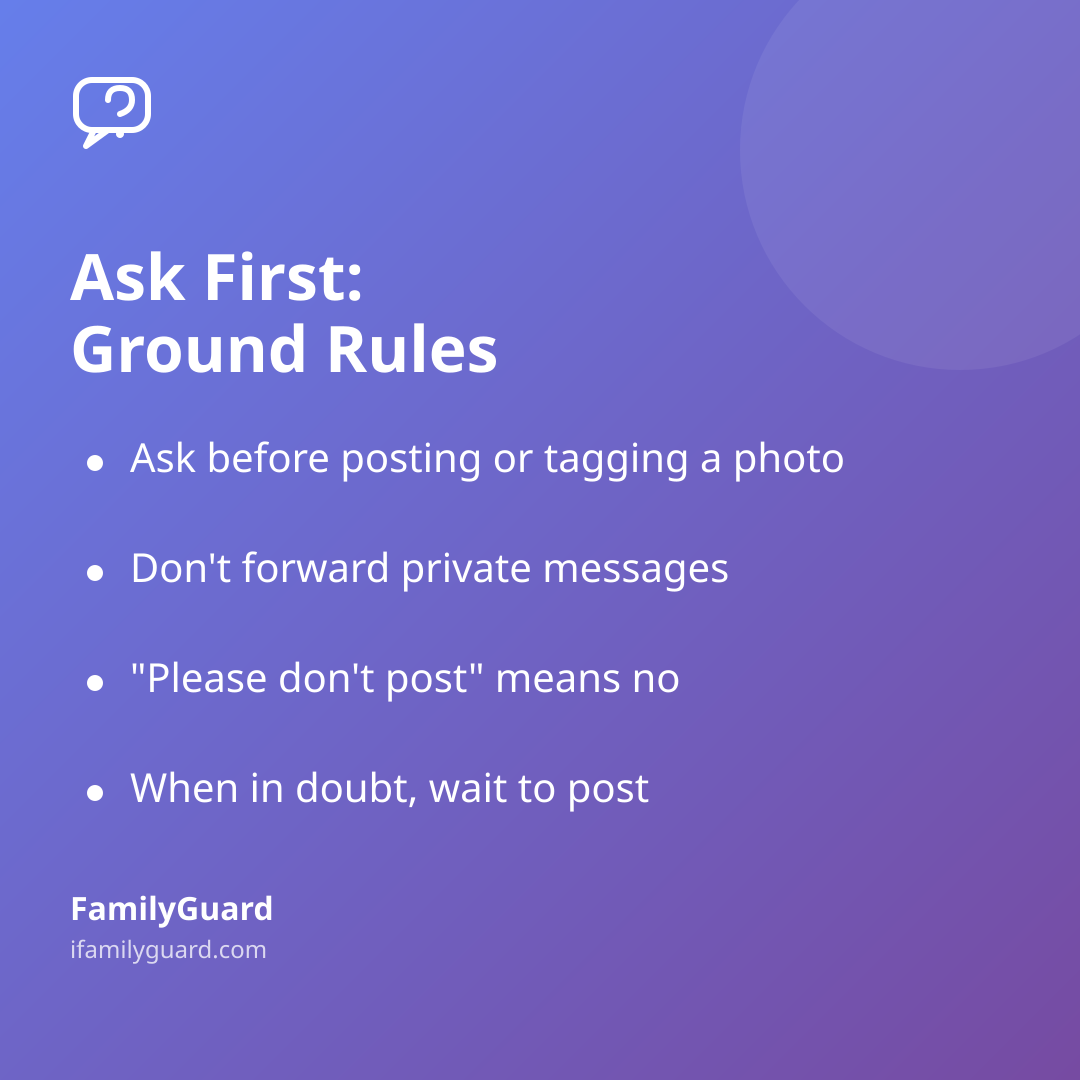
- Ask before posting, tagging, or sharing a photo that includes a friend or sibling.
- Treat private messages and group chats as things not to forward without checking first.
- If someone says "please don't post that," the answer is no — no debate needed.
- When in doubt, wait. A photo can always be posted later; it's much harder to take back once it's out.
These rules work best as a conversation, not a lecture — maybe brought up naturally after a real-life moment, like a photo shared at a party or a screenshot that made the rounds at school. This is also where a family's own communication habits can reinforce the lesson: a shared family chat, like the one built into FamilyGuard, works well precisely because everything in it stays within the family by mutual consent — a small, lived example of what "ask first, share within trust" actually looks like.
A Habit Worth the Repetition
Teaching digital consent isn't a one-time talk — it's a habit built through dozens of small, low-stakes moments over years. Every time a child pauses to ask "is this okay to share?" they're practicing empathy and respect that will serve them well beyond any single photo or post. It's a quiet, steady kind of digital citizenship, and it starts with something as simple as asking first.

Sources
- American Psychological Association — What you need to know before sharing your child's life online (2026)
- Pew Research Center — Teens and social media: Key findings from Pew Research Center surveys (2023)
- Proceedings of the ACM on Human-Computer Interaction — Sharenting and Children's Privacy in the United States (2022)
- Security.org — Parents' Social Media Habits Report (2021)