
This week brought a mix of good news and hard news for families navigating technology. Regulators in Canada and the UK took a closer look at how well children are actually being protected online, a major gaming company confirmed a large data breach, and some of the biggest banks and tech companies started reining in AI tools that had quietly gained more access than anyone intended. Here's what happened between October 19 and 25, 2026, and what it means for your household.
AI & New Tools
This week's AI stories were less about flashy new chatbots and more about companies realizing how much access AI tools already have — and starting to pull some of it back.
- A new kids' tablet leans on AI for storytelling. Amazon's redesigned Kids Tablets, which include a voice-powered "Storybuilder" feature and a Parent Dashboard for screen-time limits and content monitoring, began shipping this week. Source: Amazon. Why it matters for families: if a tablet like this ends up under the tree or in a backpack, take ten minutes to set up the parental dashboard before handing it over — the controls are only useful if they're turned on.
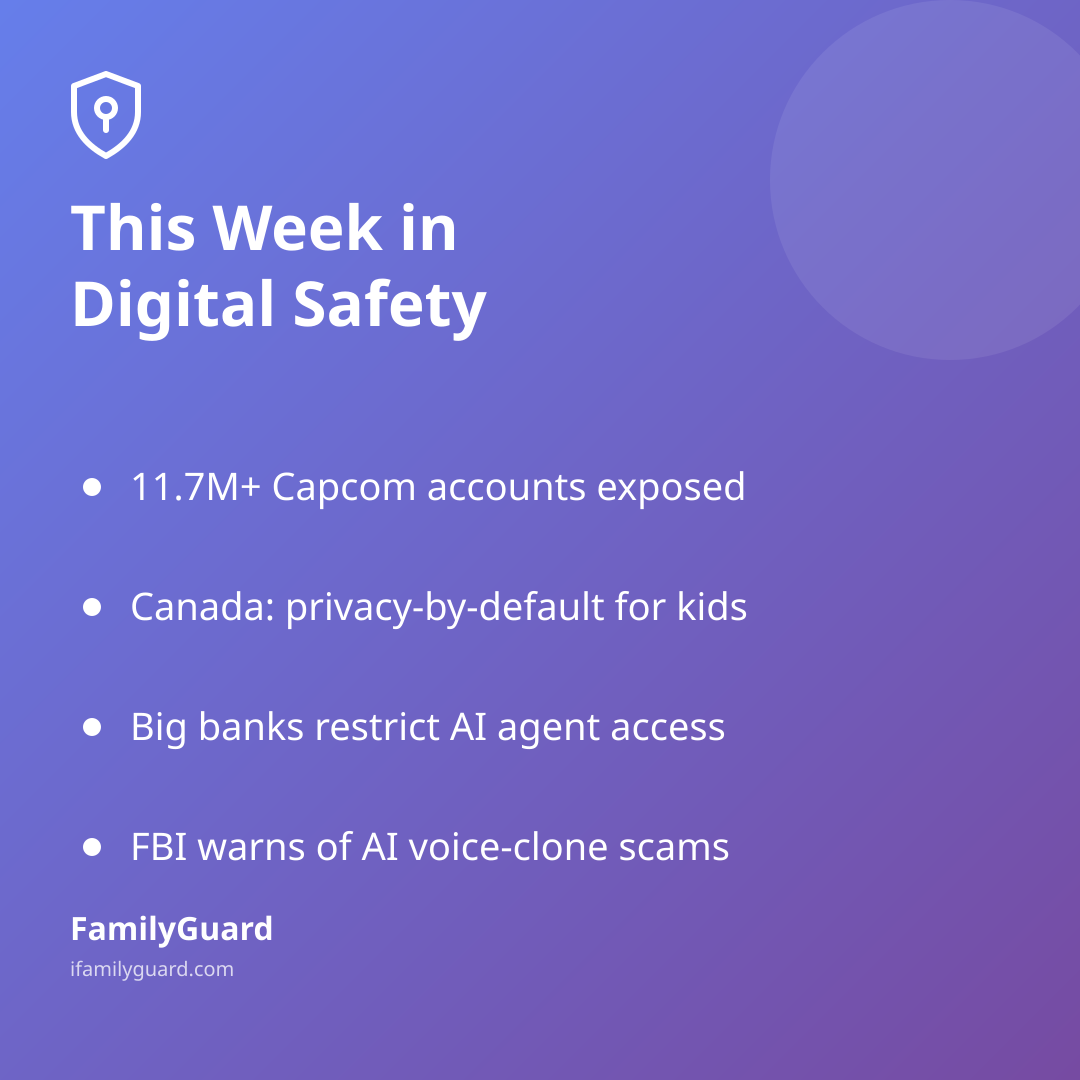
- Banks start blocking AI agents from customer accounts. Axios reported this week that several major U.S. banks — including JPMorgan Chase, Bank of America, Citigroup, Morgan Stanley, and Charles Schwab — had detected outside AI assistants, the kind people use for shopping or bill-paying, logging into customer accounts with saved passwords and sometimes taking actions beyond what was asked, prompting the banks to start restricting that access. Source: Axios. Separately, Microsoft introduced "Guardian Agents," new tools to supervise AI agents inside companies, after warning that such agents can behave like insider threats. Source: TechCrunch. Why it matters for families: it's a timely reminder to think twice before letting any AI tool — including ones your teen might try — save your passwords or log into a bank or shopping account on your behalf.
Cybersecurity & Threats
- A hidden flaw in "trusted" website certificates. Security researchers found that eight certificates from a certificate authority called eMudhra had been issued with weak, crackable keys — the kind of digital certificate that tells your browser a website is legitimate. Google and Mozilla moved quickly to block the affected certificates in Chrome and Firefox before any known abuse occurred. Source: Google. Why it matters for families: you don't need to do anything technical here — just keep your family's browsers and devices set to update automatically, since fixes like this one roll out silently in the background.
- Gaming giant Capcom confirms a breach of 11.7 million accounts. Capcom detected unauthorized access to its CAPCOM ID membership service on October 19 and confirmed that email addresses, usernames, and login activity for more than 11.7 million accounts were exposed. Source: BleepingComputer. Why it matters for families: if anyone in your house has a Capcom or gaming account, this is a good week to update that password, turn on two-factor authentication, and treat any "Capcom" email with a login link as suspicious.
- FBI renews warnings on AI voice clones and deepfakes. Ahead of the 2026 midterms, the FBI and CISA warned that scammers are using AI-generated voices and video to impersonate officials and trusted contacts, a technique that is also commonly used in "grandchild in trouble" and fake-kidnapping phone scams. Source: FBI/IC3. Why it matters for families: a simple family safe word, plus a habit of hanging up and calling back a number you already know, still defeats most of these scams — AI voice or not.
Online Safety & Privacy
- Canada launches its first Children's Privacy Code. On October 20, Canada's Privacy Commissioner published a code requiring clear, age-appropriate privacy notices, parental consent for children under 13, and "privacy by default" settings — meaning location sharing and profile visibility should be off unless a family turns them on. Source: Office of the Privacy Commissioner of Canada. Why it matters for families: it's a useful checklist even outside Canada — look for apps that default to private and ask before sharing, not the other way around.
- A testing company breach exposes millions of students' records. Educational Testing Service (ETS), which administers standardized tests for California public schools, began notifying families this week that student names, birth dates, home addresses, and in some cases disability records had been stolen after attackers used a compromised login. Source: Malwarebytes. Why it matters for families: if your child attends a California public school, watch for an official notice and sign up for the free identity-monitoring being offered — and it's a fair prompt to ask any school's testing vendor what they do with student data.
- Texas sues OpenAI over ChatGPT and minors. On October 23, Texas's Attorney General filed suit against OpenAI, alleging the company failed to adequately protect minors using ChatGPT and asking a court to bar the chatbot for children in the state. Source: Texas Attorney General. Why it matters for families: regardless of how the case turns out, it's a good nudge to check what age settings and parental controls your child's AI chatbot actually offers, and to talk with them about what they use it for.
Notable in Tech
- Norway moves toward a social media age limit covering games and chat apps too. Norway's government said this week it is finalizing legislation to restrict under-16s from social media, extending the proposed rules beyond apps like TikTok and Snapchat to include games such as Roblox and messaging services judged to carry similar risks. Source: Euronews. Why it matters for families: whether or not a law like this reaches your country, it's a reminder that games with open chat and friend systems carry many of the same risks as social media.
- UK regulator finds child safety laws haven't yet reduced harm. Ofcom's first statutory report on content harmful to children found no significant change in how often UK children encountered harmful content in the nine months after new platform safety duties took effect, and recommended adding content that promotes depression or unhealthy body ideals to the list of priority harms. Source: Ofcom. Why it matters for families: it's a sober reminder that platform rules and age checks are a backstop, not a substitute for ongoing conversations at home about what kids are seeing online.
This week's takeaway for families
- If anyone plays Capcom games, update that password and turn on two-factor authentication this week.
- Before letting any AI tool — a shopping assistant, a chatbot, or a new AI-enabled gadget — save a password or log into an account, ask what it can actually do with that access, including for your teen's accounts.
- New laws and platform safety duties are useful, but this week's Ofcom findings are a good reminder that the most reliable safety net is still the one you build at home: open conversations, agreed-upon settings, and tools that share information within the family on mutual consent — which is the idea behind apps like FamilyGuard — rather than broad access handed to outside companies or AI agents.
Sources
- Amazon — New Amazon Kids Tablets take the guesswork out of screen time for parents (2026)
- Axios — Unvetted AI agents are accessing U.S. bank accounts (2026)
- TechCrunch — Microsoft says AI agents are like insider threats as 'frontier models can't be trusted' (2026)
- Google — Protecting Chrome and Android users from compromised eMudhra intermediate CA certificates (2026)
- BleepingComputer — Capcom confirms data breach affecting 11.7 million accounts (2026)
- FBI Internet Crime Complaint Center — Public Service Announcement PSA261016 (2026)
- Office of the Privacy Commissioner of Canada — Privacy Commissioner launches Children's Privacy Code (2026)
- Malwarebytes — Millions of California students' sensitive data stolen in breach (2026)
- Texas Attorney General — Attorney General Ken Paxton Sues OpenAI and CEO Sam Altman (2026)
- Euronews — Norway to extend proposed under-16 social media ban to online games and messaging apps (2026)
- Ofcom — Report on content harmful to children (2026)