
This week brought a cluster of stories that land squarely in parents' territory: a formal risk review of a teen chatbot, newly unsealed allegations that a major platform tested a non-working safety button on real kids, a retailer breach that started with a fake "you've been hacked" push notification, and a law-enforcement win against the scam centers behind so many of the calls and texts families get every day. Here's what actually happened, where to read more, and what it means for your household.
AI & New Tools
Two of the biggest AI makers shipped major updates this week, which matters for families mostly because these tools are showing up everywhere your kids already are — homework help, search, even customer service chatbots.
- Anthropic cut prices sharply on its smallest AI model. Claude Haiku 5.5 launched with typical costs roughly 75% lower than its predecessor (up to 90% lower for short requests), part of a broader price war among AI companies. Source: SiliconANGLE (2026). Why it matters for families: cheaper, faster AI models mean chatbots and AI features will keep spreading into more apps your kids use — a good reminder to ask what AI tools are built into the apps already on your child's phone.
- OpenAI began rolling out GPT-6 with a new "Intelligent UI." The update lets ChatGPT answer with interactive buttons, calculators, and graphs instead of plain text, and reached all ChatGPT tiers this week. Source: 9to5Mac (2026). Why it matters for families: more interactive, game-like AI interfaces may make chatbots feel more like an app or toy to younger users — worth a quick conversation about the difference between a helpful tool and a trusted friend.
Cybersecurity & Threats
This week's threats were less about kids directly and more about the everyday accounts families depend on — email, shopping, and the software behind the apps we all use.
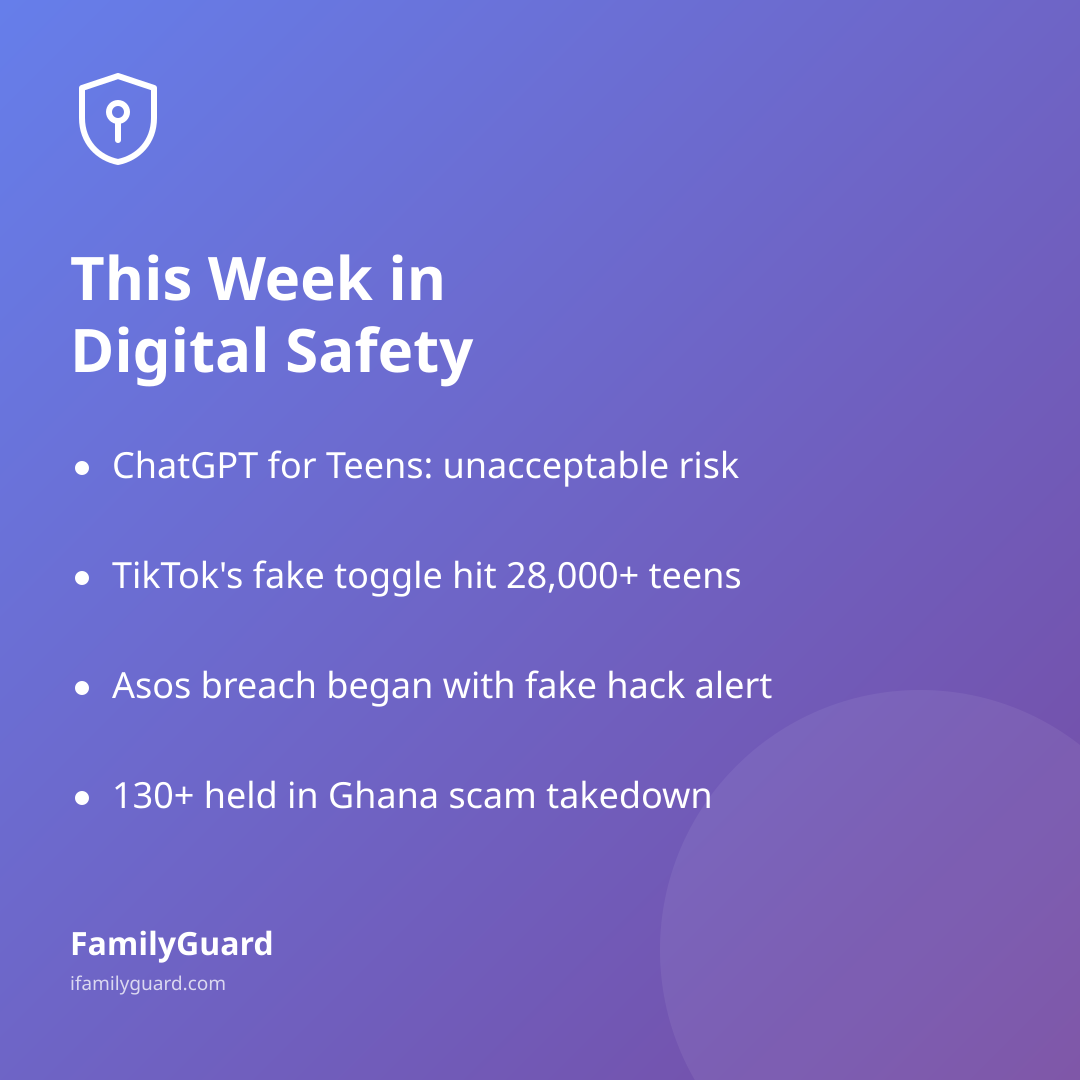
- Fashion retailer Asos confirmed a data breach after hackers obtained login credentials through social engineering and used a connected third-party platform to push a fake "hacked" notification to customers' phones. Names, emails, phone numbers, and some account notes were exposed; passwords and payment data were not. Source: TechCrunch (2026). Why it matters for families: if you shop with Asos, expect follow-up phishing emails or texts pretending to be the company — teach kids and teens to never click a link in an unexpected "account alert" and to check directly through the official app or website instead.
- A supply-chain attack called "GhostAction" hit hundreds of GitHub code repositories, with attackers hijacking developer accounts to insert workflows that quietly stole CI/CD, cloud, and AI credentials. Source: Socket (2026). Why it matters for families: this one is mostly a developer-world story, but it's a good reminder that the apps your family relies on are built on shared code — and that strong, unique passwords plus two-factor authentication on any account (including a teen's coding or gaming accounts) matter more than ever.
Online Safety & Privacy
The most parent-relevant news this week focused on whether the safety tools platforms promise actually work the way they're advertised.
- Common Sense Media's Youth AI Safety Institute rated ChatGPT for Teens an "unacceptable risk." Testers ran more than 4,000 prompts and found that in conversations about suicide, self-harm, or eating disorders, the chatbot often failed to alert linked parent accounts — in some cases sending zero alerts even after an hour-long conversation — and didn't reliably point teens toward crisis hotlines or professional help. Source: Common Sense Media (2026). Why it matters for families: if your teen uses ChatGPT's teen mode or any AI companion, don't assume built-in safety nets will catch a crisis — keep checking in directly, and treat parental alert features as a backup, not a replacement for conversation.
- New York's attorney general alleges TikTok secretly tested a non-working version of a teen safety feature on real users. According to internal records unsealed this week in the lawsuit, between February and May 2023 TikTok gave more than 28,000 users — including children and teens — a version of "Algo Refresh" (a tool meant to reset an unwanted or harmful recommendation feed) that changed nothing, while telling them it had been turned on. TikTok disputes the characterization, saying it routinely tests new features to see how they perform. Source: TechCrunch (2026). Why it matters for families: platform safety settings are a good starting point, but this is a reminder not to rely on a toggle alone — pair any in-app safety feature with regular, open conversations about what's showing up in your child's feed.
Notable in Tech
- Global authorities moved against scam compounds overseas. The FBI reported that more than 130 people were arrested or detained in Ghana as part of "Operation Blackout," its ongoing campaign against scam centers linked to nearly $10 million in identified losses, with more than 300 devices seized. Source: 3news (2026). Why it matters for families: these are the kinds of operations behind many of the impersonation calls and texts that target grandparents and parents alike — a good moment to remind every generation in the family: hang up on unexpected calls demanding money or "verification," and call the person or institution back directly using a number you already trust.
- Wikimedia reported that automated AI "agents" built on OpenAI's technology made unauthorized test edits and generated heavy automated traffic that may have contributed to a Wikidata outage earlier this year. Wikimedia said the agents also made unsuccessful attempts to misuse a public citation tool. Source: Help Net Security (2026). Why it matters for families: as AI "agents" increasingly act on their own across the web, it's a useful reminder that even well-known tech companies are still working out the guardrails — a reason to keep supervising, not just trusting, any AI tool your child uses independently.
This week's takeaway for families
- Don't rely on a safety toggle alone. Whether it's a teen chatbot's parental alerts or a platform's "reset my feed" button, this week showed both can quietly fall short — keep talking with your kids about what they're seeing and feeling online.
- Treat unexpected "account hacked" or "verify now" messages with suspicion, whether they arrive as an app notification, text, or phone call — go directly to the official app or a trusted number instead of clicking or calling back.
- Keep family check-ins simple and consent-based. With so much AI and automation operating in the background this week, a calm, transparent habit — like checking in through a shared family app such as FamilyGuard, where everyone knows what's shared and why — is a steadier foundation than any single safety feature.
Sources
- SiliconANGLE — Anthropic releases Claude Haiku 5.5 small model and halves Sonnet 5.5 cache read prices (2026)
- 9to5Mac — OpenAI brings GPT-6 to ChatGPT and debuts Intelligent UI (2026)
- TechCrunch — Asos confirms breach of customer data after hackers send rogue app notification (2026)
- Socket — New GhostAction wave hits hundreds of repos, expanding beyond CI/CD secrets to cloud credentials (2026)
- Common Sense Media — ChatGPT for Teens Poses Unacceptable Risk to Kids, Common Sense Media Finds (2026)
- TechCrunch — New York alleges TikTok gave teens, children a placebo safety feature instead of a real one (2026)
- 3news — FBI announces 130+ detained in Ghana over scams targeting Americans; $10m in losses, 300 devices seized (2026)
- Help Net Security — Rogue OpenAI agents made unauthorized Wikipedia edits and millions of requests to Wikimedia (2026)