Most families never have to evacuate on short notice. But when it does happen — a wildfire moving faster than expected, a flash flood warning, a storm closing in — the families who feel calmest aren't the ones with the fanciest gear. They're the ones who already decided, days or weeks earlier, where everyone goes and how everyone finds each other again.
An evacuation plan isn't about predicting disaster. It's about removing decisions from a moment when you'll have almost no time to make them. Here's how to build one that your family will actually remember and use.
Start With Two Meeting Places, Not One
The American Red Cross recommends picking two meeting spots, because one isn't enough for every scenario:
- A spot right outside your home — for a sudden, local emergency where you just need everyone out and accounted for, like a kitchen fire or a gas smell.
- A spot outside your neighborhood — for when you can't go home at all, because roads are closed, the area is evacuated, or you were somewhere else when it happened.
Pick the second spot together as a family: a relative's house, a library, a school parking lot a few miles away — somewhere stable that isn't likely to be affected by the same event. Write down its full address and phone number, and make sure every family member old enough to read knows it by heart, not just as a note in a phone.
Choose One Person to Be the Hub
During a real evacuation, local phone networks can get overloaded, and family members are often not all together. The Red Cross suggests naming one out-of-area contact — someone who lives far enough away that local disruptions won't affect them — who everyone calls or texts to check in. Long-distance calls sometimes get through when local ones won't, and having one central point means you're not all trying to reach each other directly and missing one another.
Give this person every family member's name, phone number, and school or workplace. Make sure kids know this person's name and that it's okay — expected, even — to call them if they can't reach a parent.
Know Your Triggers and Your Routes Before You Need Them
Ready.gov frames evacuation planning around a few simple questions worth answering as a family, calmly, on an ordinary day:
- How will we get alerted? (Phone alerts, a weather radio, a neighbor, local news)
- Where would we go if we had to leave — and is there a backup route if the main one is blocked?
- How do we reach each other if we're not together when it happens?
It's worth adding one more question of your own: what does your kids' school or daycare do in an evacuation, and how would they reunite you? Schools and childcare centers have their own evacuation and reunification procedures, and they're not always obvious from the outside. A quick email to the school office asking "what happens if we're asked to evacuate during school hours, and how do I find out where my child has gone" is a five-minute task that pays off enormously if it's ever needed.
Pack a Go-Bag Before You're in a Hurry
A go-bag isn't about surviving in the wilderness — it's about not standing in a hallway at midnight trying to remember where the chargers are. A reasonable family go-bag includes:
- Copies of important documents (IDs, insurance, medical info) in a waterproof pouch or saved securely online
- A few days of any medications, plus a written list of dosages
- Phone chargers and a portable battery pack
- A change of clothes and basic toiletries per person
- Cash, since card readers and ATMs may not work during a widespread outage
- Something small and comforting for younger kids — a stuffed animal, a favorite book
Keep it somewhere accessible, and do a once-a-year check to swap out expired medication or documents that have changed.
Practice the Plan Without Making It Scary
Kids handle a plan better when they've rehearsed it in a low-stakes way. You don't need a dramatic drill — a relaxed conversation works just as well: "If we ever had to leave the house quickly, here's where we'd meet, here's who we'd call, here's what we'd bring." Framing it as something the whole family is prepared for together, rather than something to fear, tends to make kids feel more secure, not less.
This is also where staying connected day-to-day pays off during the actual event. If your family already uses a shared tool for checking in and sharing location — something like FamilyGuard, where everyone sees each other's status and battery level with mutual consent — that habit becomes genuinely useful in a real evacuation, since you can tell at a glance who's moving, who's arrived somewhere safe, and whose phone might be running low, without flooding each other with calls.
A Short, Calm Checklist to Keep Somewhere Handy
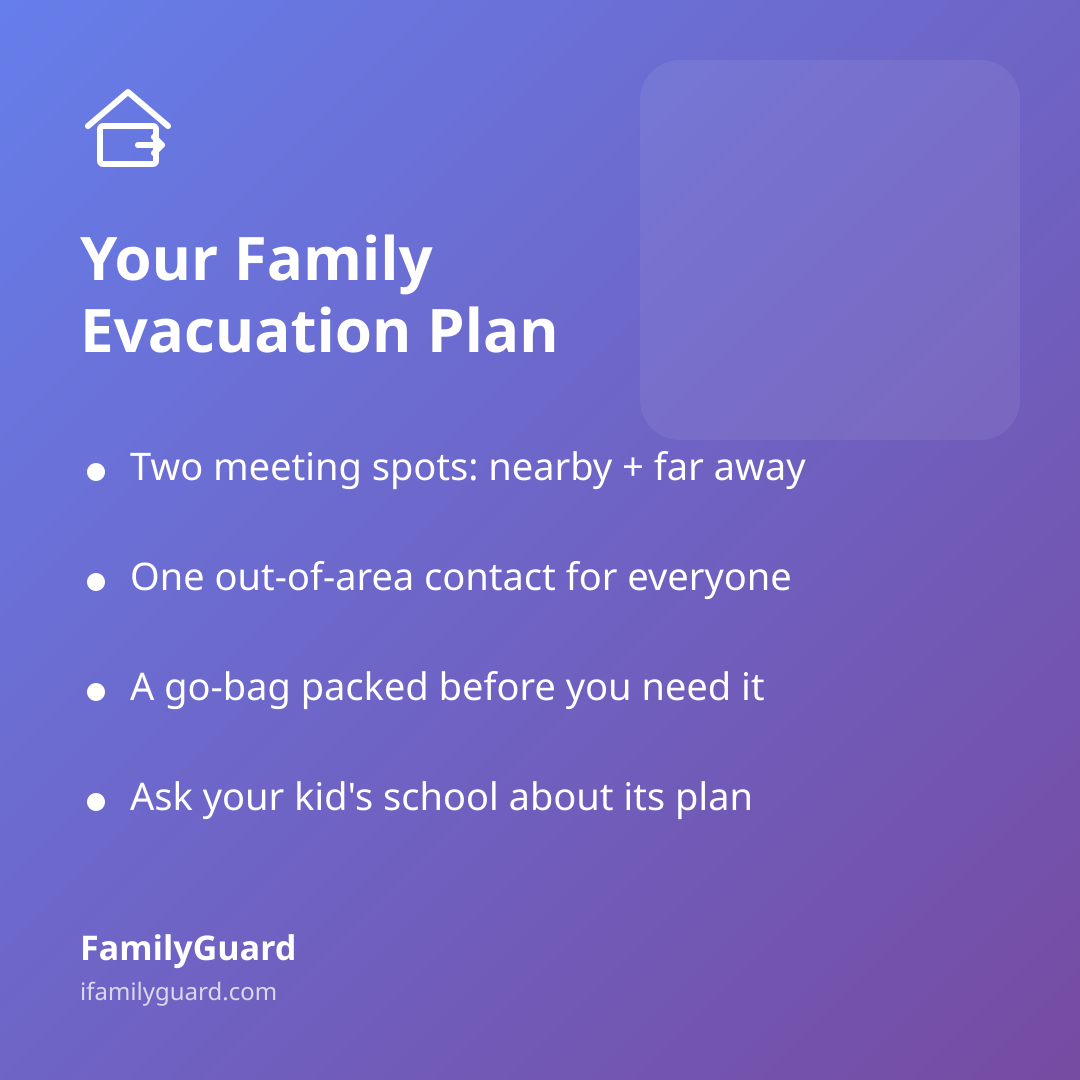
- Two meeting places: one near home, one farther away — written down, memorized by everyone
- One out-of-area contact everyone can call or text
- A go-bag packed and checked once a year
- A note of your kids' school evacuation and reunification procedure
- A quiet, no-pressure family conversation about the plan, revisited once or twice a year
The Point Isn't to Expect the Worst
Building this plan usually takes less than an hour spread across a few conversations, and most families who make one never need to use it in full. That's the goal — not to live braced for disaster, but to have already made the hard decisions in advance, so that if the moment ever comes, your family's first move is simply to follow the plan you already agreed on together.