Every family seems to have one: a group chat that started with good intentions and now sits mostly silent, except for the occasional "running 10 min late" or a meme nobody replies to. Parents send a message, and it lands with a thud — seen, maybe, but not answered. It's easy to take this personally. It's rarely about you.
Kids and teens don't avoid family chats because they don't care. They avoid them because the chat has become a place where they only hear from you when something is wrong, late, or expected of them. The fix isn't a stricter rule about response times. It's rethinking what the chat is actually for.
Why Kids Mute the Family Chat
Put yourself in their shoes for a second. If a group chat only ever contains logistics ("pick up time?"), reminders ("don't forget your dentist appointment"), or mild nagging ("where are you?"), muting it is just... efficient. It's not disrespect. It's the same thing you'd do with a chat that was 90% notifications and 10% anything you'd actually want to read.
Teens especially are building their own communication habits elsewhere — fast, casual, often funny. Research from Pew Research Center found that 61% of young adults text with their parents a few times a week or more, which is encouraging — it shows texting is already a comfortable channel between generations. The opportunity isn't getting kids to text their family. It's making the group chat itself a channel worth having open.
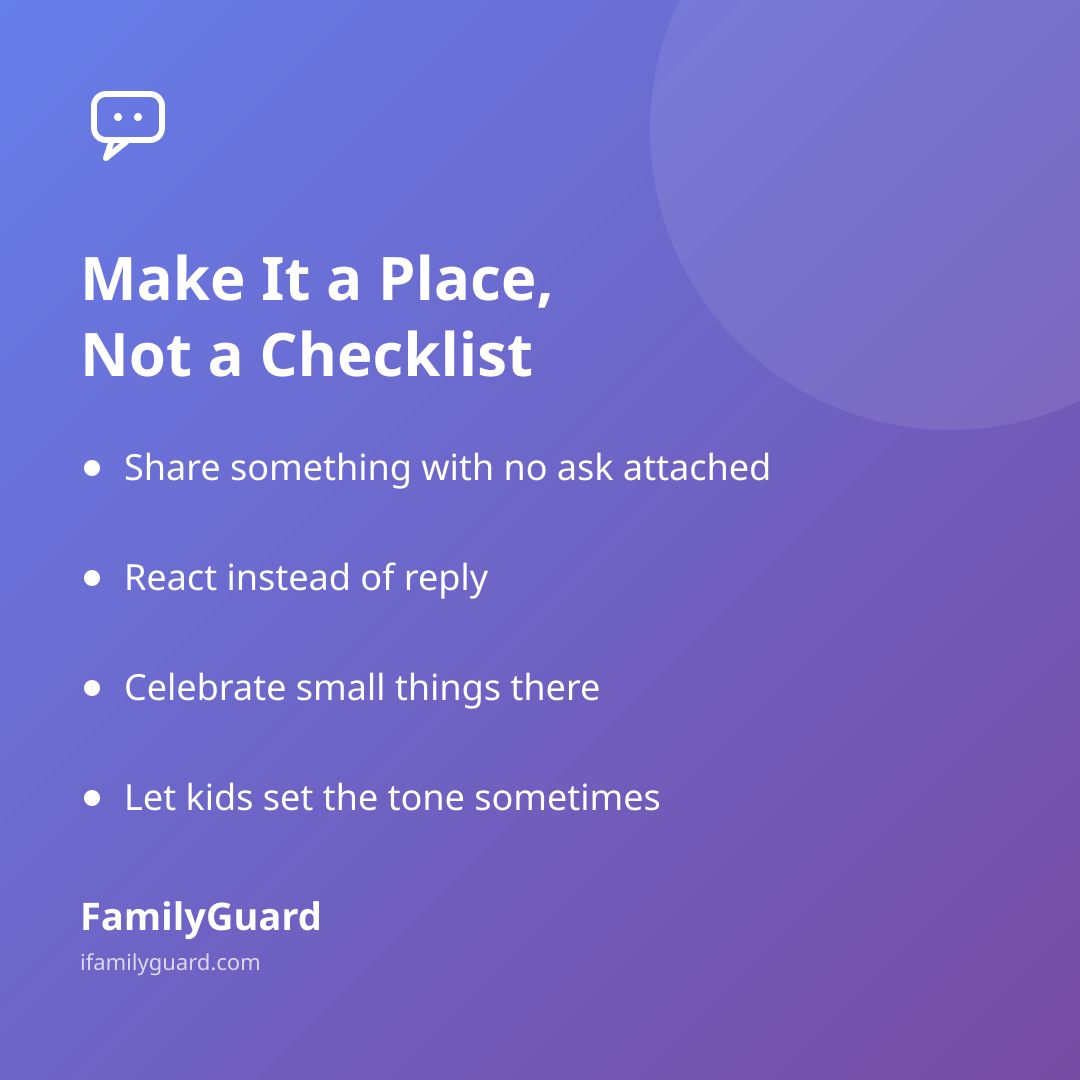
Make It a Place, Not a Checklist
The family chats that stay active tend to have one thing in common: they're not exclusively functional. Logistics live there, sure, but so does everything else — a dumb joke, a photo of the dog doing something ridiculous, a "this reminded me of you" link. If the only notifications your kids get from the family chat are tasks, the chat starts to feel like an extension of chores.
A few small shifts tend to help:
- Share something with no ask attached. A funny video, a photo from your day, a song. No response required — that's the point.
- React instead of reply. A thumbs-up or a laughing emoji on something a sibling posted takes two seconds and signals "I saw this and I'm glad you shared it," without demanding a conversation.
- Celebrate small things there. A good grade, a goal scored, a tricky day survived — the chat becomes a place good news goes, not just a place problems get managed.
- Let kids set the tone sometimes. If your teen wants to rename the group chat something embarrassing or pick a group photo, let them. Ownership makes a channel feel like theirs, not just yours.
Separate "Urgent" From "Everyday"
One reason kids tune out a group chat is that every message arrives with the same weight. If "what do you want for dinner" and "call me right now" look identical, it's hard to triage — so everything gets the same low-priority glance, or none at all.
It helps to agree, as a family, on how urgency gets signaled. That might be as simple as a word everyone uses for "actually time-sensitive" messages, or relying on a call or a direct ping for anything that truly can't wait. Some families keep day-to-day "arrived safely" check-ins separate from the group chat's more social, lower-stakes traffic — using a dedicated arrival or location-check feature, like the one built into FamilyGuard, instead of the family chat itself, so routine logistics don't compete with the conversation everyone actually wants to have.
Match the Chat to the Kid
Not every child engages the same way, and that's fine. A younger kid might love a chat full of stickers and photos. A teen might only really show up for quick, dry humor and the occasional useful logistics update — and that's still a win if it means they're reading it. Trying to force the same tone and expectations on a nine-year-old and a sixteen-year-old in one group chat often backfires.
If your family is big enough, a smaller "just us two" thread alongside the main family chat can also help. Teens in particular often open up more in a smaller, lower-pressure space than in front of siblings and parents at once. Neither replaces the other — the group chat is for shared family life, the smaller thread is for the individual relationship.
When Silence Isn't a Red Flag
It's worth separating two very different things: a chat that's quiet because it's become a chore, and a chat that's quiet because your teen is simply going through a normal stretch of wanting more independence. Pulling back from constant chatter with parents is a typical and healthy part of adolescence, not evidence that something is wrong.
The goal isn't maximum message volume. It's making sure that when something does matter — a change of plans, a bad day, a need for help — the family chat is a channel your kid actually trusts and checks, rather than one they've long since muted. That trust gets built slowly, in the ordinary, low-stakes messages, long before it's ever tested by something urgent.
A Few Habits Worth Trying This Week
- Send one non-logistical message a day — a photo, a joke, a "thinking of you."
- React to messages even when you don't have time to reply properly.
- Ask your kids what would make the chat better, and actually make the change.
- Keep genuinely urgent messages distinct from everyday chatter, by word or by channel.
- Don't track response times — notice whether the chat gets opened, not whether every message gets a reply.
A family group chat that works isn't the one with the strictest rules. It's the one that earns a place in your kid's attention because it's actually worth checking — a small, steady habit that keeps everyone a little more connected, one unremarkable message at a time.