Somewhere between "track everything, always" and "turn it off completely" is where most families actually need to land. If your teen has ever asked to pause location sharing for a few hours, or quietly stopped checking in as often, it doesn't necessarily mean something is wrong — it might just mean they're asking for a little more room to breathe inside a system that still keeps them safe.
Location sharing works best as a living agreement, not a fixed setting. And one of the most overlooked parts of that agreement is privacy: the idea that a teen can have moments that are theirs, even while the family's safety net stays in place.
The all-or-nothing trap
A lot of families fall into a binary: either location sharing is on all the time, for everything, or it gets switched off entirely. That binary is exactly what pushes some teens to disengage completely rather than negotiate.
Research backs this up. In a study of 729 adolescents published in the Journal of Family Psychology, about half reported their parents were tracking their location digitally — and the researchers found that this kind of tracking was only weakly related to how much parents actually knew about their teen's day-to-day life, and was linked to more behavior problems among adolescents who experienced it as controlling rather than caring (Burnell et al., Journal of Family Psychology, 2023). Earlier research from the Pew Research Center found that 46% of teen app users had turned off a location-tracking feature specifically because of privacy concerns, with girls far more likely to do so than boys — 59% versus 37% (Pew Research Center, 2013).
Put together, these findings point to a simple pattern: when tracking feels like surveillance instead of care, teens find a way around it — often by abandoning it altogether. Building in some flexibility from the start tends to keep the whole system working.
What "privacy within safety" can actually look like
Privacy doesn't have to mean the family can't see anything. It can mean agreeing, together, on specific moments or places where checking the map isn't necessary — because the safety net is still there if it's truly needed.
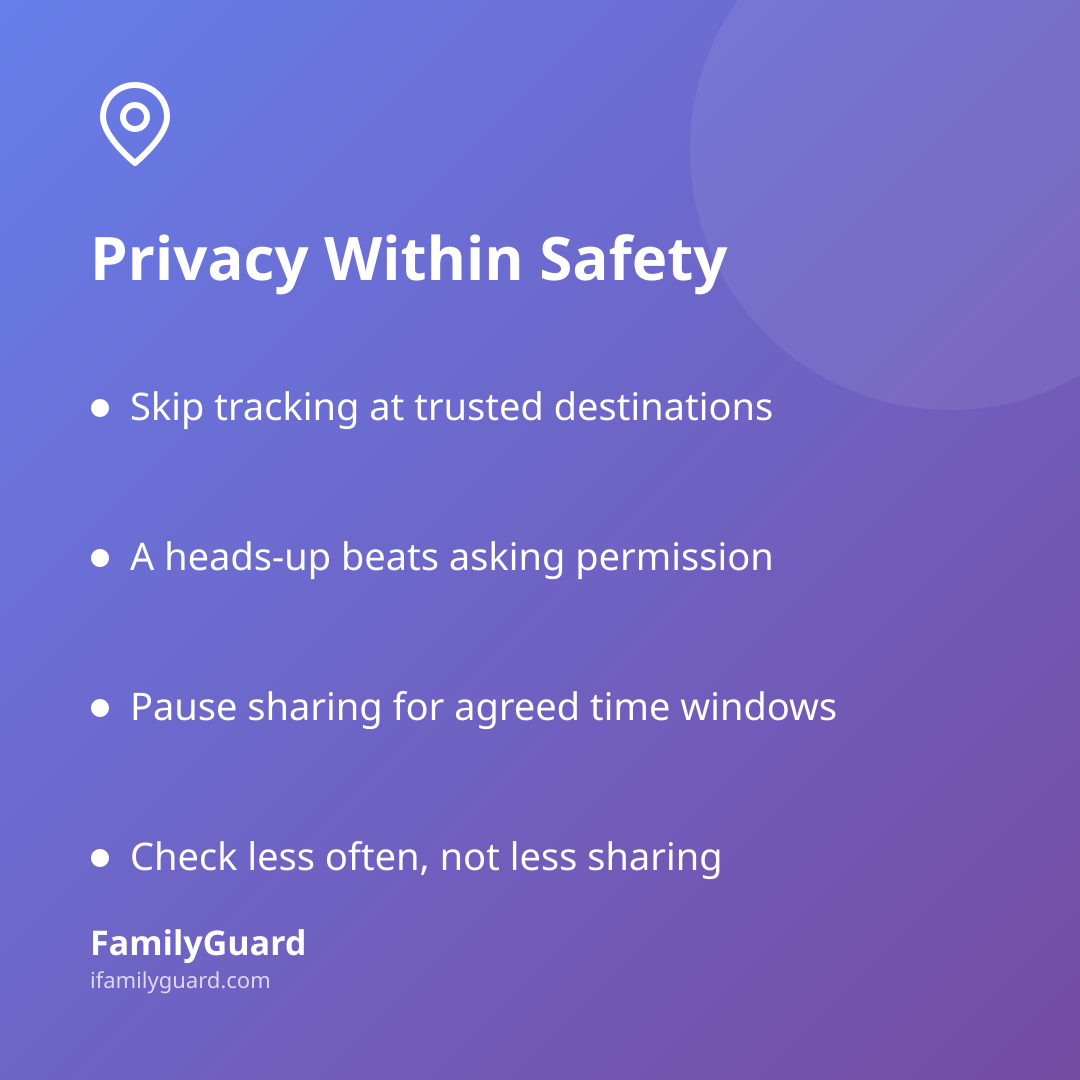
- Private, known destinations. If your teen is at a counselor's office, a religious youth group, or a friend's house you already know and trust, you may not need to watch the dot move the whole time they're there.
- A heads-up instead of a request. Instead of "can I turn this off," encourage "I'm going to be at Mia's for a few hours, I'll text when I leave" — the map stays on, but nobody's staring at it.
- Pausing for specific, agreed windows. Some families agree that sharing pauses during a therapy session or a sensitive appointment, with an understanding of when it resumes.
- Less frequent checking, not less sharing. The setting can stay the same while the habit changes — checking once a day instead of several times, for example.
The common thread is that these aren't loopholes — they're agreements. The difference between a teen quietly disabling location sharing out of frustration and a teen asking for a specific, time-limited pause is enormous. One erodes trust; the other builds it.
Making it a conversation, not a negotiation you win or lose
It helps to treat these requests as information rather than threats. A teen asking for more privacy is usually telling you they're growing, not that they're hiding something. The goal of the conversation isn't to "win" back full visibility — it's to find a version of sharing that both of you can actually live with.
A few questions can keep the conversation productive:
- What specifically feels uncomfortable about always being visible?
- Is there a place or time this is really about, or is it about the general feeling of being watched?
- What would make you comfortable keeping the emergency option on, even if everyday checking goes down?
This is also where tools matter less than the agreement behind them. Apps like FamilyGuard are built around the idea that sharing is a family-wide, consent-based choice rather than a one-way setting — features like pausing sharing for a set period, or defining specific smart zones, exist precisely so families can adjust how much is shared, when, without anyone feeling like they have to go dark to get a bit of space.
Keeping the safety net intact while privacy grows
The point of any of this isn't to loosen safety — it's to make sure the safety net survives the teenage years instead of getting cut off altogether. A few things tend to help:
- Keep the emergency layer non-negotiable. One-tap SOS, knowing how to reach each other quickly, and a shared understanding of what counts as an emergency should stay constant even as everyday location checking flexes.
- Revisit the agreement on a schedule, not just in the heat of an argument. A quick check-in every few months — "is this still working for both of us?" — normalizes change instead of treating every request as a crisis.
- Notice the difference between privacy and disappearing. A teen who wants a quiet hour at a friend's house is different from one who consistently can't be reached and avoids explaining why. The first is normal development; the second is worth a direct, calm conversation.
It's worth remembering that privacy requests, in context, are often a sign the relationship is healthy enough for your teen to ask directly rather than work around you. That's generally worth encouraging, even when it means adjusting a setting you'd rather leave as is.
A system that bends instead of breaks
No single setting will fit a family for years at a stretch. The teens who keep location sharing on into their late teens and beyond are rarely the ones who were monitored most closely — they're usually the ones who felt like the system adapted to them as they grew. Building in privacy isn't a concession that weakens safety; it's often what keeps the whole arrangement standing long enough to matter when it's really needed.