
If you've ever lain awake wondering whether your child is on their tablet too much, you're not alone — and you're not failing. Screen time is one of the most asked-about topics in parenting, partly because the advice keeps shifting and partly because every family's rhythm looks different. The good news is that healthy boundaries don't require a stopwatch or a perfect number. They require a plan that fits your child's age, your household's routines, and the kind of relationship you want to have with technology together.
What the Experts Actually Say
It helps to start with what's actually backed by research, rather than what shows up in alarming headlines.
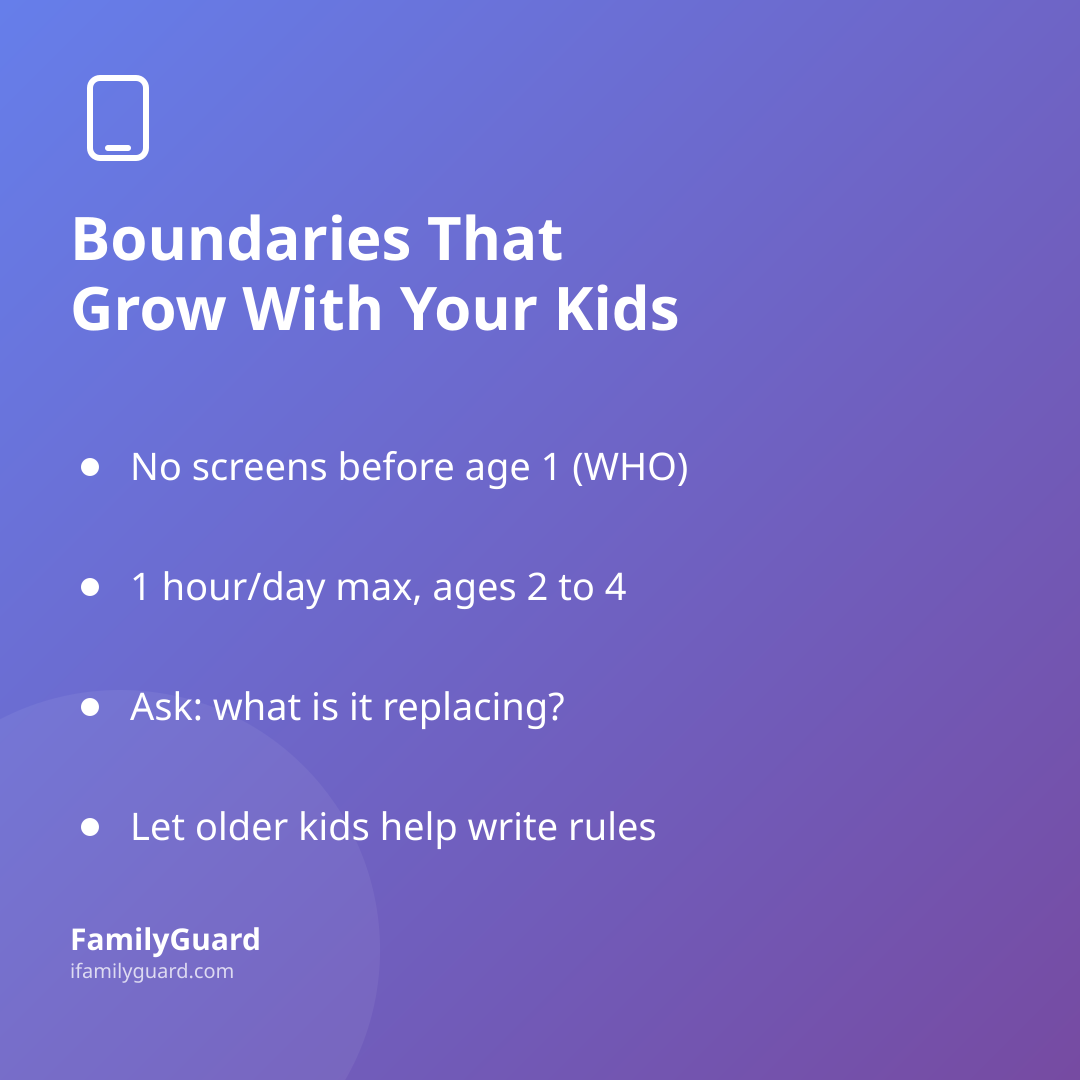
The World Health Organization's guidelines on physical activity, sedentary behaviour and sleep for children under 5 (2019) recommend no screen time for infants under 1, and no more than one hour a day of sedentary screen time for children aged 2 to 4, with less being better. The emphasis isn't just about screens in isolation — it's about making sure young children get enough sleep and active play, since those years matter enormously for development.
For school-age kids and teens, the American Academy of Pediatrics has moved away from a single hours-based rule for older children. Instead, the AAP encourages families to build their own Family Media Plan that weighs content quality, co-viewing, and what screen time is replacing — sleep, homework, outdoor play, face-to-face time. In its policy on children's programming, the AAP also notes that children under 6 have a harder time separating fantasy from reality, which is worth keeping in mind when choosing content, not just counting minutes.
In short: for the youngest kids, less genuinely is more. For older kids, the conversation shifts from "how many hours" to "what's this replacing, and is it good for them?"
Why Quality and Context Matter More Than the Clock
Thirty minutes of a video call with grandma, thirty minutes of a creative art app, and thirty minutes of fast-cut, ad-heavy content are not the same thing — even though they'd all count equally on a timer. A more useful question than "how long" is often:
- What is this replacing? If screens are crowding out sleep, meals, or outdoor time, that's the real red flag — more than the number on the clock.
- Is my child watching or playing alone, or are we doing it together? Co-viewing turns screen time into shared time, and gives you natural openings to talk about what's on the screen.
- Does this content fit their age and temperament? A sensitive 7-year-old and a laid-back 11-year-old might need different boundaries for the same show or game.
- How do they feel afterward? Wired, irritable, and hard to disengage is a different signal than calm and ready to move on.
None of this means screens are the enemy. Video calls with distant family, collaborative games with friends, creative apps, and even some downtime scrolling can be perfectly healthy parts of a balanced day. The goal is intention, not elimination.
Boundaries That Flex as Kids Grow
A rule that works for a 6-year-old will feel suffocating — or simply won't apply — to a 14-year-old. Rather than one fixed rule, think of screen-time boundaries as something you renegotiate together every year or two, the same way bedtimes and curfews evolve.
A few approaches that tend to hold up well across ages:
- Protect the non-negotiables first. Sleep, meals, homework, and physical activity get priority; screens fill in around them, not the other way around.
- Set "where," not just "how long." Many families find device-free zones — the dinner table, bedrooms at night, the car on short trips — easier to enforce consistently than a daily minute count.
- Let older kids help write the rules. Teens especially are far more likely to stick to a boundary they helped set than one that was simply handed down.
- Revisit the plan out loud. A quick check-in every school term — "is this still working for you?" — keeps the rules from feeling frozen in time or arbitrary.
- Model it yourself. Kids notice when the "put the phone away" rule only applies to them. Shared family screen-time habits land better than one-way restrictions.
Talking About Limits Without the Power Struggle
Boundaries stick best when they're explained, not just enforced. Instead of "because I said so," try framing limits around what you're protecting — sleep, mood, time together — rather than what you're taking away. If a conversation about limits turns into a daily argument, that's often a sign the current plan needs adjusting, not that your child is being difficult.
It can also help to separate screen-time talks from other digital-safety conversations your family is already having, like device permissions or who can see what online. For instance, some families use the same check-in moment where they talk about parental controls to also talk about daily screen-time expectations — it keeps the message consistent: these are shared agreements, not surprise rules. Tools that show device and battery status, like FamilyGuard, can also give parents a gentler way to notice patterns — say, a phone that's clearly still active well past bedtime — without needing to read messages or monitor every app individually.
A Quick Screen-Time Checklist
If you're building or refreshing your family's approach this month, these questions can anchor the conversation:
- Does our current plan protect sleep, meals, and movement first?
- Are there clear device-free times or places everyone — adults included — follows?
- Have we talked with our child about why these boundaries exist, not just what they are?
- Is the plan still appropriate for their current age, or is it time to revisit it?
- Do we have a simple way to notice when something feels off, without constant monitoring?
The Takeaway
There's no single number that works for every child or every family, and chasing one can create more stress than it solves. What actually helps is a plan built around your child's age and needs, revisited regularly, and talked about openly rather than imposed from above. Screens aren't going anywhere — but with a little structure and a lot of conversation, they don't have to crowd out the rest of a happy, well-rested childhood.

Sources
- World Health Organization — Guidelines on Physical Activity, Sedentary Behaviour and Sleep for Children Under 5 Years of Age (2019)
- American Academy of Pediatrics / HealthyChildren.org — How to Build Healthy Digital Habits: 5 Tips for Families (Family Media Plan)
- American Academy of Pediatrics / HealthyChildren.org — Where We Stand: Children's Programming (2018)
- American Academy of Pediatrics / HealthyChildren.org — Parental Controls: Setting Safe & Healthy Media Limits