
At some point, usually with very little warning, the question arrives: "Can I get a phone?" Maybe it's because friends have one, or because a new school commute means more time without you nearby. Whatever sparks it, that first phone is a real milestone — for your child and for you. It's normal to feel a mix of excitement and unease about handing over a device that opens up, well, the entire internet.
The good news is that a calmer handoff doesn't come from finding the "perfect" age. It comes from doing a bit of groundwork beforehand — some settings to check, a few things to agree on together, and a conversation or two that matter more than any app ever will.
There's No Single "Right" Age — Just a Right Readiness
If you're looking for a magic number, you won't find one. According to Common Sense Media's 2021 Census on media use by tweens and teens, 53% of U.S. children already own a smartphone by age 11. Separately, a 2025 study led by Sapien Labs, published in the Journal of Human Development and Capabilities, found that young adults who'd gotten their first smartphone at age 12 or younger reported somewhat lower average wellbeing — in areas like mood and social confidence — than those who got one later. The study measured a correlation, not a direct cause, so it's a data point to weigh rather than a verdict on any one child. Neither number is a rule to follow blindly. What matters more is whether your child can already handle some version of the responsibilities a phone brings: following through on routines, telling you when something online feels off, and respecting agreed-upon limits without constant reminders.
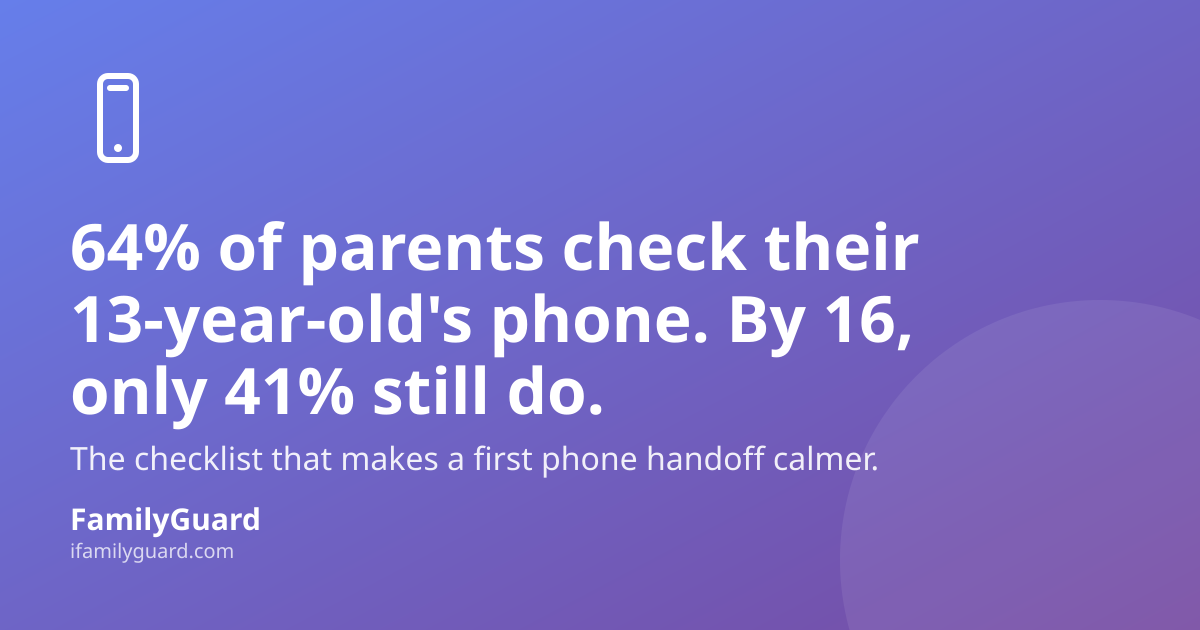
It's also worth knowing that trust naturally shifts as kids get older. Pew Research Center's 2024 survey on teens and screen time found that 64% of parents of 13- to 14-year-olds say they look through their teen's phone, compared with 41% of parents of 15- to 17-year-olds — a reminder that whatever you set up now is a starting point, not a permanent arrangement.
Before You Hand Over the Phone: A Setup Checklist
Doing this setup together, rather than as something done "to" the phone before your child even sees it, tends to go over better. Walk through it side by side so it feels like part of the gift, not a condition attached to it.
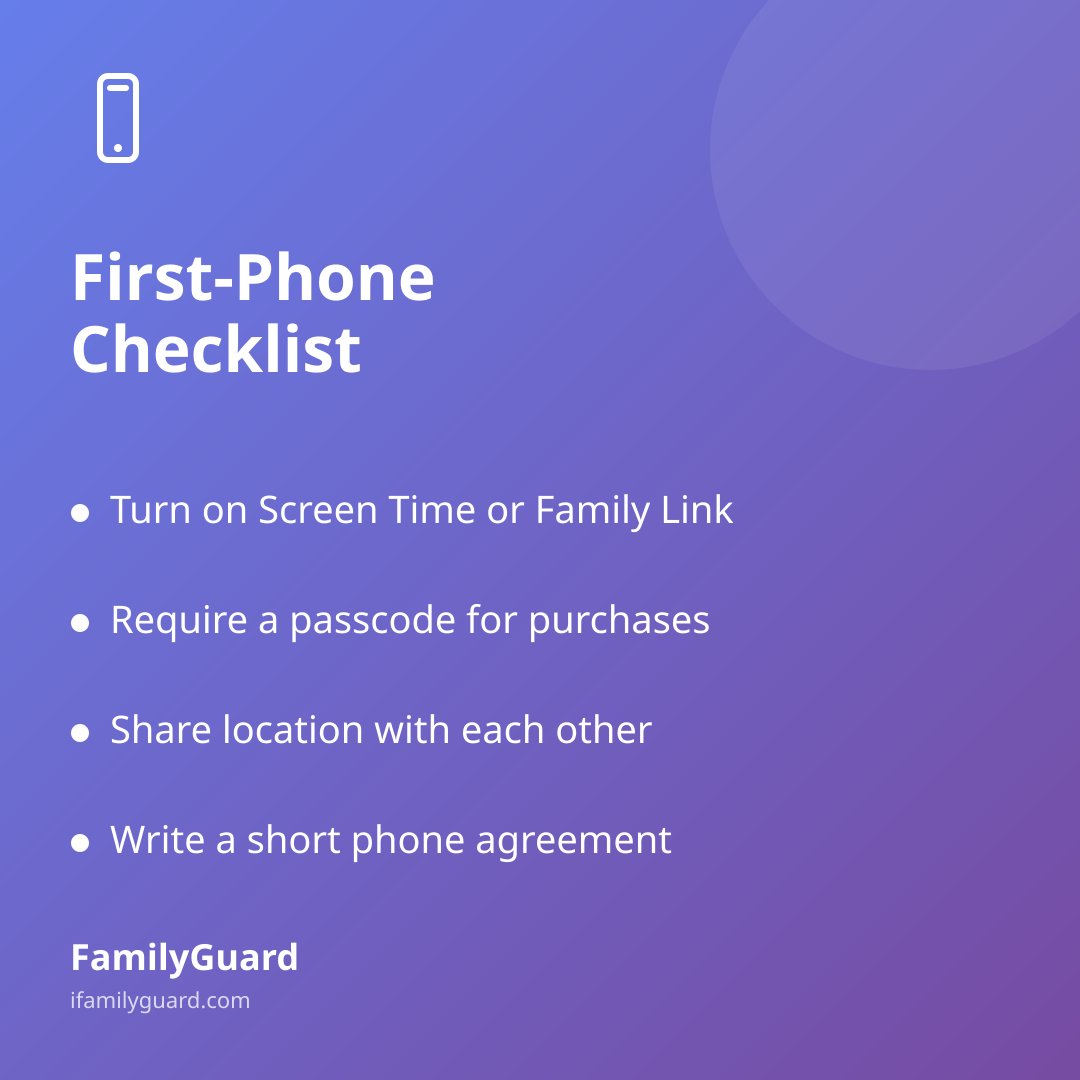
- Turn on built-in parental tools. Screen Time on iPhone or Family Link on Android let you set app limits, restrict content by age, and require your approval for new downloads.
- Disable in-app purchases or require a passcode for them, so a free game doesn't quietly turn into a real bill.
- Set a few device-free windows — during homework, meals, and an hour or so before bed — rather than trying to police every minute of use.
- Agree on who can reach your child and how unknown numbers or messages get handled.
- Turn on location sharing within the family, with your child's knowledge, so everyone can see where everyone is and check in with a tap instead of a string of "where are you?" texts. An app like FamilyGuard makes this part simple — pairing is just a quick QR code scan, and the sharing only ever goes between family members who've agreed to it.
- Save a short list of emergency contacts directly on the lock screen, so help is reachable even before the phone is unlocked.
Write It Down: A Simple Family Phone Agreement
A spoken "just be careful" rarely holds up a month in. A short written agreement — even a few lines on a sticky note on the fridge — gives both of you something concrete to refer back to when questions come up later, instead of relitigating the rules from scratch.
Good agreements are usually short and cover:
- When and where the phone is used, and where it isn't (bedrooms at night, the dinner table)
- Which apps are allowed to start, with a plan for how new ones get approved
- What happens if a rule is broken — ideally something proportionate and known in advance, not decided in the heat of the moment
- How location sharing and check-ins work, and that it's a two-way, mutual thing rather than one-sided monitoring
Letting your child help draft this list, rather than just signing off on yours, tends to make it stick. Kids who feel like co-authors of a rule are more likely to actually follow it than kids who feel it was simply handed down.
The Conversation That Matters More Than Any Setting
No parental control catches everything, and that's fine — it was never supposed to be the whole plan. The real safety net is your child feeling comfortable telling you when something online confused them, scared them, or just felt off, without worrying the phone will be confiscated on the spot as punishment for being honest.
If the first reaction to "something weird happened online" is losing the phone, kids learn to stop telling you things. If the first reaction is curiosity and calm, they keep coming to you.
A few conversation starters worth having before day one:
- "What would you do if a stranger messaged you?"
- "What's something that would make you want to put the phone down and come find me?"
- "If you ever made a mistake with this — downloaded something you shouldn't have, clicked a weird link — what do you think would happen?"
Let your answers to that last one be reassuring. The goal of a first phone isn't zero mistakes; it's a kid who knows mistakes are recoverable and worth mentioning.
Giving the Checklist Room to Change
Whatever you set up this week won't be the final version. Screen time limits, which apps are allowed, how often you check in — all of it should loosen or tighten as your child shows you how they handle the responsibility. Treat the first phone less like a locked-down device and more like a starting configuration you'll revisit together in a month, then again in six.
That ongoing conversation — not the initial settings — is really what makes a first phone go well. The checklist gets you through the first week calmly. The relationship is what carries you through the years after.