
Your child's phone buzzes with a small ghost icon, a number next to a friend's name climbs by one, and a photo opens, gets a glance, and vanishes. To a parent watching from across the room, it can look mysterious — even a little unsettling. To your child, it's just Tuesday. Disappearing-message apps like Snapchat have become one of the most common ways teens stay in touch with friends, and understanding how they actually work is the first step toward a calmer, more honest conversation about them.
This isn't about banning an app or treating your child like a suspect. It's about knowing enough to ask good questions, set sensible boundaries together, and keep the lines of communication open — which, research consistently shows, matters more than any single rule.
Why These Apps Feel Different From Regular Texting
Apps built around disappearing content work differently from a normal group chat. A photo or video — often called a "snap" — is viewed for a few seconds and then disappears from the conversation. There's also a private, passcode-locked space (Snapchat calls it "My Eyes Only") where a user can store snaps only they can see.
For a teenager, the appeal is obvious: it feels casual, low-stakes, and private, which encourages sending silly, unfiltered moments they might never post anywhere permanent. That's not automatically a bad thing — plenty of ordinary, harmless teenage communication happens this way. But the sense of privacy can also create a false feeling that nothing sent this way has consequences.
The Quiet Pressure of the Streak
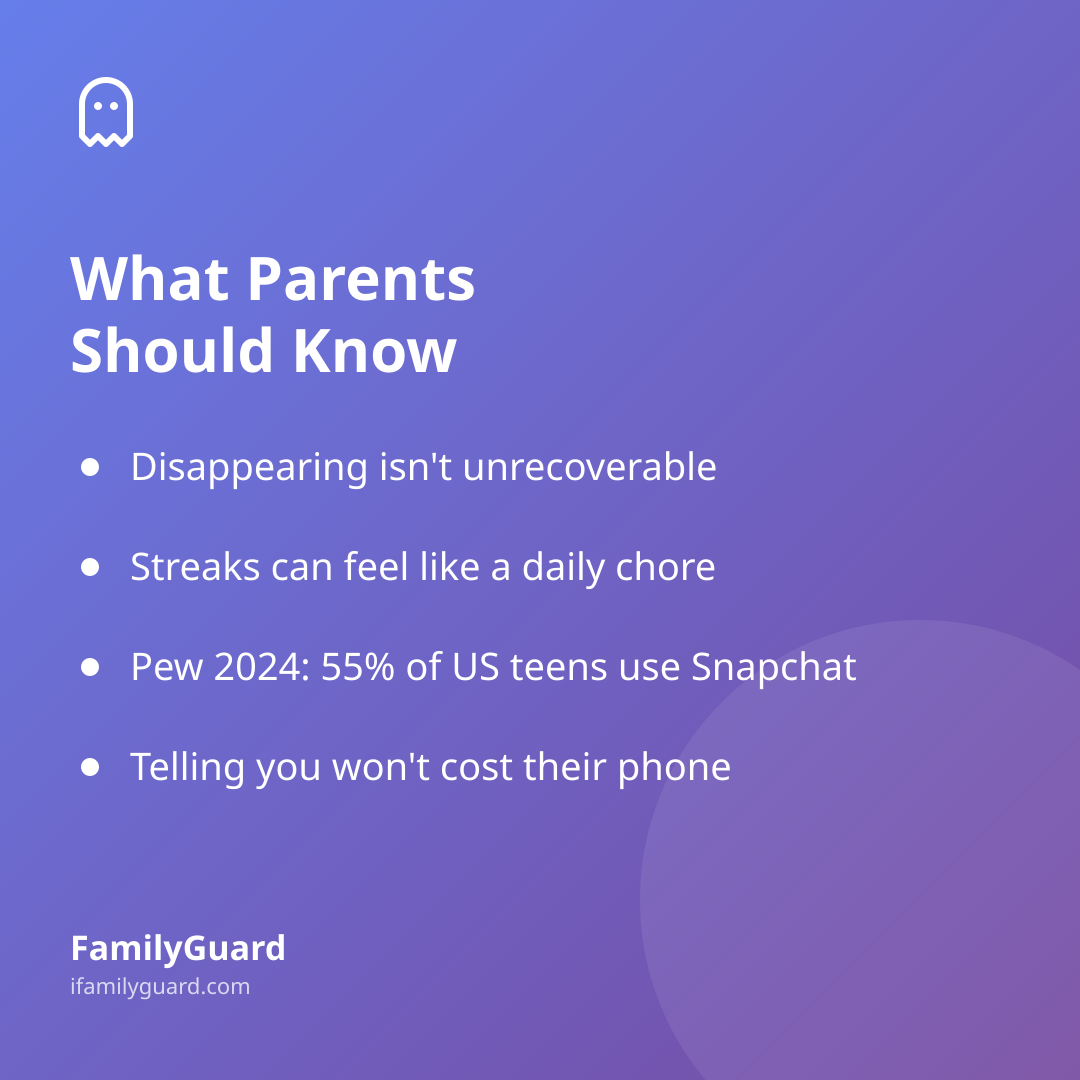
One feature worth knowing about by name is the "Snapstreak" — a running count of how many consecutive days two friends have exchanged snaps. For many teens, a streak becomes a small daily obligation, almost like a tiny relationship score. Losing one, even by accident, can feel surprisingly upsetting.
This pressure is worth naming out loud rather than dismissing. A gentle conversation might sound less like "stop worrying about a number" and more like:
- "What happens if a streak breaks — does it actually change the friendship?"
- "Do you ever feel like you have to send something just to keep a streak going, even when you don't feel like it?"
- "Is there a friend where the streak feels more like a chore than fun?"
These questions invite your child to reflect rather than defend, which tends to open up far more honest answers than a flat rule like "no more streaks."
What "Disappearing" Actually Means
It's worth being direct with your child about one technical reality: disappearing doesn't mean unrecoverable. Snapchat notifies the sender when a recipient takes a screenshot, but that protection has real limits — a second phone pointed at the screen, a quick screen recording, or simply someone's memory can preserve a moment that was never meant to last.
The most useful family rule of thumb isn't about the technology at all. It's the same guidance that applies to anything shared digitally: if you'd be uncomfortable with a screenshot of it being seen by a teacher, a grandparent, or a future employer, it's not safe to send — disappearing or not. Common Sense Media's parent guide to Snapchat makes a similar point, noting that content can be saved or shared well beyond its intended lifespan, and encourages families to talk about this openly rather than relying on the app's safeguards alone.
Conversations That Work Better Than Rules
Banning an app outright often just pushes the behavior somewhere less visible — a second account, a borrowed device, a friend's phone. A more durable approach is building enough trust that your child comes to you when something feels off, whether that's an uncomfortable message, pressure from a friend, or confusion about something they saw.
A few starting points that tend to land well:
- Ask your child to show you around the app on their terms — most teens enjoy being the expert for once.
- Agree together on what kinds of photos or messages feel fine to send, and which ones don't, rather than issuing a one-sided rule.
- Revisit the conversation occasionally as your child gets older, since what feels right at 12 may need updating by 15.
- Make clear that coming to you about something uncomfortable — a screenshot, a mean comment, an unwanted message — will never result in losing the phone as punishment.
Pew Research Center's 2024 survey of US teens found that 55% use Snapchat, making it one of the most common platforms in this age group — which is exactly why it deserves a calm, informed conversation rather than alarm.
Keeping the Bigger Family Conversation Going
Disappearing messages are really just one small piece of a much bigger habit worth building: talking openly, as a family, about what happens online. Some families find it helpful to keep a separate, always-on space for everyday family talk — a group chat that's just for the people in your household — so there's a clear line between casual check-ins with friends and the conversations that matter at home. In FamilyGuard, the family chat feature works this way: a private space shared only with consenting family members, alongside location sharing and one-tap SOS, so the people you trust most are always easy to reach without it feeling like anyone is being watched.
The goal isn't to monitor every snap or screenshot. It's to make sure your child never feels alone with something confusing or upsetting that happened online — and that starts with staying curious, not alarmed, about the apps they actually use.