The first job is a milestone that sneaks up on parents. One week your teen is asking for a later curfew, and the next they're filling out a work permit and buying non-slip shoes for a shift at the smoothie shop. It's a proud moment — and also a quiet handoff of responsibility. Your teen is about to spend hours each week somewhere you've never been, reporting to adults you've never met, doing tasks they've never done before.
That's not a reason to worry. It's a reason to prepare, calmly and together, the same way you would before a sleepaway camp or a first solo drive. A little groundwork now means your teen walks into their first shift feeling capable, not just excited.
Why the first few months matter most
Workplace safety researchers consistently find that new workers face more risk early on, simply because everything is unfamiliar — the equipment, the pace, the hazards specific to that job. The U.S. Centers for Disease Control and Prevention's National Institute for Occupational Safety and Health (NIOSH) notes that young workers have elevated rates of job-related injury, much of it tied to "little or no prior work experience and a lack of safety training." In 2022, an estimated 26,900 emergency department-treated injuries occurred among 15-to-17-year-old workers in the U.S., and 19 work-related fatalities were recorded among workers under 18 — most injuries concentrated in retail, food service, and hospitality, the exact industries where many teens land their first jobs (CDC/NIOSH, 2022).
This isn't meant to be alarming — injury rates for young workers have actually fallen sharply over the past two decades. It's simply a reminder that the first weeks on any job are the ones worth paying a little extra attention to, the same way you'd watch more closely the first time your child rode a bike in traffic.
Know the rules before your teen does
Federal labor law sets real guardrails around teen work, and it helps to know them before your teen signs anything. Under the Fair Labor Standards Act, the minimum age for most non-agricultural jobs is 14. Workers who are 14 or 15 can only work outside school hours, generally no later than 7 p.m. (9 p.m. in the summer), for a maximum of 3 hours on a school day and 18 hours in a school week. Once a teen turns 16, federal law no longer limits their hours — though they're still barred from certain hazardous jobs like operating heavy machinery or working with dangerous chemicals (U.S. Department of Labor, Workers Under 18; Fact Sheet #43).
Many states add their own, often stricter, rules — on break requirements, closing-shift limits, or which equipment minors can operate. It's worth a quick search for your state's labor department page before your teen's first shift, so you both know what's reasonable to expect from an employer.
Build the plan together, not for them
The goal isn't to hover over your teen's new job — it's to make sure they feel equipped to handle it on their own. A short conversation before the first shift goes a long way. Useful things to cover:
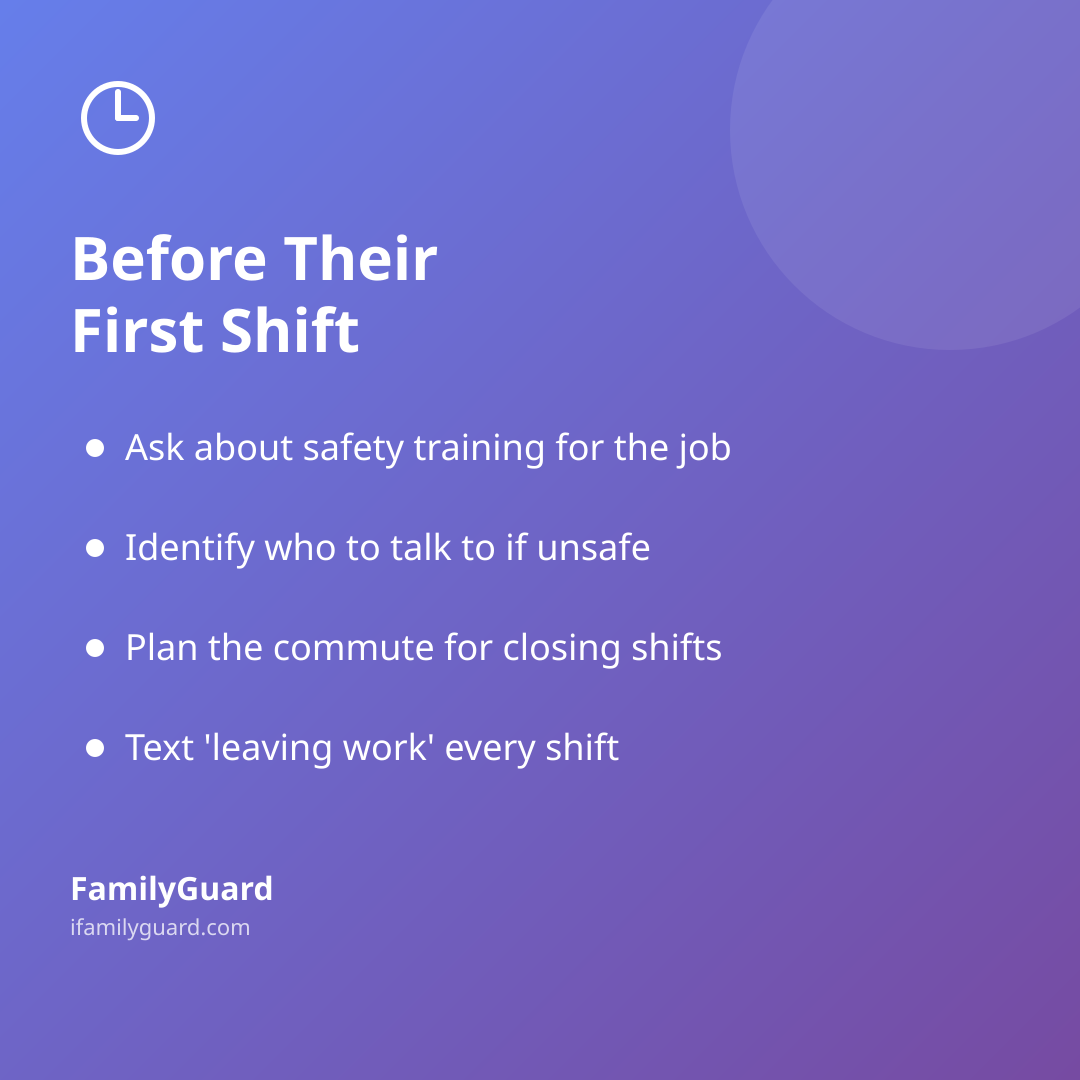
- The basics of the role: What will they actually be doing, and have they had any safety training for it — using a slicer, a fryer, a register, a ladder?
- Who to go to: If something feels unsafe, unfair, or just confusing, which adult at work should they talk to first?
- The commute: How are they getting there and back, especially for closing shifts that end after dark? Is it walking, driving, a bus, or a ride from a coworker?
- What to do if a shift runs long or plans change: A simple habit of sending a quick text when they're leaving work covers most of this.
- Their right to feel safe: Make clear that no job is worth staying somewhere that feels physically or emotionally unsafe, and that you'd rather get a call at 11 p.m. than have them figure it out alone.
These conversations work best when they feel like prep for independence, not a permission slip. Teens who feel trusted with real information tend to make more careful choices than teens who are simply told to "be careful."
Staying connected without hovering
Commuting to and from a job — often at odd hours, sometimes in the dark — is usually the part of a first job that makes parents most anxious, and it's also the easiest part to plan for. A simple agreement about when to expect a "leaving work now" message, and sharing location just for the commute rather than all day, respects a teen's independence while keeping everyone in the loop during the one window that actually carries some uncertainty.
This is exactly the kind of situational, time-boxed sharing that works better than blanket monitoring. A family safety app like FamilyGuard can make this lighter in practice — a quick, mutual way to see that someone has left work and is on the way home, or to send a one-tap alert if a ride falls through, without turning every shift into a check-in. The point isn't to watch the whole shift; it's to close the small, specific gap between "clocked out" and "walked in the door."
When something feels off
Most first jobs go fine. But it's worth preparing your teen for the handful of situations that warrant a phone call home — a supervisor asking them to do something that feels unsafe or outside their job, a coworker who makes them uncomfortable, a schedule that violates the hour limits for their age, or simply a gut feeling that something is wrong. Teens are far more likely to speak up in the moment if they've already heard, ahead of time, that doing so is not just allowed but expected.
"Little or no prior work experience and a lack of safety training" contribute to injuries among young workers — which is exactly why a short conversation before the first shift matters as much as any safety poster on the breakroom wall.
A proud moment, handled calmly
A first job is one of the clearest markers that your teen is growing up — new responsibility, a new routine, their own money. The role of a parent here isn't to manage the job for them, but to make sure they're walking in with the information, the rights, and the quiet backup they need to handle whatever comes up. A short conversation, a clear sense of who to call, and a light-touch way to stay connected during the commute cover most of what matters. The rest, your teen is more ready for than you might think.