There's a particular kind of worry that shows up the first time your child asks to go outside without you: down to the corner, over to a friend's yard, around the block on a bike. It's a small request that can feel surprisingly big. How much freedom is the right amount? And how do you say yes without spending the whole time watching the clock?
There's no single answer that fits every child or every street. But there is a way to think through it that takes the guesswork — and some of the anxiety — out of the decision.
Why Unsupervised Play Actually Matters
It's worth pausing on why this is worth figuring out at all, rather than just keeping kids close for as long as possible. The American Academy of Pediatrics has described play, including unstructured outdoor play, as important enough to child development that pediatricians should actively encourage it in well-child visits. According to the AAP's consumer site, HealthyChildren.org, time outdoors is linked to better motor development, sharper focus, lower stress and aggression, and even reduced symptoms of ADHD.
Unsupervised play adds something supervised play can't: real decisions with real, low-stakes consequences. Negotiating a game with neighborhood kids, deciding when it's time to head home, figuring out what to do when a ball rolls into the street — these are small exercises in judgment that kids only get to practice when an adult isn't standing there to solve the problem for them.
Signs Your Child Might Be Ready
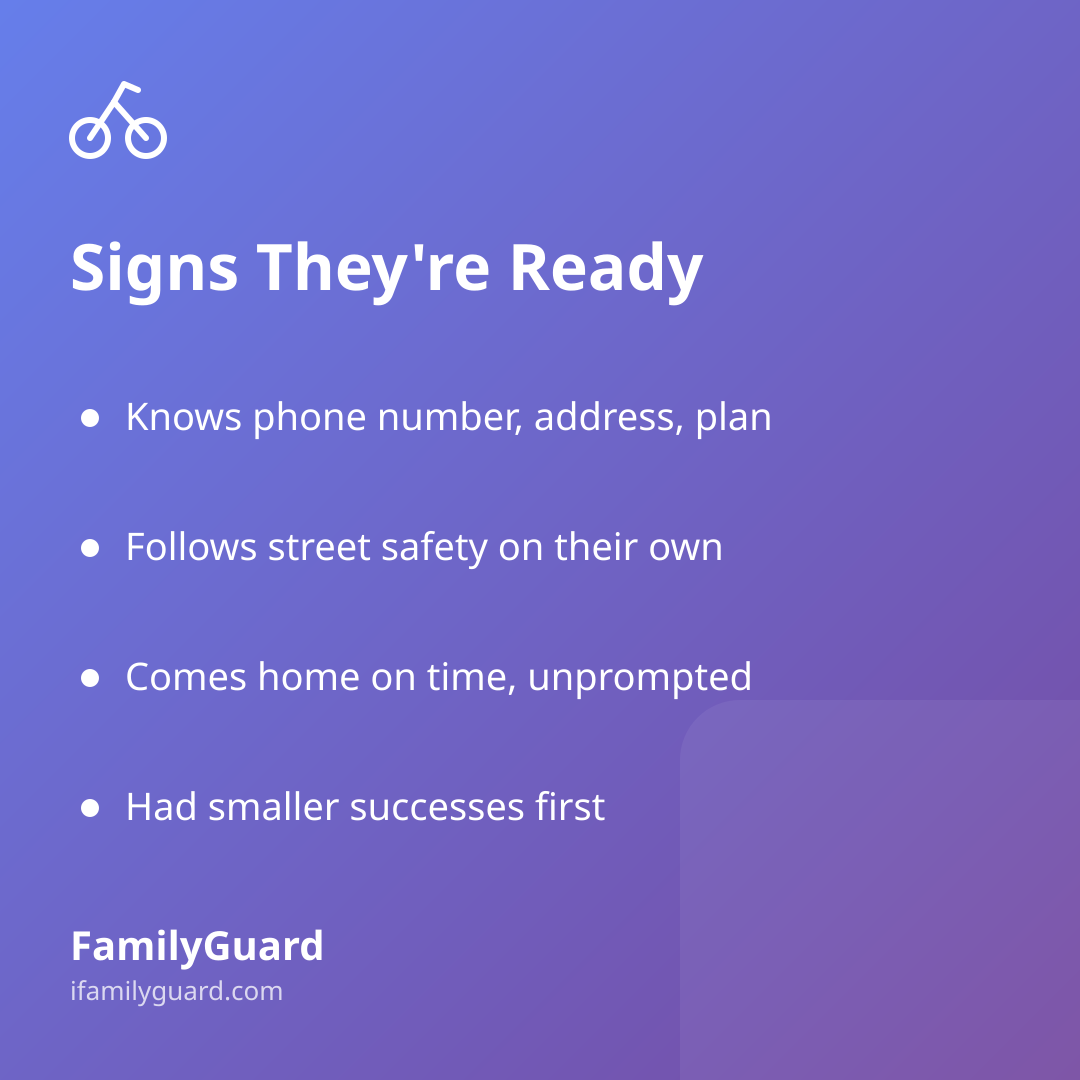
Age is a starting point, not a rule. Two ten-year-olds can have very different levels of readiness. Instead of asking "how old is old enough," it helps to ask a few more specific questions:
- Can they recite your phone number, address, and a plan for what to do if they're lost or hurt?
- Do they consistently look both ways and follow basic street safety, even when you're not reminding them?
- Have they shown they can come home, or check in, at an agreed-upon time without being chased down?
- Do they know the difference between an everyday bump or disagreement and something that actually needs an adult?
- Have they had smaller successes first — playing in the yard alone, walking to a mailbox, staying in a room while you're elsewhere in the house?
If most of these are a yes, a short, well-defined outing is a reasonable next step. If they're not quite there, that's useful information too — it points to what to practice before expanding the boundary, rather than a reason to close the door indefinitely.
What the Law Actually Says
Many parents hesitate not because they doubt their child, but because they worry about being judged — or reported — for letting a child play outside alone. That fear has prompted a wave of state legislation. As of 2026, thirteen U.S. states — including Utah, Texas, Colorado, Virginia, Georgia, and Florida — have passed what are known as "Reasonable Childhood Independence" laws, according to Let Grow, a nonprofit that tracks this legislation. These laws generally clarify that letting a child walk to a park, play outside unsupervised, or run a short errand alone is not, by itself, neglect.
You don't need a law on the books to make a thoughtful decision for your own family, but it's reassuring to know that lawmakers in a growing number of states have formally recognized what many parents already sense: ordinary childhood independence and neglect are not the same thing.
Building a Simple Plan Together
The goal isn't to hand over unlimited freedom on day one — it's to agree on a clear, small boundary and grow it as trust builds. A short conversation before the first outing goes a long way:
- Set the boundary out loud. "You can go to the Petersons' yard and back, nowhere else" is easier to follow than a vague "stay close."
- Agree on a check-in time. A specific time to be home, or a quick text or call halfway through, keeps everyone relaxed.
- Talk through the "what ifs." What do you do if it starts raining, if a stranger approaches, or if a friend wants to go somewhere new?
- Decide together what counts as an emergency versus something they can handle or tell you about later.
For families who like a little extra peace of mind while the habit is forming, some tools can help without turning the outing into something it isn't. FamilyGuard, for instance, lets families set up smart zone alerts — like a gentle notification when your child arrives at or leaves an agreed-upon area — so you have a quiet way to confirm the plan is being followed, without calling or texting every ten minutes. Because it's built on location sharing that both you and your child can see and agree to, it stays in the spirit of the outing: a bit more freedom, backed by an honest, two-way agreement rather than quiet checking-up.
Starting Small and Growing From There
If this is new territory for your family, there's no need to jump straight to "wander the neighborhood for the afternoon." A gradual sequence works better for almost everyone:
- Unsupervised time in the yard or a fenced area, in view of a window.
- A short walk to a nearby house or mailbox and back, on a known route.
- Playing at a nearby park or friend's house for a set, short window of time.
- Slightly longer outings with a friend, once check-ins have gone smoothly a few times.
Each successful step is evidence — for both of you — that the next one is manageable. If something doesn't go as planned, it's rarely a sign to shut the door on independence altogether; it's usually just a cue to shorten the boundary and try again.
A Gift, Not Just a Risk to Manage
It's easy to frame this decision entirely around risk — what could go wrong, how far is too far, what if. But for kids, that walk around the block or that afternoon at the park with friends is also where confidence gets built. The goal isn't to eliminate every worry before saying yes; it's to prepare your child well enough, and stay connected enough, that you can say yes and mean it.
Every child moves through this at their own pace. The right amount of freedom is the amount your specific child is ready for this week — not a number in a book, and not what the family down the street is doing.