If your child has recently asked a chatbot to explain a math problem, summarize a reading assignment, or help brainstorm an essay, they are far from alone. AI tools have quietly become part of homework routines in millions of households, often before parents have had a chance to think through what that means. The good news is that this doesn't have to be a source of worry. With a little conversation and a few simple family agreements, AI can be a genuinely useful study companion rather than a shortcut that undermines learning.
How Common Is This, Really?
According to Common Sense Media's 2026 Census on AI use by tweens and teens, 86% of kids ages 9 to 17 have now used AI in some form, and 85% of those who use AI have applied it to schoolwork or homework specifically. Children who struggle with focus or find certain subjects difficult are especially likely to reach for AI tools regularly.
What stands out most in the research isn't the usage itself, but the gap around it. The same census found that three-quarters of kids say their school has set some kind of rule about AI, yet just over half report being taught how to use it safely or responsibly. Even more striking: more than 4 in 10 kids say no parent or guardian has ever talked with them about AI at all. In other words, kids are experimenting with a powerful new tool largely on their own.
What Healthy AI Homework Help Looks Like
It helps to think of AI the way you might think of a calculator or a search engine: a tool that can support learning or quietly replace it, depending on how it's used. Used well, AI can help a child understand a concept they're stuck on, check their own reasoning, or get unstuck when staring at a blank page. Used poorly, it becomes a way to skip the thinking altogether and turn in work that isn't really theirs.
A separate Common Sense Media survey (2024) found that many teens are already aware of this tension. Roughly 4 in 10 teens who use AI say it leads them to generate fewer ideas of their own, and a similar share admit they feel like they're missing out on real learning when AI does too much of the work for them. That self-awareness is actually a helpful starting point for a family conversation, because it means most kids aren't looking to be sneaky, they're looking for guidance.
Starting the Conversation
The goal isn't to interrogate your child about every chatbot query. It's to open a relaxed, ongoing dialogue, similar to how you'd talk about any other tool they use for school. A few starting points that tend to work well:
- Ask what they've used AI for lately, out of curiosity rather than suspicion.
- Try a homework-help tool together once, so you understand what it can and can't do.
- Talk through the difference between "AI helped me understand this" and "AI did this for me."
- Remind them not to paste personal details, like their full name, school, or address, into AI chat tools.
This kind of open, low-pressure conversation mirrors the approach that works well for most family safety topics, including how families talk about things like location sharing. At FamilyGuard, that same principle of transparency and mutual understanding, rather than quiet oversight, is really the whole idea: kids do better when they're part of the conversation, not just subject to a rule they didn't help make.
Simple Family Ground Rules for AI and Schoolwork
You don't need a lengthy policy document. A few clear, shared expectations go a long way, and they're easier for kids to actually follow if the family agrees on them together rather than having them handed down. Consider covering:
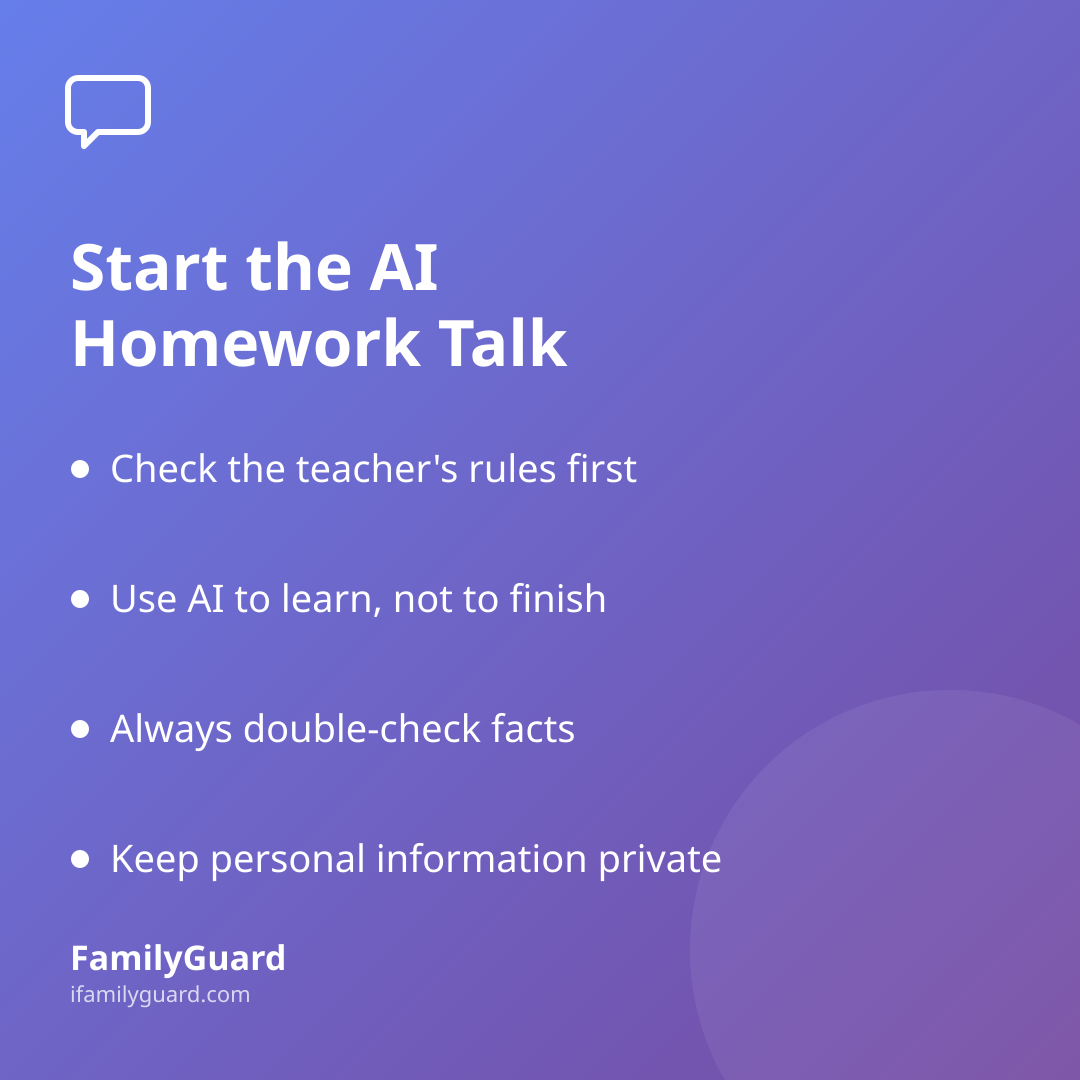
- Check the teacher's rules first. AI policies vary by class and assignment, and following them is part of academic honesty.
- Use AI to learn, not to finish. Asking it to explain a concept is different from asking it to write the answer.
- Always double-check facts. AI tools can sound confident while being wrong, so a second source matters.
- Keep personal information private. No addresses, phone numbers, or identifying school details in prompts.
- Talk about it when something feels off. If an AI response is strange, upsetting, or clearly incorrect, that's worth a family chat, not a secret.
When to Loop In the Teacher or School
If you're unsure whether a specific assignment allows AI help, a quick email to the teacher usually clears things up and models good practice for your child. It's also worth asking your child's school whether they have an AI use policy at all. Since the research shows a real gap between schools setting rules and actually teaching digital literacy around AI, your questions as a parent can help push that conversation forward, both for your own child and for their classmates.
A Tool, Not a Threat
AI in the classroom isn't going away, and treating it as either a forbidden shortcut or a magic solution misses the point. What actually helps is the same thing that helps with most family safety topics: staying curious, keeping the conversation open, and building shared expectations together. When kids understand why the ground rules exist, rather than just being told to follow them, they're far more likely to use AI, and every other tool in their digital life, thoughtfully.