
If your house has a smart speaker, there's a good chance your youngest family member is one of its most enthusiastic users. Kids ask it to tell jokes, play their favorite songs, do their math homework out loud, or settle sibling debates about dinosaurs. It's easy to see the appeal — a device that answers instantly, never sounds annoyed, and always has time for "one more question."
But that same helpfulness raises a quiet question many parents haven't gotten around to answering: what actually happens to everything a child says to it? The good news is that this isn't a topic that requires alarm — just a little attention, a few settings adjusted, and a short conversation with your kids. Here's a calm walkthrough of what to know and what to do.
Why Kids Take to Voice Assistants So Naturally
Voice assistants are designed to feel conversational, and young children in particular don't always draw a firm line between "talking to a device" and "talking to a person." A Common Sense Media and SurveyMonkey poll (2019) found that roughly six in 10 parents of children ages 2 to 8 say their young children interact with a voice-activated assistant like Siri or Alexa, and about four in 10 families report owning a dedicated smart speaker such as an Amazon Echo or Google Home.

That same research found something worth sitting with: nine in 10 parents who use voice-activated devices said it was important to them to know when their family's voice was being recorded and to be able to control what information the device collects — a concern that persisted even as families kept using these devices. That's a very normal place to be — plenty of useful technology comes with a "figure out the settings" step, and smart speakers are no exception.
What These Devices Actually Do With a Child's Voice
Most smart speakers only start recording after a wake word ("Alexa," "Hey Google," "Siri"), then send that short clip to the company's servers to figure out a response. Depending on the device and its settings, that recording — and a text transcript of it — can be stored, sometimes indefinitely, and used to improve the service.
This isn't hypothetical territory. In 2023, the U.S. Federal Trade Commission and Department of Justice reached a $25 million settlement with Amazon, alleging the company kept children's Alexa voice recordings indefinitely and made it difficult for parents to get that data deleted, in violation of the Children's Online Privacy Protection Act (COPPA). As part of the settlement, Amazon was required to overhaul its deletion practices and give families clearer controls over how long children's data is kept.
The point here isn't that any one company is uniquely at fault — it's that voice data from kids is treated as sensitive enough to warrant federal enforcement, which is a useful signal for how seriously to take the settings on your own device.
Privacy Basics Worth Setting Up Today
Most of this takes about ten minutes, and you only need to do it once, with the occasional check-in as your child gets older or your household adds a new device. A few things worth doing:
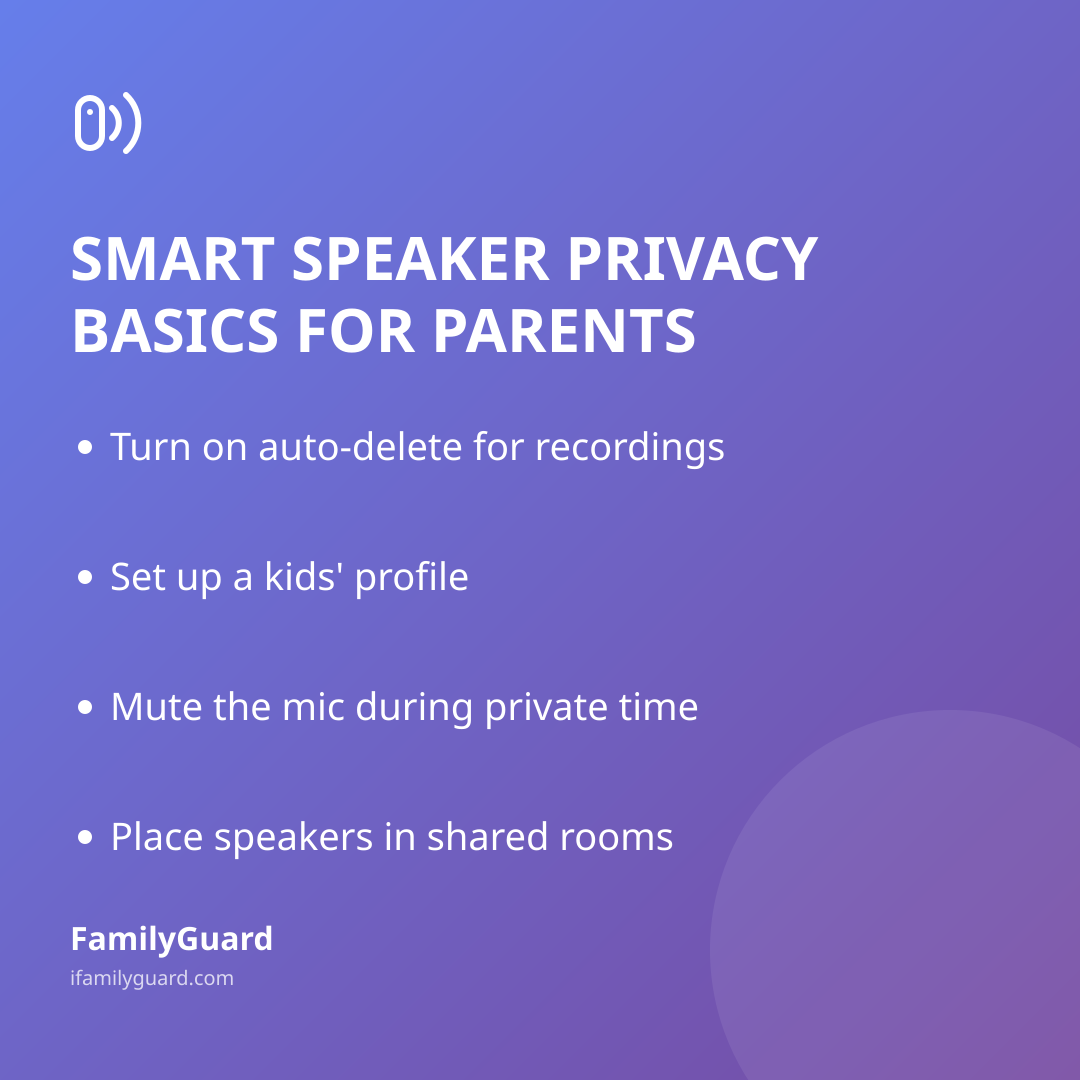
- Turn on auto-delete. Most major assistants let you set voice recordings to delete automatically after a set period, like three months, instead of keeping them indefinitely.
- Review and clear the voice history occasionally. Each platform has a dashboard where you can see, and delete, what's been recorded.
- Set up a kids' profile if the device offers one. These usually filter content, mute purchasing by voice, and limit what personal information the assistant will share back.
- Disable voice purchasing, or require a spoken confirmation code, so an "order more toy trucks" request doesn't turn into an actual delivery.
- Keep the microphone mute button in mind. Every smart speaker has a physical mute switch — a simple, screen-free way to turn listening off during homework time, sleepovers, or private conversations.
- Place shared speakers in common areas like the kitchen or living room rather than a child's bedroom, so their use stays part of family life rather than something separate and unsupervised.
Turning It Into a Conversation, Not a Rulebook
Kids don't need a technical lecture about server storage to understand the basics — they just need an honest, age-appropriate explanation. Something like: "This only listens for its name, and then it sends your question somewhere to find an answer. It's not a person, and it doesn't keep secrets the way a friend would." That framing helps kids understand the device is a tool, not a confidant, without making them anxious about using it.
It's also a natural moment to reinforce a habit that will serve your child well across every device they'll use growing up: personal details like a full name, school, or address aren't something to share out loud with an assistant, any more than they would with a stranger.
This kind of open, ongoing conversation is really the same spirit that shapes how many families approach location sharing, too — transparency over secrecy. Apps like FamilyGuard are built on that same principle: location and check-ins are shared openly and with everyone's knowledge, inside the family, rather than monitored quietly from the outside. The habit of talking things through as a household, rather than just flipping a setting and moving on, is what actually sticks.
A Small Step That Pays Off
Smart speakers aren't going anywhere, and for most families they're a genuinely helpful presence: a kitchen timer, a homework helper, a way to play the same song for the hundredth time without complaint. A few minutes spent on privacy settings, plus one easy conversation about how the device actually works, is really all it takes to feel confident about its place in your home. Nothing here requires giving up the convenience, just knowing where the dials are.
Sources
- Federal Trade Commission — FTC and DOJ Charge Amazon with Violating Children's Privacy Law by Keeping Kids' Alexa Voice Recordings Forever (2023)
- Common Sense Media — Common Sense/SurveyMonkey Poll Reveals Privacy Is a Top Concern for Families Who Use Smart Speakers and Voice-Activated Assistants (2019)