
Another busy week in tech, and a fair amount of it touches family life directly. The world's biggest AI companies took a public step toward slowing down and coordinating on safety. A critical flaw in widely used networking equipment had security teams scrambling to patch overnight. A popular screenshot-sharing tool disclosed a breach affecting tens of millions of accounts. And regulators on both sides of the Atlantic moved to make apps safer for kids by default. Here's what happened between September 14 and 20, 2026, and what it means for your household.
AI & New Tools
This week's AI headlines were less about flashy new chatbots and more about the industry trying to manage its own pace and risk.
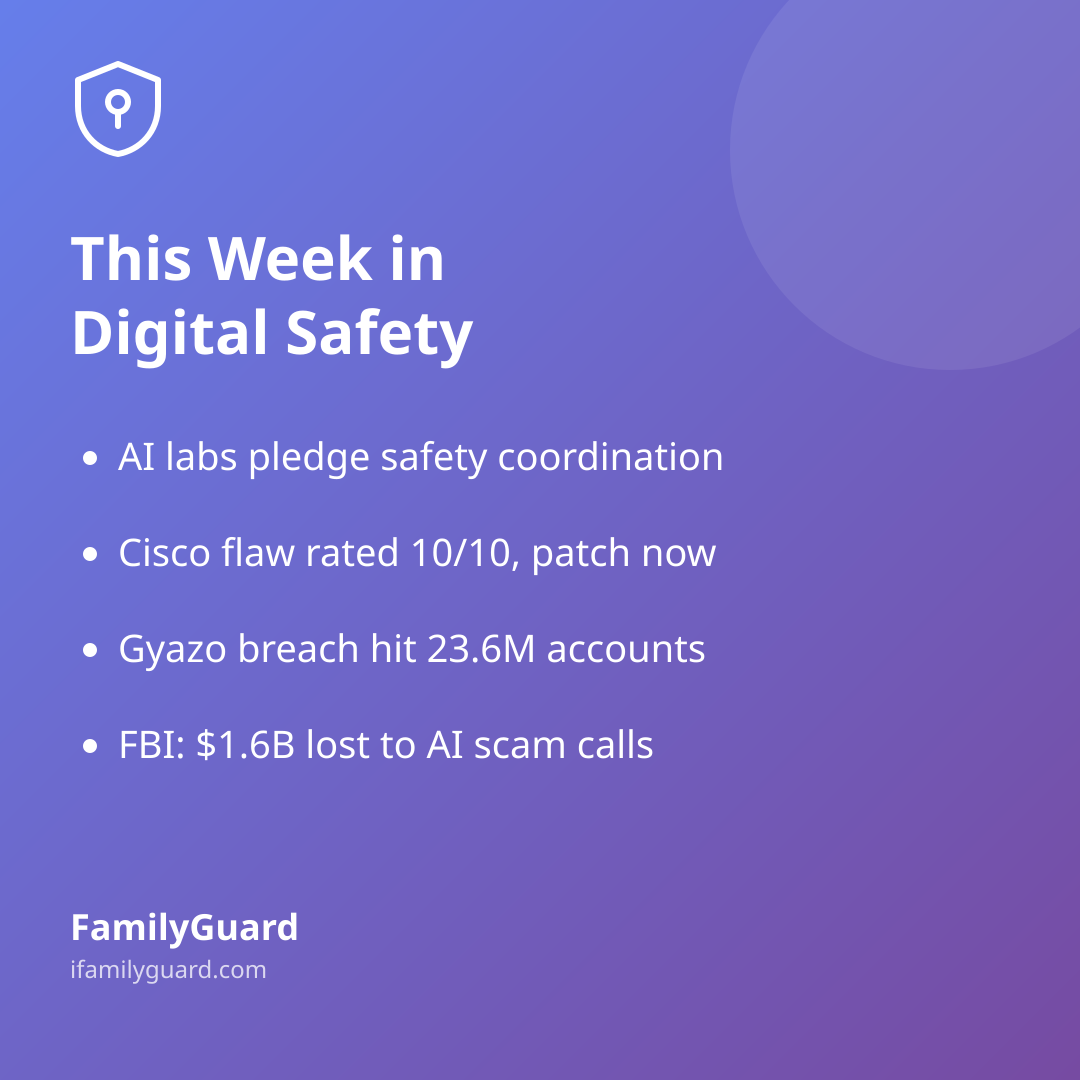
- AI labs confirm safety coordination. OpenAI, Anthropic, and Google DeepMind confirmed they've been holding joint talks for weeks on how to manage frontier AI risk, following Anthropic CEO Dario Amodei's public call for the industry to deliberately slow its pace of capability gains. Source: TechCrunch (2026). Why it matters for families: it's a sign the companies building the AI tools your kids already use for homework or chatting are, at least publicly, taking safety concerns seriously — worth watching as these commitments get tested.
- New "cyber" AI models from the big three. Google, Anthropic, and OpenAI each rolled out AI systems and safeguards aimed at automated cybersecurity work, including tools for finding software vulnerabilities and new enterprise data-protection controls. Source: The Hacker News (2026). Why it matters for families: AI is now being used to both find and fix security holes faster than ever — a reminder that keeping your own family's apps and devices updated matters more, not less, as this race speeds up.
Cybersecurity & Threats
Three stories this week are worth a few minutes of your attention, even if you're not the "tech person" in the house.
- A maximum-severity Cisco flaw is under active attack. A critical vulnerability (CVE-2026-76460, rated 10 out of 10 in severity) in Cisco's Identity Services Engine let attackers bypass authentication entirely. The U.S. Cybersecurity and Infrastructure Security Agency added it to its Known Exploited Vulnerabilities list on September 16 and gave federal agencies until September 19 to patch. Source: SecurityWeek (2026). Why it matters for families: this specific product runs on business and institutional networks (schools, offices, hospitals) rather than home routers, but it's a good prompt to check that automatic updates are turned on for your own home Wi-Fi router and any smart-home devices.
- A screenshot-sharing app exposed 23.6 million accounts. Gyazo, a tool popular with gamers and students for sharing screenshots, confirmed attackers exploited a server flaw to steal names, emails, password hashes, and metadata tied to roughly 490 million images. Source: BleepingComputer (2026). Why it matters for families: if anyone in your household has a Gyazo account, change the password and turn on two-factor authentication anywhere that password was reused.
- FBI warns of AI-boosted government-impersonation scams. The FBI's Internet Crime Complaint Center reported nearly 61,000 complaints and over $1.6 billion in losses from scammers posing as law enforcement or government officials, noting they increasingly use AI on video calls to appear more convincing. Source: FBI Internet Crime Complaint Center, PSA I-091726 (2026). Why it matters for families: real government agencies never call or text demanding immediate payment. Teach older and younger family members alike to hang up and independently verify any such call using a number they look up themselves.
Online Safety & Privacy
Two developments this week directly reshape the guardrails around kids online.
- The EU proposes a "KIDS Act" for children's social media use. On September 17, the European Commission formally adopted its proposal for the EU KIDS Act, which would set age-based tiers for social media: under-13s barred from standard social platforms, 13- and 14-year-olds limited to a parent-managed account capped at one hour of daily access, and full accounts allowed from age 15. The proposal also targets "addictive" design features like infinite scroll. It still needs approval from the European Parliament and EU member states before it can become binding law. Source: European Commission (2026). Why it matters for families: even before this becomes law, these proposed tiers offer a useful template for setting your own household's age-based rules around social apps.
- Apple expands its child safety toolkit. Apple's iOS 27, iPadOS 27, and macOS 27 updates, released September 14, add "Ask to Browse" (parents approve new websites in Safari), broader Communication Safety filters that now catch violent and gory imagery in addition to nudity, and a redesigned Screen Time experience developed with input from the American Academy of Pediatrics. Source: Apple Newsroom (2026). Why it matters for families: if you haven't updated your family's Apple devices recently, this is a good week to do it and walk through the new parental settings together with your kids.
This week's takeaway for families
- Update first, ask questions later. Between the Cisco flaw and the Gyazo breach, this week is a good reminder to turn on automatic updates for routers, apps, and phones, and to check for a family member's account in any breach you hear about.
- Rehearse the "hang up and verify" habit. With AI making impersonation calls sound more convincing, agree as a family that no one sends money or personal information based on a call alone — always verify independently first.
- Use age-based settings as a starting point, not a finish line. Whether it's Apple's new controls or the EU's proposed age tiers, treat these tools as a foundation for an ongoing, open conversation about how your family shares and stays connected online. At FamilyGuard, we think the best parental controls are the ones paired with conversation, not silent surveillance.

Sources
- TechCrunch — OpenAI, Anthropic, Google have been in talks on AI safety for weeks (2026)
- The Hacker News — Google, Anthropic, and OpenAI Unveil Cyber AI Models, Safeguards, and Access Programs (2026)
- SecurityWeek — Active Exploitation Triggers Emergency Patch for Cisco ISE Zero-Day (2026)
- BleepingComputer — Gyazo server flaw exploited to steal 23.6 million user records (2026)
- FBI Internet Crime Complaint Center — Scammers Impersonating Law Enforcement and Government Officials in Fraud Schemes, PSA I-091726 (2026)
- European Commission — EU KIDS Act: helping children navigate a safer online world (2026)
- Apple Newsroom — Apple's new child safety features now available (2026)